
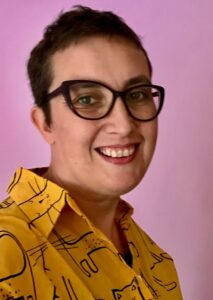
Community Researcher (CR), Rachel Fricker, joined Brighton’s research team earlier this year, having learned about the project through her participation in our chickpea meal kit workshops. Shelley Taylor (Brighton & Hove Food Partnership, BHFP) and Jessica Horne (University of Sussex) talk to Rachel about her experiences as a CR with BHFP. Rachel reflects on her participation in the workshops and how it led her to become a Community Researcher, offering insight into her experiences and our way of working with the CRs in Brighton.
Rachel’s Participation in our Chickpea Meal Kit Workshops
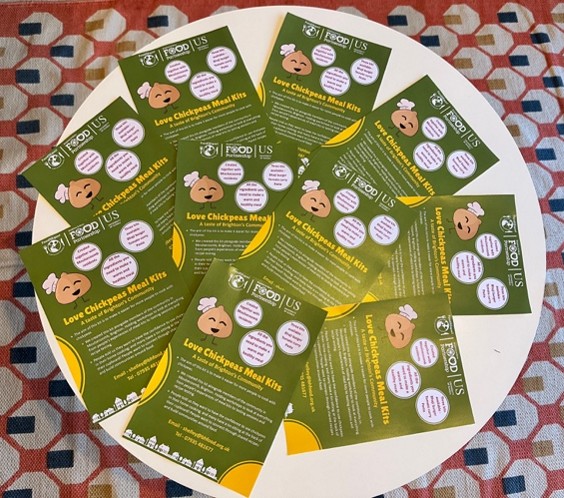
Rachel first discovered the project through taking part in our chickpea meal kit workshops. As we’ve explained in the chickpea toolkit blog, we planned our research workshops to help us co-design our chickpea meal kit product innovation with the community in Moulsecoomb. We asked Rachel to reflect on her experience of participating in the research workshops.
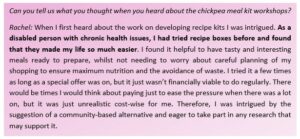
As Rachel explains, she had experience with meal kits and was intrigued to be part of our co-production work, which aimed to develop an affordable chickpea meal kit. We asked Rachel how she felt about participating in the research, and she reflected that:
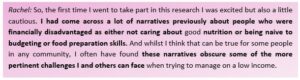
Rachel draws attention to the stigmatising narratives related to food insecurity that local food hubs and organisations work hard to address[1]. We asked Rachel how she found the experience of participating in the workshops after her initial reservations, and she told us that:
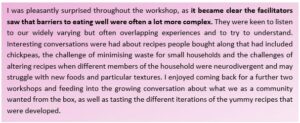
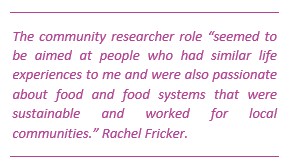
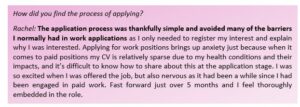
Community researchers are ‘peers’ of those they research due to shared characteristics, geographical proximity, and experiences[2]. Community researchers bring their own experiences from life and different configurations of paid and unpaid work, which they use in their roles. CR work can be a route back into paid work in the public sphere, as Rachel’s case shows. In Brighton, our CRs have experience working in local food hubs, the catering industry and in public sector organisations, including Brighton and Hove City Council.
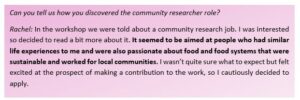
In Brighton, an opening for a CR role became available towards the end of last year. As Rachel explains, Shelley advertised the role to the community members participating in our workshop.
Rachel’s Involvement in Our Pilot Launch Workshop
The CRs play an important role in facilitating our workshops. Before the workshops, Shelley and Jessica work together with the community researchers to co-design the workshop questions and research activities. We meet at least twice to plan the workshops. In the first planning meeting, the team discuss draft research aims and objectives and decides which questions to ask. In the second meeting, we review the questions and give the CRs the opportunity to practice their facilitation roles. It’s really important for Shelley and Jessica that the CRs have the space to share their views. We make sure that we have enough time to visualise the workshop and work at a pace that suits the needs of the team.
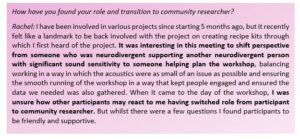
In our Pilot Launch workshop in April 2025, Rachel played a key role in supporting our colleagues at Reading who ran an eye tracking study. We asked Rachel how she found this process.
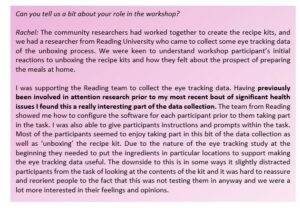
Here, Rachel reflects on the skills she developed as part of the “eye tracking” research we undertook within the workshop. She also highlights the complexity of incorporating new research methods and technologies in our research workshops, which can change how we approach data collection. After each workshop, the CRs reflect on the key learnings including what went well and what could have been done differently.
Moving forward, the team of CRs, including Emma and Cailen, will be analysing the data from our chickpea meal kit pilot and making adaptations to the recipes for our kit, based on participants’ feedback.
Key Points for Community Research
Rachel explains how she became a community researcher after taking part in our research workshops.
- Taking part demonstrated to Rachel that the team understood complex barriers to healthy eating, so she was encouraged to apply for a CR role.
- Rachel explains that her transition to community researcher went smoothly and gave her a different perspective on the research she had been part of.
- Rachel explains some of the processes involved in community research, including the specialist research skills she has acquired.
[1] Psarikidou K, Kaloudis H, Fielden A, and Reynolds C (2019) Local food hubs in deprived areas: de-stigmatising food poverty? Local Environment 24(6): 525–538.
[2] Pettinger C, Hunt L, Gardiner H, Garg P, Howard L, and Wagstaff C (2024) Engaging with “less affluent” communities for food system transformation: a community food researcher model (FoodSEqual project). Proceedings of the Nutrition Society 83(3): 180–194.
Interviewed and edited by Shelley Taylor (BHFP) and Jessica Horne (University of Sussex).
R