
Jessica Horne (Research Fellow at the University of Sussex), Shelley Taylor (Brighton & Hove Food Partnership, BHFP), Cailen Magee and Emma Moore (BHFP) share their experience of launching their product innovation: a co-produced chickpea meal kit.
Introduction to the Research Design
On Friday 25 April, we launched our chickpea meal kit. We developed the kit using Jessica and Elaine’s participatory qualitative research design. In our review of the academic literature, we observed that there are few examples of studies that have co-produced meal kits with the community (Olive and Worosz, 2024). Based on existing studies, we crafted a research design that included three main phases. Phase 1 involved a review of existing meal kits, Phase 2 involved product development with the community, and Phase 3 involved piloting the kit with members of the community. Our research design included five research workshops and a small-scale pilot with 12 participants who tried the kit at home. The main aim of the research design was to co-produce a meal kit with the community. We used “user design principles” as part of our co-production work, which means that we involved intended users of the meal kit in our design process (Roy et al., 2024).
November – December 2024: Product Development Workshops
During our product development phase, we conducted three workshops to explore participants’ experiences of using meal kits. We asked participants to bring their chickpea recipes to the workshops, and we learned their preferences for specific design features.
Key research activities during this phase included:
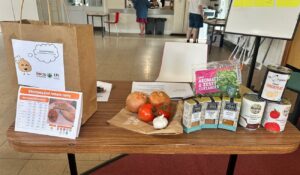
- Collective unboxing of meal kits: Guided by the marketing literature on meal kits which explores how specific features influence people’s purchasing decisions, we conducted an unboxing of meal kits. We showed participants examples of three boxes. They unboxed two Riverford Organic boxes and one example of BHFP’s “In the Bag” style kit, introduced during the summer of 2020 to help those using community shops in deprived areas of Brighton and Hove (Sustainable Food Places, 2025). We asked participants to comment on those features discussed in the marketing literature (Von Laar and Knier, 2021). These include the branding, packaging, freshness of ingredients and ease of instructions.
- Exploring people’s experiences of using meal kits: We asked participants to reflect on their experiences of using meal kits more broadly. Most participants had tried or seen BHFP’s “In the Bag” kits. Some participants had experiences of well-known commercial meal kits, such as Hello Fresh. They explained that they used these to help them diet or during pregnancy. They also explained their limitations including excessive packaging and cost. They appreciated that the kits contained everything needed for a healthy meal.
- Exploring participants’ preferences for specific design features: We spoke to participants about their preferences for packaging, branding, and recipe card design. Participants criticised the excessive packaging used by commercial companies like Hello Fresh. They wanted our kit to contain minimal packaging and insisted that the packaging should be recyclable. They connected their concerns to the environment. They had specific requests for the format of the recipe card shaped by personal preferences and neurodiversity. They also insisted that the ingredients should be fresh and had different preferences on suppliers for the ingredients.
- Tasting recipes shared by the community: During the workshops, participants were given the chance to taste and provide feedback on a selection of chickpea dishes created from recipes shared by participants. We used criteria developed by the teams at Reading to help evaluate the recipes, and we discussed ways of improving them. We asked participants to tell us which were their favourite recipes, and why. This helped us narrow down our choice of recipes for the kit.
January to April 2025: Recipe Validation and Meal Kit Design
Once the product development workshops had finished, we started analysing our data and we designed our meal kit collaboratively with teams at Reading and the CRs over the space of four months. A large part of this work involved validating recipes for our meal kit, based on feedback from the product development phase workshops. It also involved reflecting on the barriers and drivers we learned of earlier in the project, which informed our decision to work with chickpeas as a food type. We received helpful input from the CRs and academics across the FoodSEqual project.
We chose to develop three of the most popular recipes shared by our participants during the product development phase. Each recipe has a story behind it. The recipes include:
- Paula’s Chickpea and Tomato Curry
- Mary’s Chickpea Pastini
- Mary and Paula’s Bhaji Burger
Recipe Validation
With the support of former CR Holly, Jessica and Shelley prepared the recipes at home and made suggestions for how they could be adapted, based on the feedback participants had provided during the workshops. We observed that the quality of chickpeas affected the integrity of the dishes.
Examples of the changes made include:
- To reduce the creaminess of Paula’s curry, Jessica reworked the recipe using a different type of coconut milk.
- To give the chickpea pastini recipe more flavour, Shelley added paprika to the recipe.
- To make the bhaji burger crispier, CR Holly made specific suggestions for preparing the burger, based on her experience as a professional chef. She also suggested specialist techniques for steaming the brioche burger bun.
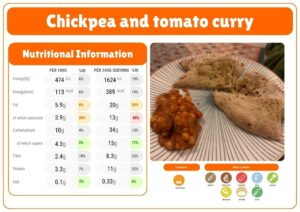
Once we had adapted the recipes, we worked with Dr Rosie Tsikritzi at Reading, who helped us calculate the nutritional composition of each of the recipes using a specialist software called Nutritics. Using this software, Rosie was able to calculate the nutritional information for each of the recipes, including calories, salts, and allergens which we included on the recipe cards.
Recipe Card Design and Meal Kit Branding
In the marketing literature, scholars talk about the importance of branding for meal kits and how this influences people’s purchasing decisions (Von Laar and Knier, 2021; Khan and Sowards, 2018; Sharda et al., 2024). During the meal kit unboxing, participants commented on the branding of the commercial kits we explored together and told us what they liked and disliked.
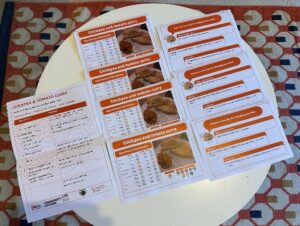
We listened to participants’ feedback on the design of recipe cards and used this to inform the development of our own recipe cards. Participants liked the style of BHFP’s existing recipe cards, commenting that they are “easy to follow” and “clearly laid out”. Participants wanted realistic food photography, and specific advice on how to adapt the recipes based on texture and taste, attributing some of their preferences to neurodiversity.
Community Researcher Cailan Magee designed the recipe card, and Jessica formatted his graphics onto a simple A4-sized card. Community Researcher Emma Moore designed an information leaflet to help introduce the community to the research underpinning the kit (all shown below).
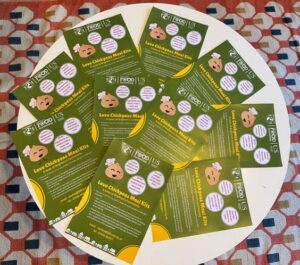
Reflecting on her experience of designing the information leaflet, Emma said that:
“I wanted to highlight community involvement and that these recipes were “by the community, for the community” as well as capture the aspirations of the difference the kits would make. It was tough to depict this visually in a way that would be engaging and not too text heavy. But everyone felt it was really important that people who received the kits knew a little of their story. In the end I used just a few key highlights from all the information we had to bring those points to life in an accessible, easy to read way”.
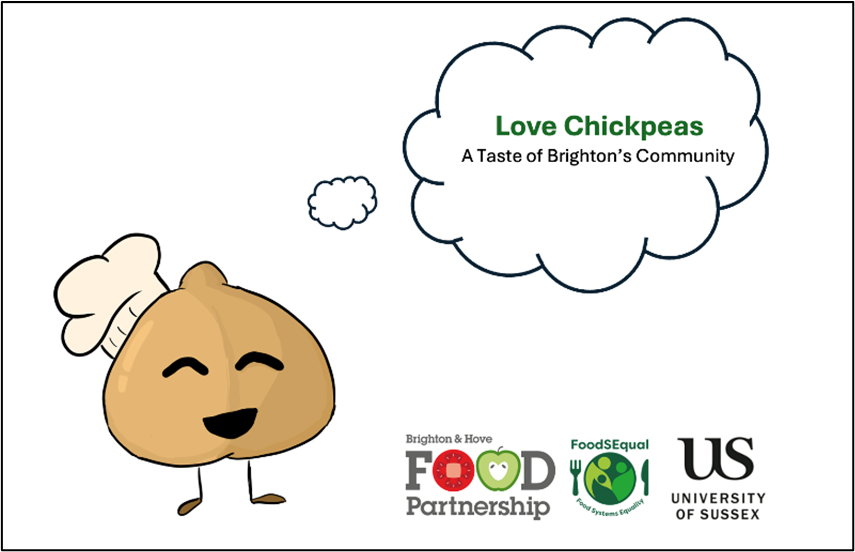
Cailan also designed the character for the logo for the kit, who is affectionately named Chōlā, which means chickpea in Bengali. This name was chosen as Moulsecoomb has a large Bengali community, and many of our participants are Bengali.
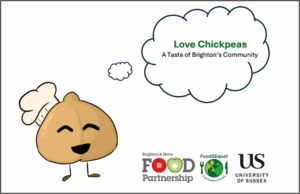
Reflecting on the process of creating the logo, Cailen said that:
“In my work on the logo, we had three main elements we wanted to bring together: the obvious chickpea element, Brighton, and our focus on working with the community. Those aspects would have made a very cluttered logo, so instead, the elements are spread out over the logo, the slogan, and the name of the kits. Working with the logo and the recipe cards, I wanted to keep with the bright and friendly style of the initial recipe cards that feedback suggested people loved, and I drew on my own experience as a chef to make suggestions for adaptations to the recipe for taste and texture.”
Sourcing the Ingredients and Packing the Kits
We thought carefully about which suppliers we should use for the ingredients of our meal kits. Participants had different interpretations of what counted as “local” produce. For some people, local meant ingredients sourced from the UK, while for others, local extended to countries in Europe. Participants spoke a lot about the implications of food miles for the environment, and they wanted to support local farmers. Still, they also acknowledged the cost implications of local produce, and they recognised the need to import products that aren’t grown in the UK. Participants indicated their desire for fresh produce in their kits, in addition to shelf-stable tinned goods. What’s interesting is that participants did not have a strong preference for organic vs. non-organic produce during the product development workshops, although they did insist that they like fresh produce, even if it is sourced from the supermarket. For our pilot, we sourced the non-perishable goods from Infinity Foods, a local cooperative based in North Road, Brighton. Participants recognised Infinity Foods’ reputation locally as an ethical provider of organic produce. As Infinity Foods did not provide fresh ingredients wholesale, we sourced the fresh ingredients for our kit from a local supermarket. We gathered together two days before the pilot launch to pack the non-perishable ingredients ahead of the launch.
Initial Feedback from the Community
At the workshop, the community were excited to receive their kits. Together, they unpacked the contents and shared their initial impressions. Participants commented on the quality and freshness of the ingredients, including the brightness of the tomatoes and the smell of the fresh coriander. They shared their hopes for the kit: that it would save them time, produce a tasty, healthy meal, and that it would be easy to make. We are now in the process of analysing participants’ food diaries, which they completed as they cooked the recipes during the pilot. These diaries help us see how participants found the kits and we can make adaptations based on their feedback. We look forward to sharing our findings soon!
Key Reflections
- One-size kit does not fit all: The community have different preferences for meal kits. These preferences are based on different factors, including most notably for our participants, neurodiversity, but also household size and religious beliefs. Our participants had different preferences for the design and layout of meal kit recipe cards. Participants asked us to develop specific advice on how to adapt recipes according to their household’s needs.
- Connections through recipe sharing: Participants told us that they genuinely enjoyed the experience of sharing their recipes and having the chance to try dishes that other people had shared. Stories of individuals and their families were told during the recipe sharing, and we witnessed some intercultural exchange between the White British and British Bengali participants in our workshop, who shared recipes and approaches to cooking with one another.
- Participatory user-design is an iterative process: At our recent pilot launch workshop, participants shared their initial impressions of the kit and pointed out things that we could do to make the bags more accessible for different audiences. They identified further changes to the recipe card to help make the method easier to follow. We are in the process of working with participants’ feedback to make changes to the product to enhance the long-term viability of our meal kit as a sustainable food systems transformation.
- Capacity needed for meal kit construction and distribution: This blog has hinted at some of the resources required to co-produce a meal kit and deliver a small-scale pilot. BHFP have experience of distributing kits on a larger scale through their “In the Bag” scheme (Sustainable Food Places, 2025). Practically speaking, resources for our pilot included labour, ingredients, packaging, a dedicated food hub space, printing facilities and transport, all of which come at a cost. Since launching our pilot, we have been working with academics on the project to evaluate different supply chain scenarios and considering how we can integrate the kits into existing infrastructure, again to increase the long-term viability of this innovation.
- Finding reliable suppliers: Due to unpredictability in the supply chain, exacerbated by Brexit and seasonality, it can be challenging to source ingredients reliably from suppliers. We found during our pilot that some of the ingredients we ordered did not arrive, which meant a few “emergency” trips to Infinity Foods for missing ingredients. To ensure the long-term viability of our kit and economies of scale, we aim to achieve buy-in from local suppliers in Brighton’s food system.
Acknowledgements
We want to thank Holly Cranfield, Sophia Martin and Nikki Dowbiggin-Lamb for their earlier contributions to the research that informed this blog. We would also like to thank Professor Lisa Methven and Professor Colette Fagan for their input and suggestions during the product development phase, and Dr Rosie Tsikritzi’s careful recipe validation work. Thank you to Dr Elaine Swan and Julia Kidd for their feedback on this blog.
Sustainable Food Places (2025) Brighton and Hove – innovation and coordination between council and community and voluntary sector. Available at https://www.sustainablefoodplaces.org/case_studies/1299/
Olive, L., & Worosz, M. R. (2024). Better Than Blue Apron? The Dominant Nutrition Framework Packed in a Community-Based Meal Kit. Journal of Hunger & Environmental Nutrition, 1–23. https://doi.org/10.1080/19320248.2024.2348564
Roy, R., Alsaie, A., Malloy, J., Kemper, Jhttps://doi.org/10.3390/su16020928.A. (2024). Sustainable Culinary Skills: Fostering Vegetable-Centric Cooking Practices among Young Adults for Health and Environmental Benefits—A Qualitative Study. Sustainability,16(2): 1-22. https://doi.org/10.3390/su16020928
Shin, H., Jeon, J., & Jeong, E. L. (2024). Investigating consumers’ perceived benefits and risks of meal-kit delivery service. International Journal of Hospitality Management, 119, 103715.https://doi.org/10.1016/j.ijhm.2024.103715
Sharda, N., Krampe, C., & Ingenbleek, P. T. (2024). HelloFresh: Transitioning to a plastic-free future?. International Food and Agribusiness Management Review, 27(2), 378-396. https://doi.org/10.22434/ifamr2023.0068
Von Laar, Mara, and M. Knier. (2021). “Food for thought: What factors influence the meal kit purchase.” PhD diss., master’s thesis]. Copenhagen: Copenhagen Business School. https://research-api.cbs.dk/ws/portalfiles/portal/68331723/1098733_Master_Thesis_von_Laar_Knief_excluding_Appendix.pdf