
Authored by Sayantani Ghosh,
Violence against women (VAW) in India is not only a persistent social issue, but also a pressing policy challenge, with 51 cases of crimes against women registered every hour according to the 2023 National Crime Records Bureau (NCRB) report. Despite legal frameworks and institutional responses, such violence continues at alarming levels. The recurring narrative of women as the weaker sex, evident across both lived experiences and public discourse, has drawn increasing attention to the deeper social drivers of this issue. What began as an interest in these questions gradually evolved into a doctoral research project.
Violent crimes against women in India are often addressed through crime statistics and legal interventions. While these are essential, they do not fully explain why such violence persists. In her PhD research, Sayantani Ghosh approaches the issue from a broader perspective, focusing on how gender discrimination and gender-biased social norms shape both the prevalence of violence and societal attitudes towards it.
The doctoral thesis comprises three research chapters. The first chapter examines how gender disparities across dimensions such as education, employment, health, and decision-making are associated with domestic violence. A Gender Disparity Ratio Index (GDRI) at the district-level is created. Using household data from across India, the analysis finds that district-level inequalities are closely linked to individuals’ experiences of, and attitudes towards, domestic violence.
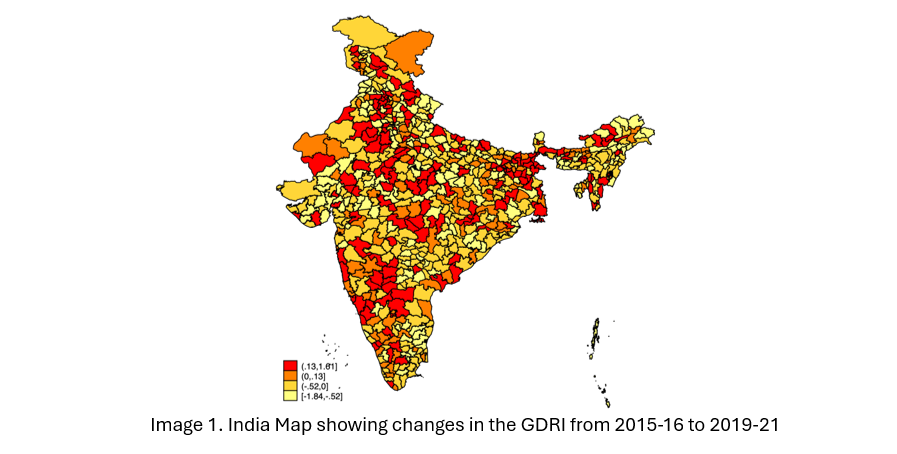
Image 1 shows the map of India depicting the changes in the GDRI across the districts from 2015-16 to 2019-21 (generated by author from Stata). The shades of red show increases in disparity levels while the yellows show decreases or no changes in the disparity levels. However, these relationships are not always straightforward, suggesting complex social dynamics. In some dimensions of human development, improvements in women’s status relative to men are associated with reductions in violence, while in others they coincide with increases, indicating a potential backlash effect.
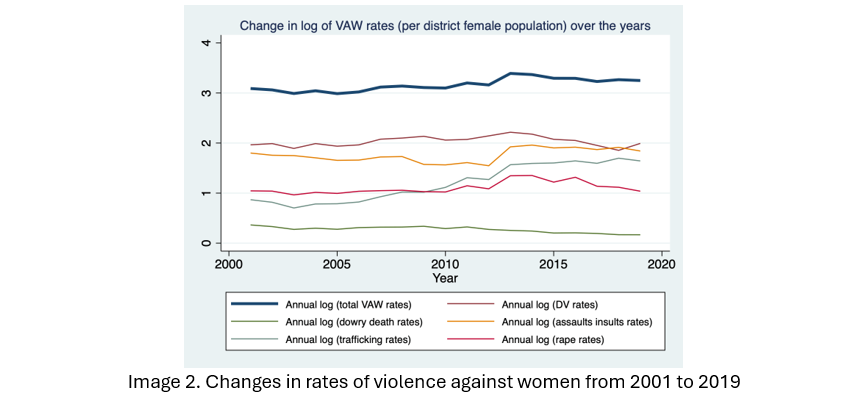
The second chapter expands the analysis to violent crimes against women reported in both domestic and public spheres. Image 2 (generated by author as part of data analysis) highlights the changes in the rates of total and different kinds of violent crimes against women over two decades.
This paper examines how these crimes are linked to son preference and sex ratios at birth, which serve as proxies for favouritism towards male children and are widely recognised indicators of gender-biased norms. Using panel data, the findings show that regions in India with stronger bias towards male children tend to report higher levels of violence against women. This highlights the role of deeply entrenched social norms in shaping outcomes related to violence.
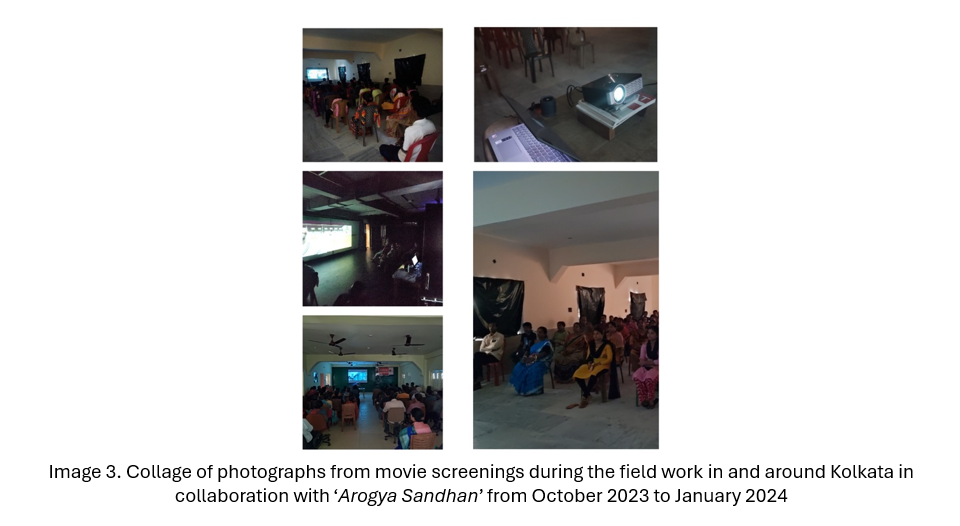
To better understand the attitudes underlying these patterns, Sayantani’s third doctoral chapter presents findings from a field experiment conducted in and around Kolkata, India, in collaboration with the voluntary charity organisation ‘Arogya Sandhan’. The study examines the effects of education through entertainment (edutainment) on individuals’ attitudes towards gender norms and violence against women. Participants attended a series of film screenings designed to engage with themes of gender and socio-cultural norms. Image 3 below comprises a collage of photographs from the movie screening sessions during the field experiment.
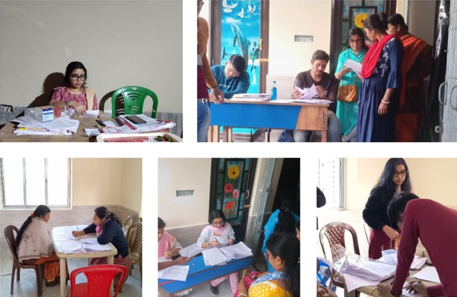
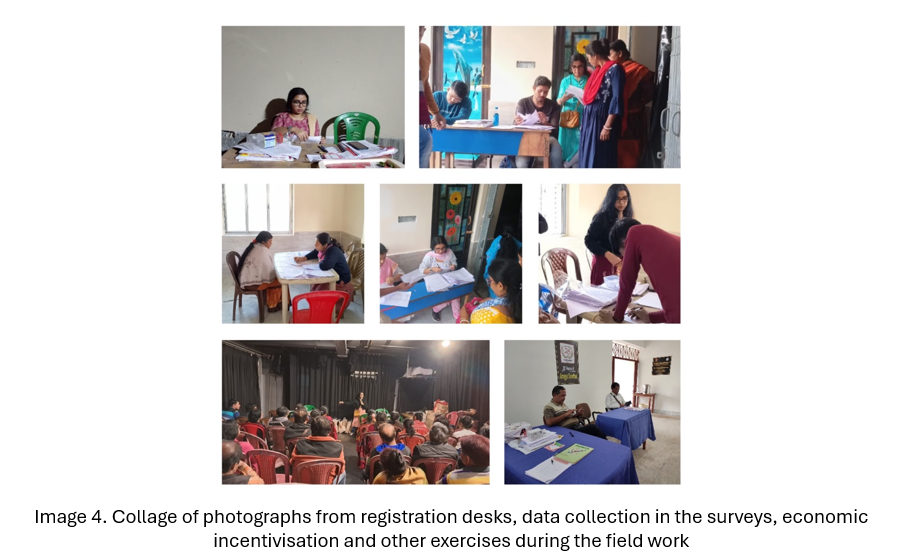
 Measuring attitudes on such sensitive topics is challenging due to social desirability bias. To address this, the study used an indirect survey method that allowed participants to respond more freely and honestly. The findings suggest that while such interventions can encourage more positive views on women’s empowerment and raise awareness about gender-based violence, individuals often remain cautious in expressing their opinions, even when asked indirectly. A reversal of attitudes towards gender norms is observed owing to an increased awareness caused by Edutainment. Image 4 below shows another collage of photographs depicting data collection in the surveys, economic incentivisation and other exercises during the programme.
Taken together, the findings demonstrate that violence against women in India is not simply a legal or administrative issue, but a deeply rooted socio-economic problem. These crimes are closely linked to long-standing gender norms and discriminatory practices, limiting the effectiveness of policy responses that focus solely on enforcement. Addressing the issue therefore requires sustained engagement with the attitudes and norms that underpin it.
From a policy perspective, this highlights the need for long-term, large-scale interventions aimed at shifting social norms. Mass-awareness programmes should be designed as sustained medium- to long-term strategies rather than short-term campaigns. Education through entertainment can be particularly effective due to its wide reach and cost efficiency. At the same time, policies that reduce gender-based disparities in education, employment, health, and decision-making remain crucial.
While backlash effects may arise as gender roles evolve, these should inform more context-sensitive policy design rather than discourage efforts to promote women’s empowerment. Laws can punish violence, but only transformation in social norms can prevent it.
The findings presented here contribute to ongoing discussions on gender, violence, and social norms in India. For further discussion, workshops, collaborations, or presentations related to this research, please contact Sayantani Ghosh at sayantani.cal89@gmail.com.