
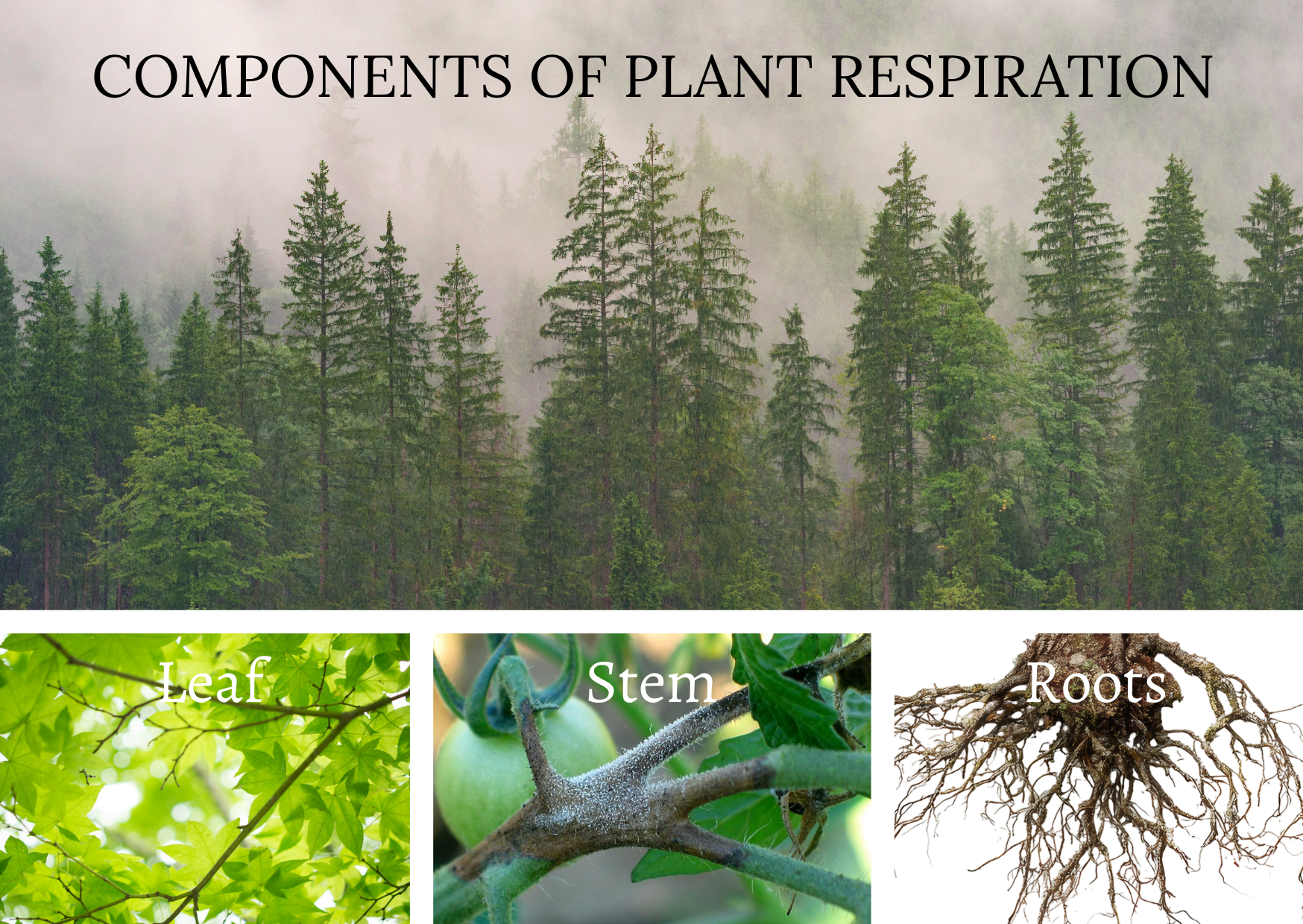

Plant respiration is a central yet uncertain component of the terrestrial carbon cycle. While photosynthesis has received sustained theoretical and observational attention, how and why plant respiration acclimates to long-term warming remains unresolved. Most land surface models either ignore acclimation or assume that leaves, stems, and roots respond similarly, an assumption increasingly at odds with observations.
At the January LEMONTREE Science Meeting, members of the Working Group A (Leaf area dynamics and carbon allocation) presented new results across the three major components of whole-plant respiration: leaves, stems, and fine roots, alongside emerging insights into biomass production efficiency (BPE). Together, these talks point toward a more integrated, theory-based understanding of carbon costs in plants.
1. The approach to predicting leaf respiration
 Wang Han presented a unifying, theory-based framework for understanding leaf respiration acclimation under long-term warming. Observations have long shown that plants reduce respiration at a reference temperature (e.g. 25 °C) when grown in warmer environments, weakening the climate–carbon feedback. However, most models either neglect this effect or implement it empirically, without a clear mechanistic basis.
Our current research applies eco-evolutionary optimality (EEO) principles, proposing that leaf respiration acclimates to maintain an optimal balance between carbon costs and photosynthetic capacity. By linking dark respiration at 25 °C (Rd25) to the acclimation of Vcmax through the coordination hypothesis, the framework predicts that both Rd25 and Vcmax25 decline by ~4–5% per °C of warming, substantially lower than instantaneous temperature responses. These predictions closely match global datasets spanning broad temperature gradients.
Crucially, this framework also resolves temporal dynamics. Building on earlier work, Wang and colleagues show that leaf respiration acclimates to night-time temperature over ~15-day timescales, improving predictions of both spatial and seasonal variation relative to existing hypotheses that rely on leaf nitrogen or short-term temperature alone. When implemented in land surface models, this acclimation substantially reduces overestimation of canopy respiration, particularly in boreal forests, and dampens exaggerated seasonal swings in modelled carbon fluxes.
The key message: leaf respiration acclimation is predictable, theory-constrained, and essential for realistic carbon-cycle modelling.
2. The approach to predicting stem respiration
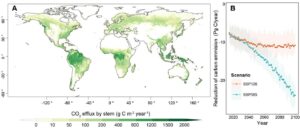
 Stem respiration is often overlooked in large-scale carbon analyses, despite the fact that woody tissues represent a substantial fraction of plant biomass and long-term carbon storage. Zhang Han addressed this gap by developing a new global stem respiration dataset, synthesizing more than 5,000 observations from roughly 100 sites across major biomes.
Using this dataset, Zhang Han demonstrated a consistent negative relationship between mass-based stem respiration at a reference temperature and growing-season temperature, indicating strong thermal acclimation. Importantly, this pattern emerges across independent data sources, including field measurements, laboratory incubations, and warming experiments, suggesting it reflects a fundamental biological response rather than methodological bias.
To explain this pattern mechanistically and enable prediction, Zhang introduced a new theory grounded in least-cost principles, in which plants minimise maintenance costs while sustaining hydraulic and structural function. Unlike leaves, which are tightly coupled to photosynthesis, stem respiration reflects the metabolic costs of maintaining living woody tissue, costs that appear to decline systematically in warmer climates. The empirical results align with these predictions, consistently yielding the expectation that respiration normalized to 25°C (rs25) decreases by about 10% per 1°C of warming.
The implications for Earth system modelling are significant. When stem respiration acclimation is ignored, models likely overestimate respiratory carbon losses from woody biomass. These projections suggest that accounting for acclimation could reduce estimated carbon losses by more than 20 Pg C per year by the end of the century, a magnitude comparable to major terrestrial carbon sinks.
This work positions stem respiration as a dynamic, climate-sensitive component of the plant carbon budget that must be explicitly represented in global models.
3. Fine root respiration: linking below ground costs to canopy demand
 Zhu Yuzhi presented the first global synthesis of fine root respiration acclimation, drawing on ~7,600 observations from 182 sites worldwide. Fine roots are metabolically active and essential for nutrient uptake, yet their respiratory costs remain poorly constrained at large scales.
The analysis reveals strong Type-II thermal acclimation in fine roots: basal respiration at 25 °C declines by ~4.1% per °C increase in growing-season soil temperature. This response dominates over changes in short-term temperature sensitivity (Type-I acclimation), resembling patterns observed in leaves and contrasting with the stronger reduction responses of basal respiration rate seen in coarse roots and stems.
Beyond documenting acclimation, Zhu introduced a demand-driven framework linking fine root respiration to canopy nitrogen demand. The key idea is that respiration per unit land area supports nutrient uptake required to meet photosynthetic and leaf respiratory demands. Empirical analyses show that mass-specific rates of fine root respiration at 25 °C (rr25) scales tightly with leaf dark respiration and Vcmax25, while soil properties exert weaker direct control on rr25.
Calculations further confirm that the carbon cost of fine roots is orders of magnitude smaller than that of leaves, supporting prior P- model assumptions that treat leaves as the dominant respiratory carbon sink. When implementing the acclimation of fine root respiration in global simulations, the best-performing model predicts a ~20 Pg C yr⁻¹ reduction in future respiratory carbon losses under high-emissions scenarios.
This work reframes roots not as independent carbon sinks, but as coordinated components of whole-plant carbon–nitrogen economics.
4. Biomass production efficiency
Ruijie Ding tackled a long-standing debate in ecosystem science: whether biomass production efficiency (BPE) (i.e., the fraction of gross primary productivity allocated to biomass) is approximately constant or strongly environmentally dependent. While early studies suggested a near-universal value (~0.47), more recent observations and models show substantial variability.
Using a global empirical framework with 15 candidate predictors, Ruijie identified nine key controls on BPE, spanning climate, vegetation type, soil properties, and forest structure. The dominant driver is forest age, followed by forest type and soil C:N ratio. Overall, BPE declines towards more organic, sandy, or alkaline soils and increases with climatic aridity; while responding differently to growing-season and winter temperatures – declining with both growing-season warmth and winter cold. Such a dual temperature response highlights the role of winter respiration costs and dormancy, and reconciles contradictory published reports of both positive and negative effects of temperature on BPE.
Vegetation type also matters. Boreal forests exhibit low BPE, while temperate deciduous forests show higher values, partly due to differences in leaf lifespan, allocation strategies, and mycorrhizal associations. Soil properties further modulate BPE by influencing belowground allocation and maintenance costs.
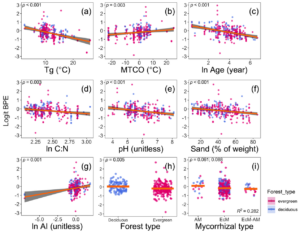
When applied globally, the empirical model reproduces broad latitudinal patterns. A higher BPE at mid to high latitudes, with notable reductions in boreal regions, consistent with the predominance of ectomycorrhizal species there, and outperforms many existing trend-based models. Our findings underscore that BPE is not a fixed constant and emphasize the importance of including both abiotic and biotic drivers in modelling BPE across ecosystems and plant types, the relevance of soil as well as climate properties in determining biomass allocation.
Key questions moving forward
- How can insights on biomass production efficiency be consistently integrated with respiration and allocation frameworks?
- How should these findings be implemented in global land surface models?
- What is the mechanistic link between fine root respiration and canopy nitrogen demand, and how does nutrient availability regulate this coupling?
Together, the talks highlight a growing consensus: plant respiration is acclimated, tissue-specific, and theoretically predictable. Capturing these dynamics is essential for robust projections of terrestrial carbon cycling in a warming world. We look forward to sharing more as our research progresses.