
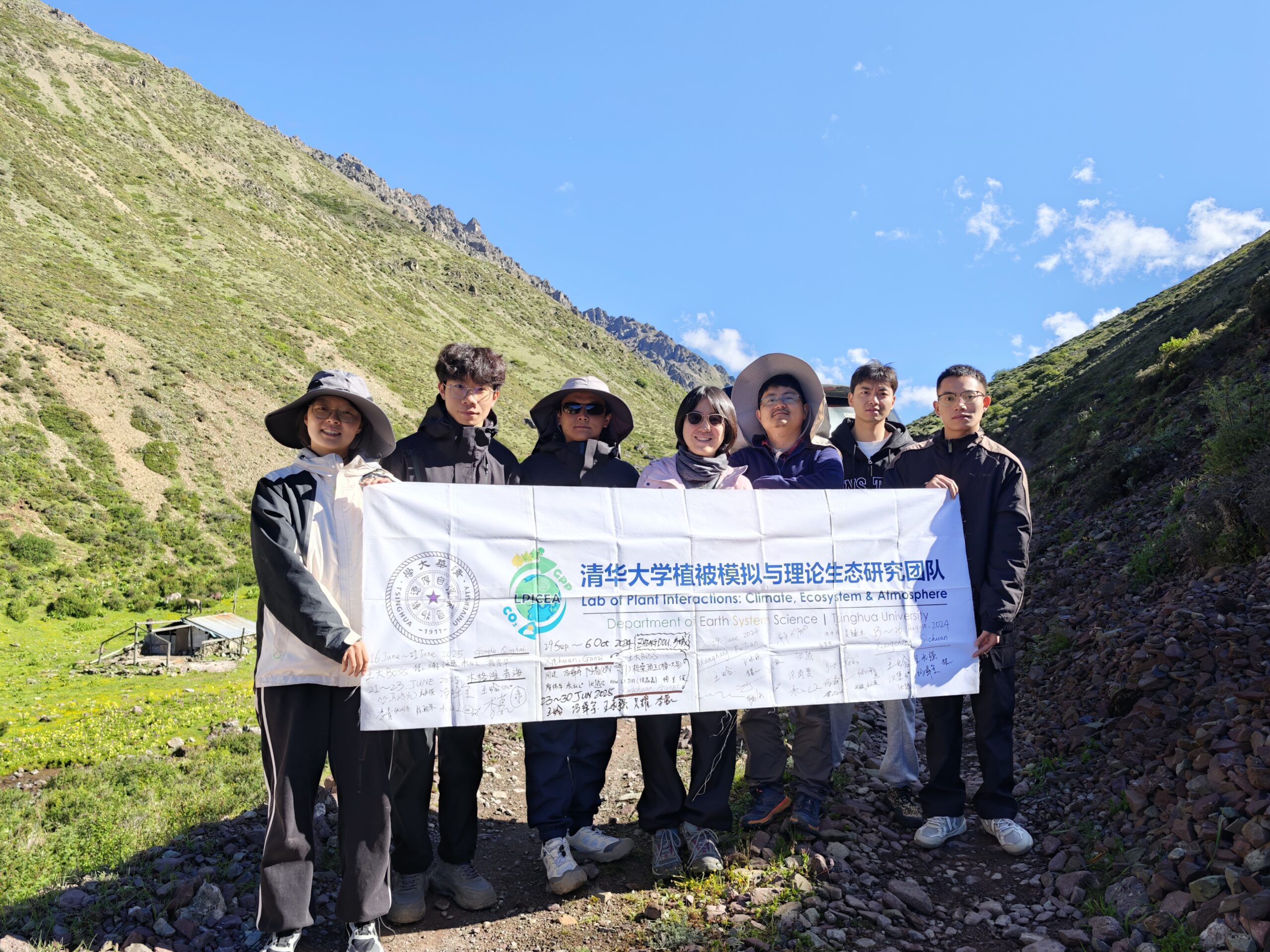

Last week, we shared the start of this year’s field campaign in the spectacular Baima Mountains of Yunnan Province, where LEMONTREE Principal Investigators Prof. Sandy Harrison and Prof. Colin Prentice have joined colleagues from Tsinghua University to explore one of China’s most remarkable environmental gradients.
Now the real work has begun.
The team is collecting an extensive set of plant traits across 10–11 sites spanning more than 4,000 metres of elevation, from alpine tundra and yak pastures to mixed conifer and broadleaf forests and finally the dry shrublands of the Jinsha River valley. Together, these measurements will help us understand how plants coordinate their strategies as temperature and water availability change with elevation.
Meet the Field Team
None of this work would be possible without a fantastic team on the ground.
Identifying Every Species
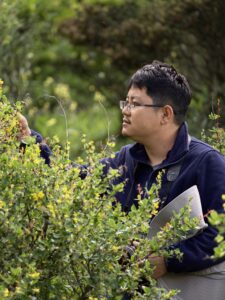
One of the first challenges in any biodiversity-rich ecosystem is making sure every plant is correctly identified.
Li Meng, described by Sandy as “the world’s best taxonomist” has been busy identifying the many species encountered along the transect. Here he is examining Berberis dictyophylla, a shrub native to Sichuan, Yunnan and Tibet that is characteristic of the dry-hot valleys of the Jinsha River. However, it is often found alongside several other closely related congeneric species that co-occur in the same habitat, which makes careful observation and precise identification essential—distinguishing them requires close attention to subtle morphological differences. It’s been putting his skills to the test and so far Li has identified and verified over 30 typical plant species from the dry-hot valley ecosystem.
Measuring How Plants Balance Water and Leaves
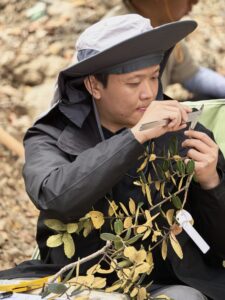
Wu Yangyang is measuring the Huber value, the relationship between the area of water-conducting sapwood and the leaf area it supports.
To do this, intact branches are collected and the sapwood cross-sectional area is measured at both ends of each branch. Every leaf supplied by that branch is then collected so its area and other functional traits can be measured later. Together, these measurements quantify the relationship between sapwood area and the leaf area supplied by the branch.
This provides valuable insight into how plants balance water transport with the demands of their leaves under different environmental conditions.
Figure 3. Wu Yangyang measuring the Huber value from freshly collected branches.
Measuring Photosynthesis in Real Time
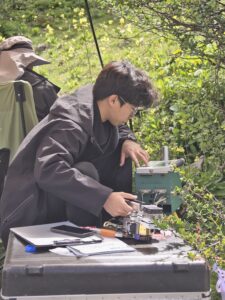
Meanwhile, Wu Ruipeng has been using a LI-COR portable photosynthesis system to measure how efficiently leaves are converting carbon dioxide into sugars.
These measurements include photosynthetic rate, intercellular CO₂ concentration, transpiration, leaf temperature and the Ci/Ca ratio, that allow the team to calculate Vcmax, one of the key indicators of photosynthetic capacity.
Our aim is to comprehensively evaluate plant photosynthetic physiological traits and providing critical data for testing and refining the eco-evolutionary optimality (EEO) model.
Digging Deeper Below Ground
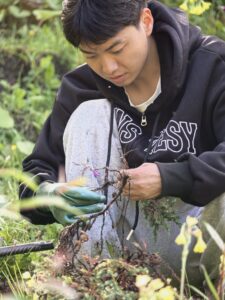
Understanding plants also means understanding what happens beneath the soil surface.
Yuan Panli has been carefully excavating intact fine roots, which are gently washed before their respiration is measured as quickly as possible to minimise disturbance.
The roots are then kept cool and moist before being scanned and analysed for their morphology, dry mass and elemental composition. These measurements complement the above-ground observations, helping the team build a complete picture of how plants coordinate leaf and root function across the environmental gradient.
More Updates to Come
It’s already been a productive field season but there is still much more work to be done. By combining measurements of photosynthesis, hydraulics, roots and plant traits across one of China’s most dramatic environmental gradients, the team hopes to uncover new insights into how plants adapt to changing climates and provide valuable data to test the theories underpinning LEMONTREE’s research.
We’ll be following the team’s progress over the coming weeks, so watch this space for more updates from the Baima Mountains.
If you missed the first instalment from this field campaign, you can read it here: Fieldwork Begins in the Baima Mountains – Lemontree
*All photos were provided by Zhao, Jierong and Wang Han.