

A new study led by LEMONTREE post-doc, David Sandoval, was just published in New Phytologist. It challenges a long-standing assumption used in terrestrial biosphere models that the maximum quantum yield of photosynthesis is effectively constant.
This study showed that photosynthetic intrinsic (maximum) quantum efficiency follows a predictable bell-shaped response to temperature across ecosystems worldwide, and that this response is strongly shaped by climate.
Using data from hundreds of eddy-covariance flux tower sites, the team found that plants are most efficient at converting light into carbon uptake within an optimal temperature range, with efficiency declining at both colder and hotter temperatures. Remarkably, this pattern appeared consistent across ecosystems ranging from tropical forests to Arctic tundra.
What Is Quantum Yield?
The “maximum quantum yield” of photosynthesis (φ₀) is the initial slope of the light response curve of photosynthesis without any other limitations. So, it constraints how efficiently plants convert absorbed light into carbon fixation.
Because photosynthesis drives the terrestrial carbon sink, φ₀ strongly influences how much carbon ecosystems can absorb from the atmosphere. Yet most terrestrial biosphere models still assume φ₀ is fixed for each plant functional type, with little or no temperature dependence.
Experimental studies have increasingly suggested otherwise, but until now there had been no global ecosystem-scale assessment of how φ₀ changes with temperature.
A Global Analysis of Ecosystem Photosynthesis
To address this, the team combined half-hourly CO₂ flux measurements from eddy-covariance towers with observations of absorbed light from more than 300 globally distributed sites.
By analysing ecosystem light-response curves and using optimality theory, they inferred ecosystem-level maximum photosynthetic efficiency across a wide range of climates and vegetation types.
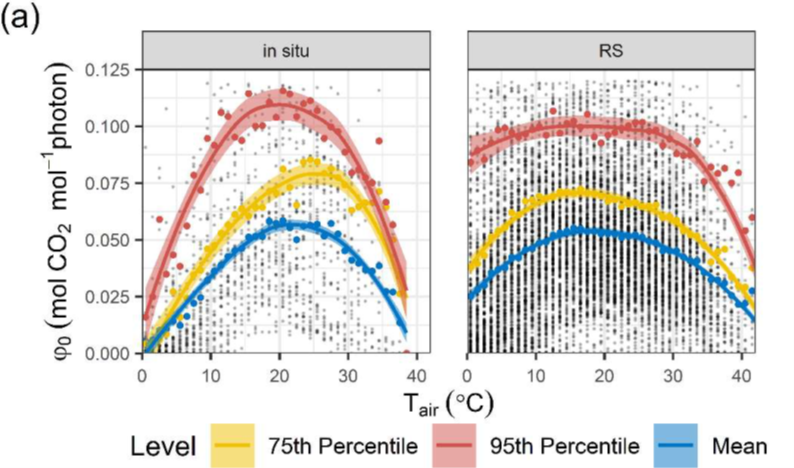
The results showed φ₀ consistently followed a bell-shaped temperature response.
Maximum photosynthetic efficiency increased with temperature up to an optimum point before declining sharply at higher temperatures. Importantly, the overall shape of the curve was not biome-specific. Instead, it shifted gradually with climate conditions:
- Warmer climates showed higher optimum temperatures.
- Colder climates showed greater temperature sensitivity.
- Increasing aridity reduced the maximum achievable efficiency.
These results suggest that photosynthetic efficiency is shaped by long-term adaptation to local climate rather than fixed biome-level rules.
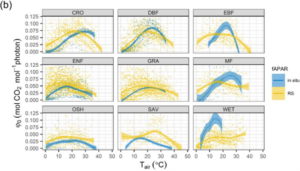
Fig. 1. 𝜑0 responses to temperature using all data pooled. The ribbons show a LOESS smoothing function including its 95% confidence intervals. a) Pooled observations from sites with in situ fAPAR and sites with remotely sensed fAPAR, b) pooled observations per biome and fAPAR source.
Why This Matters for Climate Models
Many current land surface models assume 𝜑0 is either constant or only weakly temperature-dependent. This study shows that assumption can introduce systematic errors — especially at temperature extremes.
Existing models often overestimate photosynthetic efficiency at low temperatures, while also failing to capture declines at very high temperatures. Incorporating the new temperature response improved agreement with independent observations, particularly in Arctic ecosystems.
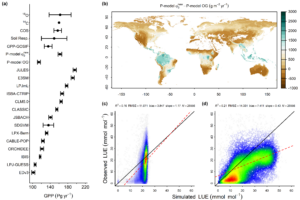
When the new formula for temperature response was incorporated into the P-model, simulated global gross primary production (GPP) increased substantially and aligned more closely with several independent observational estimates.
The effects were not evenly distributed:
- Tropical forests showed the largest increases in productivity.
- Temperate and boreal forests showed smaller increases.
- Arid ecosystems showed slight declines.
This highlights how climate adaptation shapes ecosystem function at the global scale.
Linking Ecosystems to Photosynthesis Theory
The study also connects ecosystem observations to recent advances in photosynthesis theory.
The findings support the idea that the cytochrome b6f complex — a key regulator within the photosynthetic electron transport chain — plays a major role in controlling the temperature response of photosynthetic efficiency.
At low temperatures, photoinhibition and slower repair of Photosystem II may reduce efficiency. At high temperatures, thermal stress and disruptions to electron transport appear to drive declines in performance.
Together, these mechanisms help explain the bell-shaped response observed globally.
Take-Home Message
This study shows that maximum photosynthetic quantum efficiency is not fixed, but instead varies predictably with temperature, aridity, and long-term climatic adaptation. By revealing a universal bell-shaped temperature response across global ecosystems, the research challenges assumptions still used in many terrestrial biosphere models.
Incorporating these dynamic physiological responses into Earth system models could substantially improve predictions of future plant productivity, land carbon uptake, and climate–carbon feedbacks in a warming world.
You can read the full paper here:
Sandoval, D., Flo, V., Morfopoulos, C. & Prentice, I.C. (2026). Environmental influences on the maximum quantum yield of terrestrial primary production. New Phytologist. https://doi.org/10.1111/nph.71303