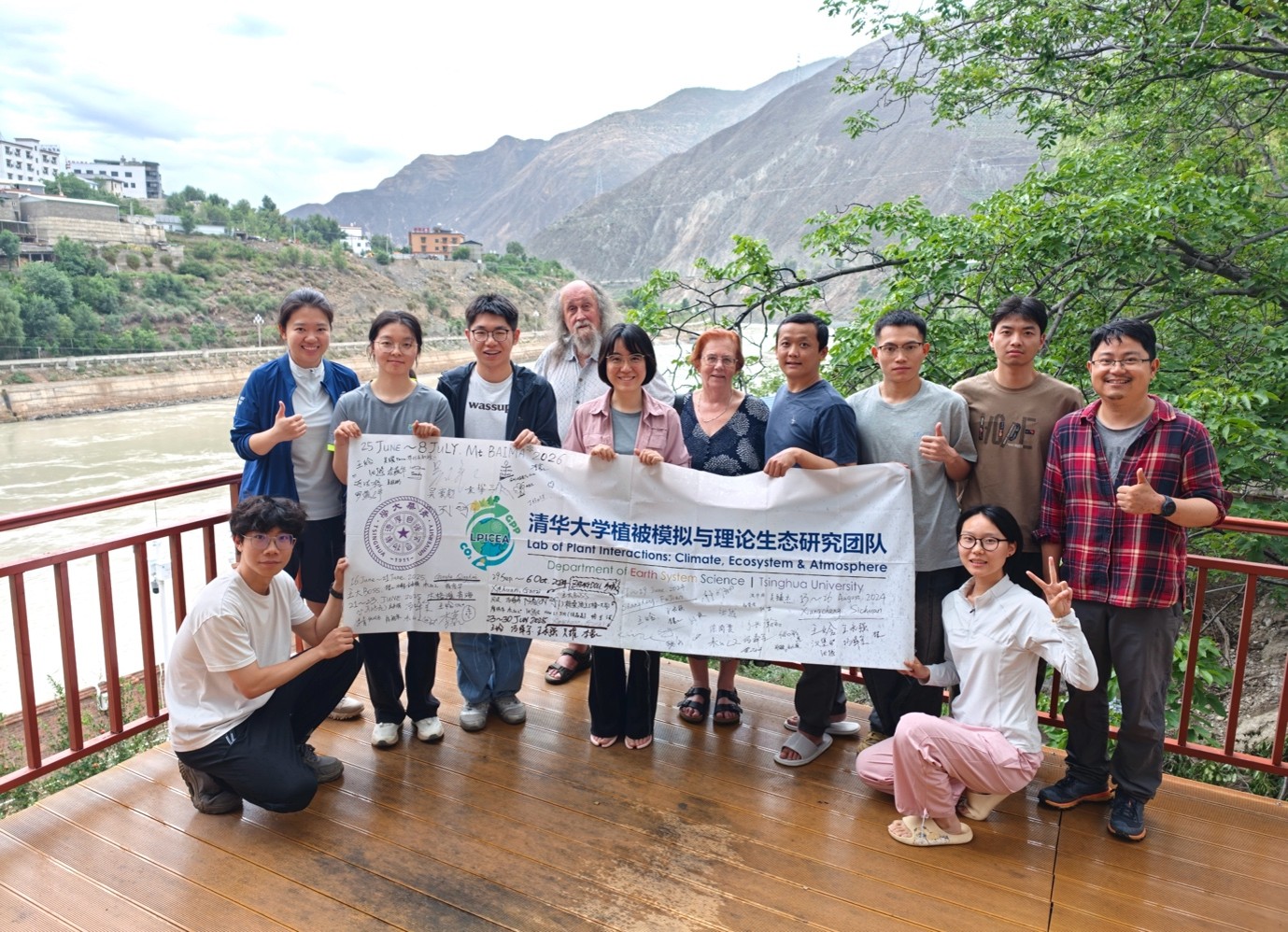

After weeks of hiking through alpine tundra, forests and dry river valleys, the field campaign in the Baima Mountains has come to an end. While the sampling in the field is complete, the team are now in their makeshift laboratory in Benzilan Town, the work is far from over.
The team has begun the painstaking process of turning hundreds of carefully collected samples into the data that will help us understand how plants adapt to changing environments.
Every leaf, branch and root collected in the field now undergoes a series of detailed measurements, providing the information needed to test eco-evolutionary optimality (EEO) theory across one of China’s most remarkable environmental gradients.
Documenting Plant Traits
One of the first steps is recording the physical characteristics, or functional traits, of every species sampled.
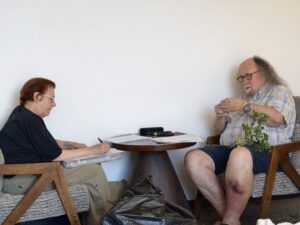
Prof. Sandy Harrison and Prof. Colin Prentice have been helping to catalogue a remarkable range of leaf and stem morphological characteristics. Leaf trait recordings include: leaf form, phenology, leaf type, texture, colour, size, thickness, orientation, display, shape, margin, hairiness, pubescence, pruinosity, rugosity, waxiness, hypostomatic characteristics, revolute/involute margins, aromatic and fetid properties, drip tips, terminal notches, surface patterning, succulence, spines, and thorns.
Stem traits such as stem form, colour, photographs, hairiness, pubescence, pruinosity, succulence, spines, thorns, and bark characteristics. including bark structure and stem morphology, are also recorded.
These detailed trait assessments provide comprehensive information on plant functional morphology and adaptation strategies.
Measuring Leaf Performance
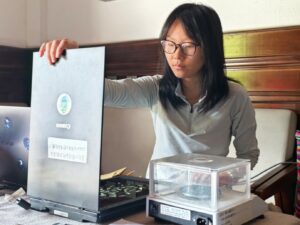
Luo Huangting has been measuring specific leaf area (SLA), one of the most widely used indicators of plant ecological strategy.
For SLA measurements, approximately 10–20 fresh leaves were collected from each sample. Leaf area was quantified using a leaf area scanner, and fresh mass was measured immediately after collection to ensure accurate estimates.
Comparing leaf area with dry mass reveals whether a plant invests in thin, fast-growing leaves or thicker, longer-lived leaves—an important indicator of how plants balance growth and resource conservation.
Preparing Stems for Hydraulic Measurements
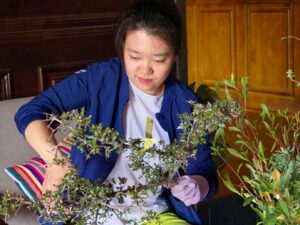
Water transport is another key part of the story.
Zhao Jierong has been preparing stem samples for measurements of stem hydraulic conductivity (Ks)—a measure of how efficiently water moves through a plant.
For stem hydraulic conductivity (Ks) measurements, healthy sun-exposed branches were collected early in the morning and kept hydrated to prevent water loss. Stem segments approximately 20 cm long were cut under ultrapure water to minimize the risk of embolism. The bark was carefully removed from both ends, and the sapwood area was identified and retained for conductivity calculations before the stems were connected to the tubing system. Each day, approximately 45 stem samples were prepared and trimmed from shrubs, small trees and trees.
Measuring Water Transport
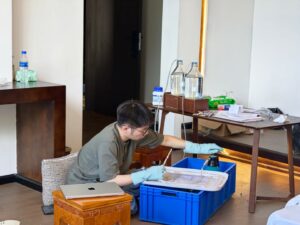
Once prepared, the stem samples are analysed by Wu Yao.
Each stem is first flushed with a 20mM potassium chloride solution for 20 minutes to remove tiny air bubbles and restore maximum water flow. The stems are then connected to a hydraulic apparatus that measures how much water passes through under controlled pressure in a given time interval. Stem length, xylem diameter, temperature, and humidity were also recorded for the final calculation and standardization of Ks.
By combining these measurements with stem dimensions and environmental conditions, the team can calculate stem hydraulic conductivity, a key trait that helps explain how plants transport water and cope with drought.
These measurements will later be linked with photosynthesis, root traits and leaf characteristics collected during the field campaign, allowing the team to investigate how multiple plant functions work together across changing environments.
A Team Effort & Special Thanks
Field campaigns like this depend on far more than scientific expertise.
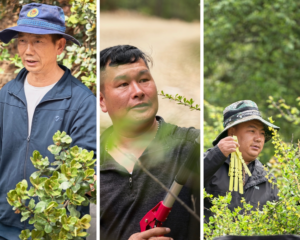
The Baima Mountains expedition required long days, challenging terrain and transporting delicate scientific equipment across steep mountain landscapes. Throughout the campaign, the team benefited from the extraordinary support of their drivers, whose contribution extended well beyond getting everyone safely from site to site.
Whether helping to climb trees, excavate roots, collect hard-to-reach samples or carry heavy equipment across difficult terrain, their enthusiasm and willingness to help became an essential part of the success of the expedition.
A huge thank you from the entire team—you truly helped make this field campaign possible.
Looking Ahead
Over the past three blogs, we’ve followed the teams journey from exploring the Baima Mountains, through collecting samples in the field, to processing those samples back in the laboratory.
Together, these measurements of leaves, stems, roots, hydraulics and photosynthesis will help us better understand how plants adapt to changing temperature and moisture across elevation gradients, providing valuable new tests of eco-evolutionary optimality theory and improving our understanding of how vegetation may respond to future climate change.
Stay tuned, we look forward to sharing what the team discovers.