

How do plants decide where to invest their resources? Should they build tough, long-lasting leaves that conserve nutrients, or thinner leaves that grow fast and photosynthesize quickly? Should they invest in dense, durable roots, or finer roots designed for rapid nutrient uptake?
For years, plant ecologists have tried to answer these questions using the idea of “plant economics”—the trade-offs plants make between fast and slow strategies for acquiring and using resources. A new paper led by LEMONTREE PhD student Yuzhi Zhu at Tsinghua University, recently published in Ecology Letters, shows that the answer may be more complicated than we thought, especially belowground.
The study, Non-correlated variation of leaf and fine root traits in subtropical forest plants, asks the question: do leaves and roots follow the same strategy, or do they operate independently?
Their findings suggest that, at least in subtropical forests, leaves and roots often do their own thing.
Plant Economics Spectrum
Ecologists describe leaf strategies using the well-known Leaf Economics Spectrum (LES). Some species have “fast” leaves (thin, nutrient-rich, highly productive leaves that turn over quickly). Others have “slow” leaves (thicker, denser leaves that are more conservative and built to last).
Scientists initially expected roots to mirror this same pattern. After all, roots and leaves are both resource-acquiring organs. If a plant has fast leaves, shouldn’t it also have fast roots?
But roots turned out to be more complicated.
Instead of following one simple fast–slow spectrum, fine roots appear to operate in a bi-dimensional Root Economics Space (RES) where plants balance not only belowground resource acquisition strategies, but also how much they collaborate with mycorrhizal fungi to help acquire nutrients.
That raised a major question: is there really one unified “plant economics spectrum,” or are aboveground and belowground strategies more independent?
Testing the theory
To test this, the team worked in subtropical evergreen broadleaf forests in southeastern China, one of the most species-rich forest systems in East Asia. They compared two nearby forest communities with very different growing conditions: a hilltop site with more light and drier soils, and a shaded valley site with higher humidity, more soil moisture, and richer nutrients.
They sampled 87 individual woody plants representing 41 coexisting species, including trees, shrubs, and lianas. Importantly, they measured both leaf traits and fine root traits from the same individual plants, which helps avoid one of the biggest limitations of earlier studies that relied only on species averages.
The weak link
They found LES and RES emerged consistently across the two sampled communities, but leaf and root functional traits were surprisingly weakly linked to each other.
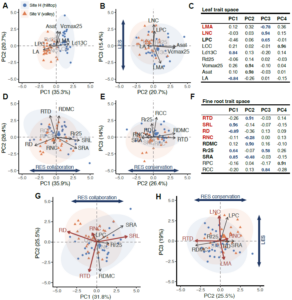
The Leaf Economics Spectrum (LES) and Root Economics Space (RES) align on separate, nearly perpendicular axes, showing that aboveground and belowground resource strategies are largely independent in subtropical forest plants. This decoupling suggests plants can mix and match leaf and root strategies rather than following a single unified “plant economics spectrum.
The classic leaf economics relationships holds. Plants with thicker, denser leaves tended to have lower leaf nitrogen and more conservative strategies. Fine roots also showed their own expected patterns, with traits like root diameter (RD), specific root length (SRL), and root tissue density (RTD) aligning along distinct root economic axes. But when the researchers looked across organs, the coordination mostly disappeared. A plant with conservative, slow-growing leaves did not necessarily have conservative roots. High leaf nitrogen didn’t strongly predict high root nitrogen. Thick leaves didn’t reliably pair with thicker roots. In other words, the Leaf Economics Spectrum (LES) and the Root Economics Space (RES) were largely decoupled. This means plants can mix and match strategies. A species might invest in conservative leaves but highly acquisitive roots, or the reverse. That flexibility may actually help explain how so many species coexist in subtropical forests.
Different worlds
Why does this decoupling happen?
The answer likely lies in the fact that leaves and roots live in very different environments.
Leaves respond to light, temperature, humidity, and competition in the canopy. Roots deal with patchy soils, nutrient hotspots, water availability, and mycorrhizal partnerships underground. Because those environments vary independently, plants may need separate strategies above and below ground.
In highly diverse forests with relatively abundant resources, that flexibility may be especially important. Instead of all species converging on one “best” strategy, they can diversify, reducing competition and occupying different ecological niches.
The study also found that this pattern was not simply explained by shared evolutionary history. Even after accounting for phylogeny, whether species were closely related, the decoupling between leaf and root economics remained strong. That suggests this is not just a legacy of ancestry, but an active ecological strategy.
Another interesting takeaway was that relying on just a few classic “marker traits” doesn’t tell the whole story. Additional traits like leaf phosphorus, root dry matter content, and fine root respiration helped better define how plants position themselves along these economic axes. Plant strategy, it turns out, is more multidimensional than a single trait pair can capture.
Overall, this work challenges the idea that plants operate along one unified economic spectrum. Instead, it supports a more flexible view: plants are balancing multiple independent strategies at once.
Leaves and roots are solving different problems, in different environments, under different constraints.
And sometimes, they don’t agree.
That may be exactly what allows diverse subtropical forests to function so well.
By showing that aboveground and belowground trait strategies can be largely independent, Yuzhi Zhu and colleagues provide an important reminder that understanding plant function means looking both above and below the surface. In ecology, some of the most important stories are happening underground.
You can read the full paper here:
Zhu, Y., Li, M., Zheng, J., Wang, Y., Ren, Y., Zhang, H., Feng, Z., Harrison, S.P., Prentice, I.C., Zhang, Y., Jin L., Sun, S., Han, M., Ni, X., Wang, Y., Fu, S., Reich, O.B., Wright, I.J. & Wang, H. (2026). Non-correlated variation of leaf and fine root traits in subtropical forest plants. Ecology Letters, 29(5), https://doi.org/10.1111/ele.70397