


As the year winds down and we all start consuming our body weight in mince pies and chocolates, it’s time to look back on what’s been a huge year for the LEMONTREE team. From graduations and new faces to workshops, conferences and a bumper crop of papers — 2025 has been busy, brilliant, and very collaborative.
Early Career Researcher News
Congratulations to the following team members who graduated with the PhD’s this year:
- Sungchan Jeong: Seoul National University. Thesis title “Tracking multi-scale vegetation dynamics by combining satellite observations and machine learning”
- Theodore Keeping: Reading University. Thesis title “Modelling Wildfire Occurrences and their Present and Future Patterns of Variability over the Contiguous United States”
- Yicheng Shen: Reading University. Thesis title “Optimality approaches linking fire-related plant traits and ecosystem responses to climate change”
- Ruijie Ding: Imperial College London. Thesis title “Principles of carbon allocation in plants and ecosystems”
We have welcomed new PhD team members: Ananda Kurth (Bern), Jisun Kim (previous Masters student, Seoul National University). We have also welcomed seven new post-docs to the project: Yitong Yao, Akash Verma, Lucas Ellison, Mateusz Lisiewski, Timothee Corchia, Ruijie Ding and Regina O’Kelley.
Wenjia (Shirley) Cai, a post-doc at ICL, attended the EEBIOMASS Summer School, Jena, Germany (May) to learn from the latest remote sensing techniques for better validation and evaluation for modellers in the LEMONTREE group
Ananda Kurth also undertook a one month secondment at SNU. Ananda worked with Youngryel’s group to develop an fPAR and LAI product that excludes anthropogenic influences on vegetation.
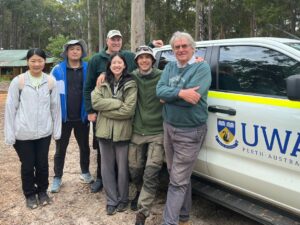 Jisun Kim (Youngryel’s lab at SNU) got the opportunity to undertake fieldwork in Western Australia with Deniil Scheifes (Utrecht University) to measure photosynthesis across the Warren River chronosequence to examine how soil nutrient status relates to leaf-level photosynthetic parameters.
Workshops & Conferences
We ran three LEMONTREE-led workshops this year, bringing together experts in ecosystems, fire, modelling, and optimality theory — lots of ideas shared, challenged, and sharpened.
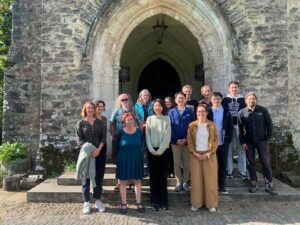
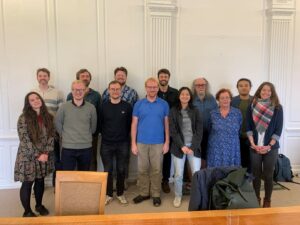
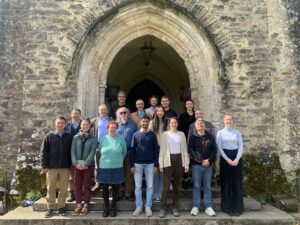
- Energy partitioning workshop part 2 in October 2025 (left). The title was “Ecosystem processing of absorbed solar energy and it’s coupling to carbon fixation: towards a new synthesis.” The workshop brought together experts in remote sensing, ecosystem modelling, field ecology, and plant physiology to push forward our collective efforts to link satellite observations with the fundamental processes that drive plant growth and the carbon cycle.
- IMFIREDUP September 2-25 (middle). The second meeting of the group “Improved modelling of FIRE: Development, understanding and prediction” led by LEMONTREE. The meeting brought together researchers from across the wildfire modelling community for three days of presentations, discussions, and brainstorming sessions. The aim was to share progress, spark new ideas, and push forward collective efforts to better understand and model the complex dynamics of fire. Key challenges identified included the importance of scale, biodiversity, and human activities, alongside new tools such as machine learning and ensembles.
- Incorporating EEO into LSMs in April (right). 18 leading scientists gathered to take on one of the most complex and pressing challenges in Earth system science: how to make Land Surface Models (LSMs) more accurate, simpler and more robust. The unifying thread? Eco-Evolutionary Optimality (EEO) theory. This three-day workshop, hosted by the LEMONTREE project, was an opportunity to share ideas, experiences, and visions for the future of modelling Earth’s land systems.
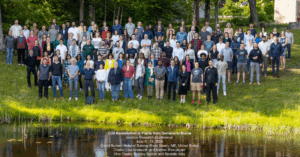
Our annual team meeting this year at Seoul National University was a real highlight. Over 100 researchers joined the opening symposium, followed by focused team discussions to map out the final stretch of the project. We wrapped it up with our second ECR summer school, diving into remote sensing, LiDAR and hyperspectral data — plus plenty of good food, drinks and catching up.
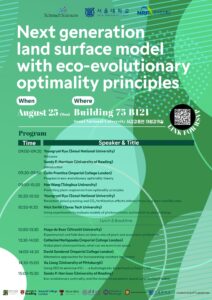
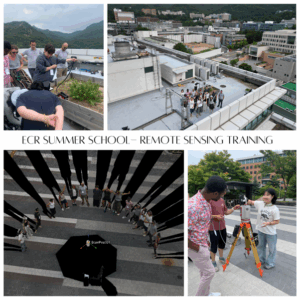
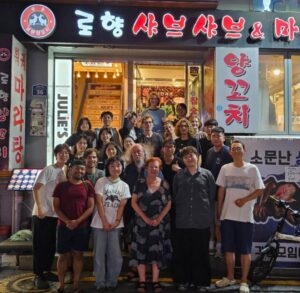
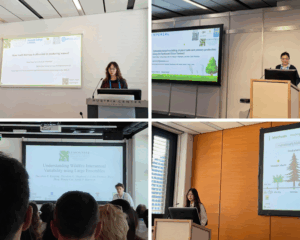
We have maintained our presence at many key conferences this year. At ESA 2025: Ecological Society America in Baltimore, Nick Smith’s lab presented several talks and then at Gordon Research Conference in Maine (June), Nick Smith gave a talk on ‘CO2 assimilation in plants: from genome to biome’. We had a large team presence at EGU in Vienna with 14 presentations from LEMONTREE (May). Our presence at EGU was marked by a mix of oral and poster presentations across a variety of sessions, covering plant respiration, stomatal regulation, wildfires, optimality in forest dynamics, and much more. Many of our PhD students had their first opportunity to present at a major international conference—an experience that is both challenging and rewarding. In September, Sandy Harrison presented at the annual VESRI Virtual Symposium This week we have a team of 13 LEMONTREE members at AGU in New Orleans. Our talks and presentations range from plant functional ecology and ecohydrology to land–atmosphere interactions, carbon cycle science, and next-generation modelling frameworks and we are delighted to have four invited talks this year.
2025 Publications
In 2025, the team published 26 papers (six more than last year!), spanning journals like Nature, Science, PNAS, Global Change Biology and more. From plant traits and photosynthesis to fire, carbon cycling and next-gen land surface models — the science has been flying.
We were also featured in Nautilus Magazine, with a fantastic piece on how “plant maths” can help predict Earth’s future — a perfect snapshot of what LEMONTREE is all about.
Here the list of our 2025 publications and you can find links to them all on our publications webpage here.
- “The global hydrogen budget”- Nature
- “Nutrient availability increases photosynthetic capacity without altering the cost of resource use for photosynthesis” in AoB Plants
- “Eco-evolutionary modelling of global vegetation dynamics and the impacts of CO2 during the late Quaternary: insights from contrasting periods”- Earth System Dynamics.
- “Global assessment of environmental and plant-trait influences on root:shoot biomass ratios”- Global Change Biology
- “Increasing nitrogen availability increases water use efficiency and decreases nitrogen use efficiency in Acer saccharum” – Tree Physiology
- “Paleoclimate perspectives on contemporary climate change”- Annual Review of Environment and Resources
- “Observed declines in leaf nitrogen explained by photosynthetic acclimation to CO2”- PNAS
- “Plant nutrient acquisition under elevated CO2 and implications for the land carbon sink”- Nature Climate Change
- “Widespread underestimation of rain-induced soil carbon emissions from global drylands”- Nature Geoscience
- “Global variation in vegetation carbon use efficiency inferred from eddy covariance observations”- Nature Ecology and Evolution
- “Northen ecosystem productivity reduced by Rossby-wave driven hot-dry conditions” – Nature Geoscience
- “Temporal constraints on leaf-level trait plasticity for next-generation land surface models”- Annals of Botany
- “Thermal acclimation of stem respiration implies a weaker carbon-climate feedback”- Science
- “Hyperspectral sensing of aboveground biomass and species diversity in a long-running grassland experiment”- Ecological Informatics.
- “Climate, vegetation, people: disentangling the controls of fire at different timescales”- Philosophical Transactions of the Royal Society B.
- “Present and future interannual variability in wildfire occurrence: a large ensemble application to the United States”- Frontiers in Forests and Global Change.
- “Temporal constraints on leaf-level trait plasticity for next-generation land surface models”- Annals of Botany
- “Soil resource acquisition strategy modulates global plant nutrient and water economics”- New Phytologist
- “A general model for the seasonal to decadal dynamics of leaf area”- Global Change Biology
- “Incorporating the acclimation of photosynthesis and leaf respiration in the NOAH-MP Land Surface Model: model development and evaluation”- Journal of Advances in Modeling Earth Systems
- “The response of carbon uptake to soil moisture stress: adaption to climatic aridity”- Global Change Biology
- “Nitrogen demand, availability and acquisition strategy control plant responses to elevated CO2”- Journal of Experimental Botany
- “Investigation of factors that affect post-fire recovery of photosynthetic activity at global scale”- Ecological Indicators
- “Soil nitrogen supply exerts largest influence on leaf nitrogen in environments with the greatest leaf nitrogen demand”- Ecology Letters
- “A unifying principle for global greenness patterns and trends”- Communications Earth and Environment.
- “Minimal impact of recent decline in C4 vegetation abundance on atmospheric carbon isotope composition” Will be published in Communications Earth and Environment end of December!
Wrapping up
What a year. For those still at AGU, it’s almost over — but for everyone else, it’s time to rest, recharge, and enjoy a well-earned break. Even Colin and Sandy are taking a Christmas holiday this year (though somehow fieldwork may still sneak in…).
We’re incredibly excited for 2026 as we head into the final phase of the project and start pulling everything together to fully integrate eco-evolutionary optimality into land surface models.
For now though — happy holidays from all of us at LEMONTREE 🎄✨
See you in the new year!