
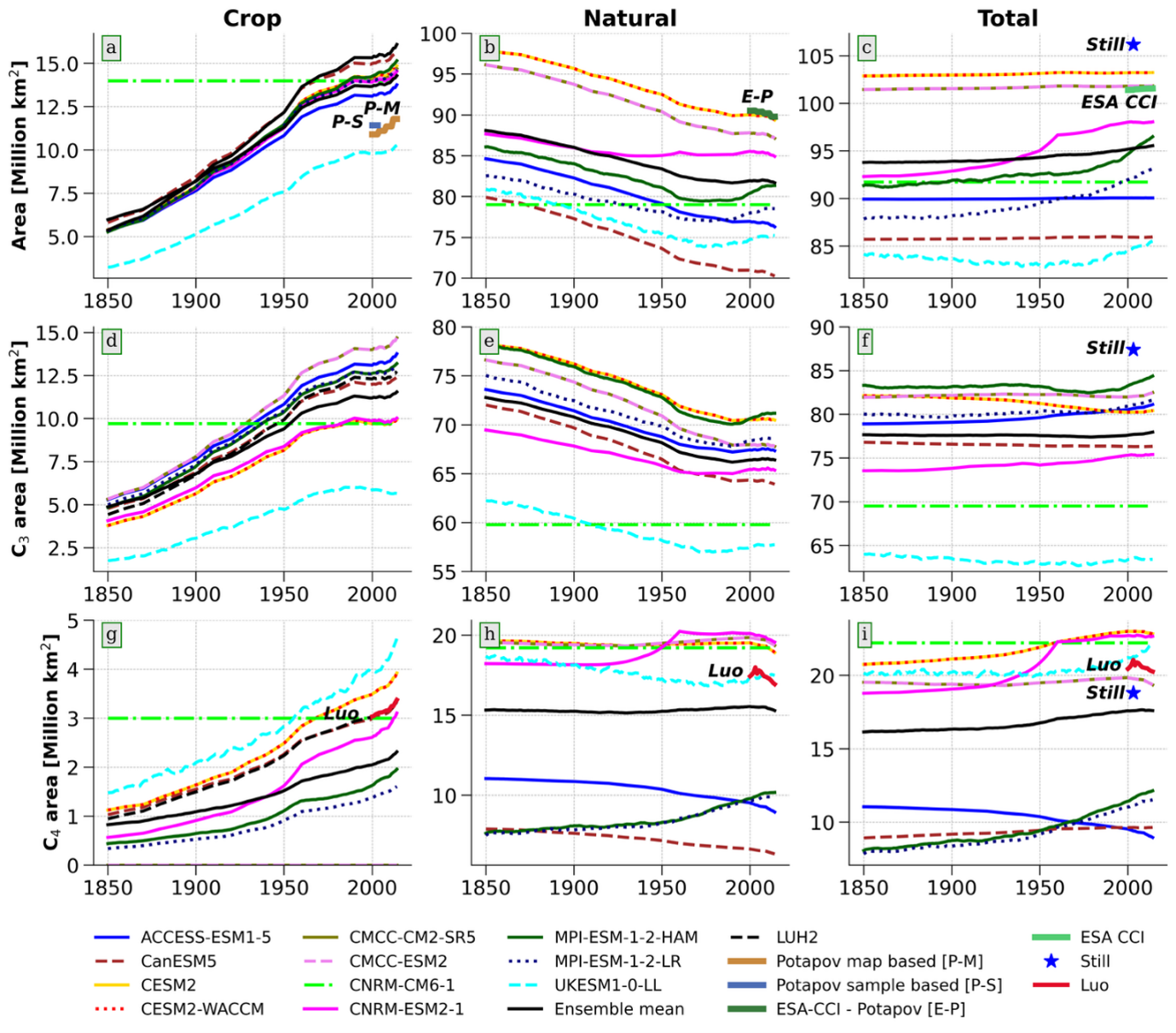

Every year, land ecosystems absorb around 30% of the carbon dioxide released by human activities, helping to slow the pace of climate change. Predicting how this natural carbon sink will evolve is one of the biggest challenges in climate science, and it depends on how well Earth System Models (ESMs) represent the composition, diversity and shifts in global plant coverage. A new LEMONTREE study led by Joseph Ovwemuvwose, currently a Research Assistant at Imperial College London, together with Prof Colin Prentice and Prof Heather Graven, found that the representation of Earth’s plant cover is one of the major sources of uncertainty in the carbon sink capacity simulation. Published in Biogeosciences, the study compared 11 leading ESMs used in the sixth phase of the Coupled Model Intercomparison Project (CMIP6) and found that they often disagree substantially on the distribution of crops and natural vegetation, particularly plants using the two major photosynthetic pathways, C3 and C4.
Why C3 and C4 Plants Matter
One way plants are categorised is by their photosynthetic pathways, that is, how they capture and fix carbon dioxide during photosynthesis. There are three photosynthetic pathways: C3, C4 and Crassulacean Acid Metabolism (CAM), but the first two are the dominant ones, accounting for approximately 95% of all plants. Most trees, shrubs and temperate crops use the C3 photosynthetic pathway. C4 plants, including tropical grasses and important crops such as maize, millet and sugarcane, have evolved a different strategy that allows them to photosynthesise more efficiently under hot, dry conditions. Because C3 and C4 plants respond differently to rising temperatures, drought and increasing atmospheric CO₂, accurately representing where they grow and how this shifts over time is essential for predicting future carbon uptake. If models get the balance between these vegetation types wrong, they may also misrepresent how ecosystems respond to climate change.
Looking Beneath the Surface of Climate Models
As many of today’s ESMs use the same global land-use dataset describing croplands and other natural vegetation types, the Land Use Harmonisation (LUH2) dataset, one therefore expects them to simulate similar vegetation patterns. Surprisingly, they do not. They produced very different estimates of crop area, natural vegetation, and the proportions of C3 and C4 plants across the globe.
Some models underestimated cropland considerably, while others had very different proportions of C3 and C4 crops and natural vegetation. These inconsistencies arise because each model processes and represents vegetation in slightly different ways to map them into their modelling framework, even when starting from the same input data.
Small Differences, Big Consequences
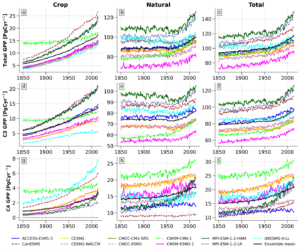
The consequences of these differences extend far beyond vegetation maps. The study found that estimates of global gross primary production (GPP), i.e., the total amount of carbon captured through photosynthesis, varied by almost a factor of two across the models. While every model agreed that global photosynthesis has increased since the mid-20th century, they disagreed on how much of that increase came from C3 vegetation, C4 vegetation, crops or natural ecosystems. In particular, the models showed strikingly different behaviour for C4 vegetation. Some predicted increasing productivity, while others simulated declines over the same period. This suggests that uncertainty stems not only from differences in vegetation area, but also from how models represent the physiology of different plant types.
Although all models agreed that productivity from C3 vegetation increased, estimates of total global GPP ranged from around 80 to 150 PgC per year by 2014, a remarkably widespread range for models used to inform climate projections. The greatest uncertainty centred on C4 vegetation. While observations suggest that C4 plants account for around 17–18% of global vegetation, the models simulated anything from 10% to 26% and disagreed not only on how productive C4 vegetation is, but even on whether its productivity has increased or declined over recent decades. Overall, vegetation cover in most models remained relatively stable, but its composition steadily shifted toward cropland as agriculture expanded, with strong negative consequences for the global carbon-climate feedback.
Testing the Models Against Atmospheric Evidence
Joseph, Heather, and Colin also used atmospheric carbon isotopes as an independent way to test the model predictions. Because C3 and C4 plants discriminate differently against the heavier carbon isotope (13C), changes in their relative contributions to global photosynthesis leave a measurable fingerprint in atmospheric CO₂.
Here too, the models told very different stories. Some predicted increasing isotope discrimination, others predicted decreases, and several showed almost no change. None reproduced the strong increase observed in atmospheric measurements. This suggests that current models are still missing important processes governing the balance between C3 and C4 vegetation and how their productivity responds to environmental change.
Taken together, the results show that uncertainty in the representation of C3 and C4 plant abundance is an important source of uncertainty in simulated land carbon fluxes. Reducing that uncertainty will require stronger observational constraints and more realistic representations of vegetation dynamics and plant physiology in the next generation of ESMs
Take-Home Message
This study shows that how we represent plants in climate models remains a major source of uncertainty. Even models starting with the same vegetation cover and land-use information can produce very different estimates of where C3 and C4 vegetation occurs, how productive those ecosystems are, and ultimately how much carbon they remove from the atmosphere.
Reducing these uncertainties will require stronger observational constraints and better representation of plant physiology and vegetation dynamics. By improving how we simulate the diversity of the world’s vegetation, we can make more reliable predictions of the future land carbon sink and better understand how terrestrial ecosystems will respond to a changing climate.
You can read the full paper here:
Ovwemuvwose, J., Prentice, I.C. & Graven, H. 2026. Uncertainty in land carbon fluxes simulated by CMIP6 models from treatments of crop distributions and photosynthetic pathways. Biogeosciences, 23, 5593-5605, https://doi.org/10.5194/bg-23-5593-2026