
In this blog for World Rivers Day, Hannah Cloke, Professor of Hydrology, explains how understanding water systems – from river health to flood forecasting – is essential for protecting our communities, economy and future prosperity.
What if the water running under our bridges holds the key to understanding our health, our economy and our future? At Water@Reading, the University of Reading’s interdisciplinary hub for water research, we believe that it does.
Our team brings together hydrologists, meteorologists, data scientists, social scientists and communicators to decode the messages our waterways are sending us – from hilltops to estuaries, and from local communities to global systems.
Here are seven important questions driving our research:
1) How healthy are our rivers, really?
River health is about more than just clear water. The real threats are often invisible – pollutants that compromise biodiversity, endanger public health and threaten food security.
Our researchers use high-frequency sensors, satellite data and citizen science to track pollutants in our rivers in the UK and around the world. This work directly supports the Environment Agency and water companies, helping them to target interventions that improve water quality and ecological resilience.
2) Can we act before the flood?
Absolutely – and we’re already doing it. Through impact-based forecasting and pre-agreed early action protocols, our researchers help humanitarian agencies act days before floods strike.
This approach, known as Forecast-based Action, has been successfully implemented in countries like Bangladesh and Peru, where millions of pounds in aid were released before disaster hit, thanks to tools like GloFAS. Our work with the Red Cross Red Crescent Movement demonstrates how science can save lives and reduce human suffering.
3) When does a dry spell become a drought?
Water is a precious resource and one that we should be managing very differently. Droughts aren’t simply about lack of rainfall – they’re complex events involving water systems, demand patterns and governance decisions.
The work we do integrates meteorological data with groundwater levels, reservoir storage and usage patterns to forecast when droughts will begin and find ways to support recovery. This research supports water companies, farmers and regulators in making informed decisions that protect both water supplies and ecosystems.
4) Can machines learn tomorrow’s flood today?
Artificial intelligence is transforming how we forecast floods. Our research feeds into the development and application of the latest techniques, exploring how machine learning can provide actionable insights for catchment managers, local authorities and emergency planners.
Crucially, we don’t make predictions in a vacuum – our methods quantify the uncertainty around forecasts, giving decision-makers the confidence they need to act.
5) How is climate change reshaping UK rainfall and floods?
Climate change is intensifying rainfall and shifting storm patterns, leading to more frequent and severe flooding in some areas. We use cutting-edge convection-permitting climate models and historical flood records to understand these changes.
Our findings have informed national planning standards and contributed to evidence submitted to Parliament on flood preparedness. This work helps to ensure that new housing, transport and energy infrastructure are built to withstand future extremes.
6) How do we communicate risk so people act?
Even the best flood warning is useless if people don’t receive it in time, understand it or know how to respond. That’s why we work directly with communities and emergency responders to co-design story maps, serious games and hyper-local dashboards. These tools promote timely evacuation, safer driving and uptake of flood protection measures – because communication is as vital as prediction.
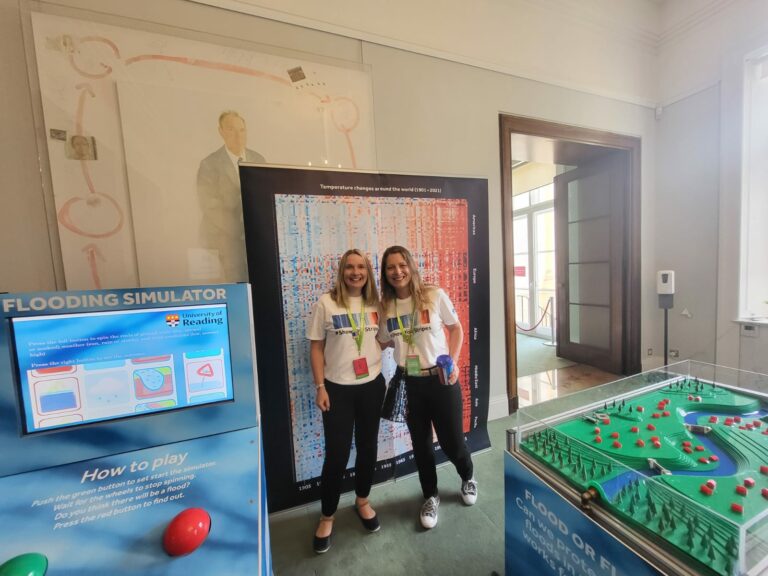
Additionally, our public engagement work, such as the Royal Society Summer Science Exhibition, turns complex science into memorable experiences. And through schools outreach, documentaries, podcasts and citizen science, we connect people with the science that affects their lives.
7) Why does this matter for society and the economy?
Water is the quiet infrastructure beneath everything we value: health, food, homes, transport, energy, the natural environment and economic productivity. Every pound invested in monitoring, forecasting, governance reform, nature-based solutions and public communication yields returns in avoided losses, lower insurance claims, stable supply chains and healthier communities.
Our proposition at Water@Reading is simple: if we can anticipate extremes, clean our rivers, govern fairly, work with nature, and communicate clearly, we can turn water from a growing risk into a shared asset.
Studying and understanding rivers and water is not a niche academic pursuit – it’s a national capability essential for prosperity and security.
Cover photo by Marco Zuppone on Unsplash