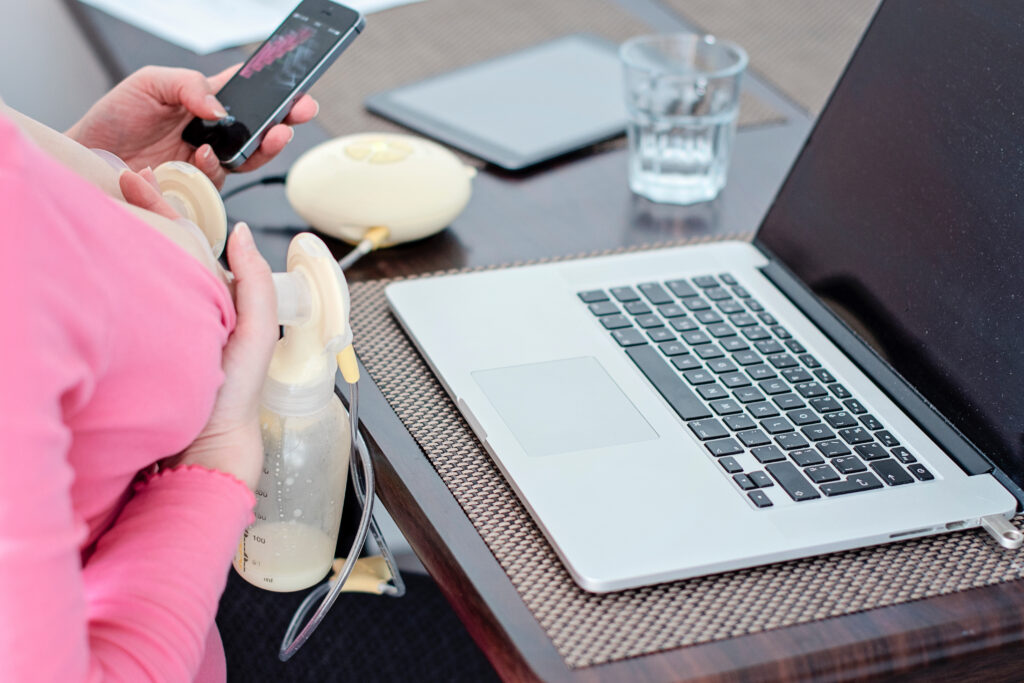

The Health and Safety Executive (HSE) states that when an employer has received written notification from an employee that they are breastfeeding, that they must undertake an individual risk assessment to considers the breastfeeding employees specific needs. This is to ensure you as the employer can put in appropriate measures to ensure that breastfeeding employees return to a safe environment. In this guide we cover some of the key things that you might like to cover in a health and safety risk assessment for a breastfeeding employee.
When should a health and safety risk assessment take place?
Employers are legally required to undertake an individual health and safety risk assessment when an employee notifies that they are pregnant, have given birth in the last 6 months and/or are breastfeeding.1 This risk assessment must consider the individual’s specific needs and should be regularly reviewed as circumstances change. For example, in the context of breastfeeding, the specific needs of the mother may change as the child gets older and/or they make changes to their feeding patterns.
A health and safety risk assessment should take place as soon as possible after being informed by an employee that they are breastfeeding / intend to be breastfeeding upon return to work (including before any keep in touch days). This could be a review / update of an existing risk assessment they received as a result of informing you they were pregnant, as long as you consider any potential risks related to breastfeeding.
What should a risk assessment cover for breastfeeding employees?
The Health and Safety Executive2 lists some common general risks for pregnant and new mothers relating to posture and position, physical injury, working conditions (long hours, shift and night work) – including work-related stress, noise and temperature – , physical injury and harmful substances (e.g. chemical and biological agents) that could be passed through to the child during breastfeeding and ensuring personal protective equipment is safe and comfortable (e.g. avoiding tight clothing).
It is worth noting there are risks that are not explicitly mentioned by the HSE that are good practice to consider. These relate to factors that may lead to an increased risk of getting engorged (breasts becoming full) and developing mastitis (inflammation of the breast tissue, which can be serious and painful), and factors that may affect milk supply (which could impact infant feeding plans/goals and hence mother and child’s wellbeing). Common contributors relate to lack of time to breastfeed/express when needed such as lack of additional breaks and suitable facilities. It is also worth recognising some mothers may suffer from fatigue due to overnight feeding, and the importance of ensuring time for proper nutrition and hydration for breastfeeding employees.
Risk assessment suggested questions
The following are examples of questions that are good practice to include in a risk assessment to ensure you can protect against risks specifically related to breastfeeding (such as engorgement/mastitis, changes to milk supply etc.), as opposed to just general risks for pregnant and new mothers as listed above (that will likely be in general risk assessments for pregnant and new mothers). We provide a table at the end of this guide with guidance on common risks for breastfeeding mothers and potential control measures.
- Where can the breastfeeding employee rest if needed? Specify where.
- Will the employee need to directly breastfeed or express milk (including for comfort, their child, or both) during work hours? If yes, where can the employee breastfeed or express breastmilk that is private and hygienic? For example:
- In a designated breastfeeding room
- On-site/nearby childcare provision
- Private office/ workspace
- At home
- Other (must be private and hygienic)
- Will the employee need to store breastmilk? If yes, where can the employee store breastmilk?
- In a fridge designated for storing expressed breastmilk
- In an alternative (communal) fridge
- The employee wishes to use their own cool bag/ box
- Other.
Ensure that any provided storage facilities are safe (in terms of temperature i.e. 4 degrees Celsius or lower with ideally a thermometer) and hygienic.
4. Will the employee need to use a breast pump?
If yes is there a place where can they wash up and/or sterilise breast pump equipment and parts? Specify where.
If yes is there a hygienic place they can store breast pump equipment if needed? Specify where.
5. Will the employee need breaks for expressing breastmilk or breastfeeding? Or will they need to adjust start/end time and / or shift patterns to accommodate this? Agree on frequency/timing of breaks, changes to start/end time, other adjustments and put in a temporary flexible working request if needed. Ensure that the employee has enough time for adequate nutrition/hydration.
6. Are there any risks related to increased fatigue e.g. as a result of feeding the child during the night?
Consider if increased fatigue imposes any risks, based on the nature of the job role. Can these be removed/controlled by, for example, changes to start/end time, changes in work location, more regular breaks.
7. Will the employee need to travel (overnight) or work outside of their normal place of work?
If yes consider availability of facilities in alternative workplace and any adjustments that need to be made. If travelling overnight, consider whether the mother would need to travel with their child and whether this is feasible. Consider if any adjustments need to be made.
8. Will the employee need to work outside of normal hours or work late or overnight shifts?
Consider if this will impact breastfeeding and/or expressing breastmilk and any resulting adjustments that need to be made. A risk assessment may be part of a general communication pathway and we have provided an example communication pathway in Employer Guide 8.
References
Breastfeeding Employees Risk Assessment Guidance
If you are conducting a risk assessment for breastfeeding employees, devising a breastfeeding risk assessment form or wish to add breastfeeding to any existing maternity / return to work risk assessment in your organisation, the following table outlines some common risks/hazards specific to breastfeeding and possible control measures, reasonable adjustments and /or best practice. This is not an exhaustive list and it is worth remembering that breastfeeding experiences vary and may vary over time for an individual (especially with the age of the child).
| Risk or hazard | Nature of risk / hazard (examples) | Possible control measures (not exhaustive) |
| Lack of convenient, private, hygienic space for resting, expressing breastmilk or breastfeeding | Stress, anxiety and discomfort; leaking milk, breast engorgement and mastitis; difficulty expressing and maintaining milk supply; limits the choice of expressed breastmilk/ breastfeeding as a feeding option | Provide a private, clean, comfortable and conveniently located room with a lockable door, comfortable chair and electrical sockets. Toilets are not a suitable place for expressing breastmilk or breastfeeding.
If such dedicated space is not possible consider temporary alternative working locations (where available), home working or adjustments to working patterns. .
|
| Inadequate storage for expressed breastmilk | Spoilage of breastmilk; stress and anxiety, limits the choice of expressed breastmilk as a feeding option | Provide access to a clean fridge maintained at 4°C or below, with a thermometer. Where possible provided dedicated storage i.e. an individual fridge designated for expressed breastmilk.
If a shared fridge is used, ensure expressed breastmilk is stored in clearly labelled storage containers. |
| Lack of access to washing facilities / inadequate storage for breast pump equipment | Increased risk of bacterial contamination of breast pump parts; infection; stress and anxiety | Provide access to handwashing facilities and a sink where breast pump parts can be washed in hot soapy water.
If a sink is not possible provide facilities such as a fridge where breast pump parts can be stored so they can be washed later.
Provide access to somewhere hygienic to store breast pump equipment. |
| Lack of time for expressing breastmilk | Stress, anxiety and discomfort; leaking milk, breast engorgement and mastitis; difficulty maintaining milk supply; limits the choice of expressed breastmilk/ breastfeeding as a feeding option | Allow flexible and sufficient breaks for expressing breastmilk/breastfeeding, recognising that the frequency and duration required will vary between individuals and over time. |
| Irregular working patterns, shift work and night shifts | Fatigue, disruption to breastfeeding routines and difficulty maintaining milk supply, particularly where the employee breastfeeds overnight / feeds their child to sleep. | Consider temporary adjustments to working patterns e.g. avoiding night, evening shifts or irregular working patterns.
A phased return may help the mother and child to adjust to changes in feeding routines. |
| Travel | No/limited access to suitable facilities; inadequate time for expressing breastmilk; difficulties storing and transporting expressed breastmilk; disruption to feeding routines and difficultly maintaining milk supply
|
Include breastfeeding and expressing breastmilk within travel risk assessments. Consider access to suitable facilities, storage and transportation of expressed breastmilk, and opportunities for expressing breastmilk and breastfeeding (if travelling with their child).
Minimise unnecessary travel, particularly overnight and international travel, where possible.
Consider whether the child can accompany the employee.
When flying, check airline policies and any restrictions regarding the carrying of expressed breastmilk and gels/ice packs, and breast pump equipment.
|
| Prolonged use of computers/Display Screen Equipment (DSE) | Postnatal hormonal changes may continue to affect posture, ligaments and joints increasing susceptibility to musculoskeletal discomfort and injury from prolonged sitting and use of mouse/keyboard
|
Encourage regular movement and screen breaks.
Undertake a DSE assessment and make necessary workstation changes including seating, desk set-up and equipment. |
| Carrying and Lifting heavy loads; prolonged sitting or standing | Postnatal hormonal changes may continue to affect posture, ligaments and joints increasing susceptibility to musculoskeletal discomfort and injury.
|
Adjust tasks to eliminate or reduce carrying and lifting risks, prolonged standing or sitting.
Provide suitable lifting aids where appropriate. |
| Uniform and personal protective equipment (PPE) | Poorly fitting clothing or PPE may cause discomfort, restrict milk flow and increase the risk of breast engorgement or mastitis | If necessary undertake uniform /PPE refitting to ensure it is comfortable.
Where suitable uniform/PPE cannot be provided consider temporary adjustments to work activity/duties.
|
| Fatigue, stress and anxiety | Increased risk of fatigue due to overnight feeding, broken sleep.
Increased risk of stress and anxiety due to balancing breastfeeding and work
Fatigue and stress can impact milk supply |
Use of flexible working arrangements to allow changes to start / end times.
Ability to work from home / come in late if had a poor night sleep.
More regular breaks.
Peer support and regular meetings to check in and discuss how things are going. |
| Exposure to harmful biological and chemical agents | Health risks to mother and to child if passed on through breastmilk | Avoid exposure
If exposure cannot be avoided make temporary adjustments to work activity/duties.
Undertake a Control of Substances Hazardous to Health (COSHH) risk assessment; see the HSE for more information https://www.hse.gov.uk/coshh/index.htm |
Last reviewed: 3rd August 2026