
As the summer draws to a close, there may still be time to escape to the countryside or see an art exhibition or two. Here, our own Robin Harragin Hussey is in Cumberland (now Cumbria) in search of artist and Christian Scientist Winifred Nicholson. Our special thanks go to the ‘© Trustees of Winifred Nicholson’ and in particular, Jovan Nicholson for his kind words and expertise.
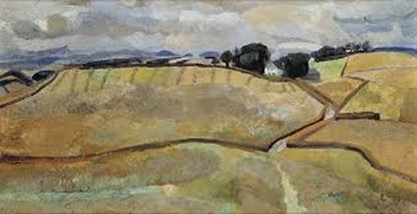
‘The earth of Cumberland is my earth…I have always lived in Cumberland – the call of the curlew is my call, the temple of the harebell is my tremble in life, the blue mist of lonely fells is my mystery, and the silver gleam when the sun does come out is my pathway’.
Early Life
Winifred Nicholson (1893 – 1981), is a key artist in the 20th century British modernist movement who managed to overcome the often career-eclipsing challenges of a famous artist husband and childrearing. She was a descendent of the Howard family on her mother’s side. Her grandmother was Rosalind Frances Howard, the ‘Radical Countess’, known for her activism in the women’s voting rights and temperance movements. Rosalind was married to George Howard, 9th Earl of Carlisle. Among their homes was Castle Naworth, Cumberland (became Cumbria in 1974), which was part of Winifred’s childhood. Her mother, Lady Cecelia Maud Howard, married Charles Henry Roberts the Liberal MP who later chaired the Cumberland County Council for 20 years. Her parents were given Boothby House near Brampton and Naworth by Rosalind. Winifred lived at Boothby as a child and later during and after World War 2.
When she was a young girl, her grandmother gave her George Howard’s painting materials. George was an amateur artist of some merit and a friend of Pre-Raphaelites Edward Byrne-Jones and William Morris. One of Winifred’s biographers, Christopher Andreae, wrote that: ‘Winifred was extraordinarily close to her grandfather. He was a strong influence on her as a young girl, and she owed her idea of painting more to him than has been fully recognised.’
While reminiscing about her early years as an art student at Byam Shaw in London, Winifred tells the story of how her grandfather asked her to finish a painting of daffodils, but he had gone to bed before he saw it. ‘Next morning, they told me he had died in the night – I did not go into his room again…
‘…I went down the garden, through the bilberries and the heath, to that low brick wall round the kitchen garden and sat there. The heavens were opened above me and all the glory of the heavenly host were there in golden light. I never finished those little daffodils…but I was going to finish them now or something better than them – in my life.’
Three Elements
This visionary sense was prevalent throughout her life, and it undergirds three key elements that inspired her life and art. The first element was the land. For most of her adult life Winifred lived at Banks Head, the farmhouse she bought with her husband, Ben Nicholson. Apart from living briefly in Switzerland, London and Paris during her marriage, Cumberland was her home for over 70 years. She wrote that ‘The earth of Cumberland is my earth…I have always lived in Cumberland – the call of the curlew is my call, the temple of the harebell is my tremble in life, the blue mist of lonely fells is my mystery, and the silver gleam when the sun does come out is my pathway’.
The second element is the one that is most commented on in Winifred Nicholson’s paintings, it is her extraordinary sense of colour. In an article published in The Christian Science Monitor (1978) she articulates her ideas about it:
‘Sunlight, moonlight, candlelight, electric light, all change the colour of an object – a human eye, a bee’s eye, a butterfly’s eye, all see the colour differently. So the local colour of an object does not belong to the object. The colour that seems to sit on it is subjective, fleeting, effervescent, and is as illusive as magic.’
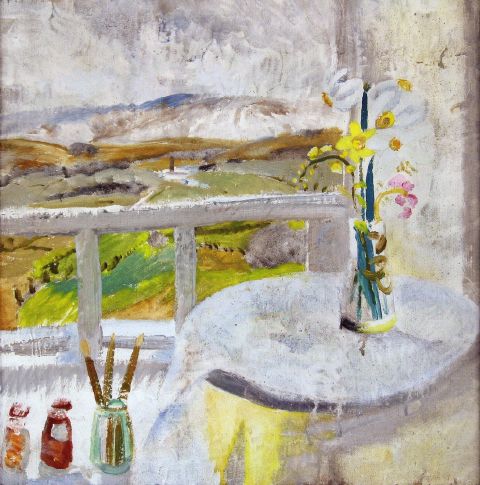
From Bedroom Window (1930s)
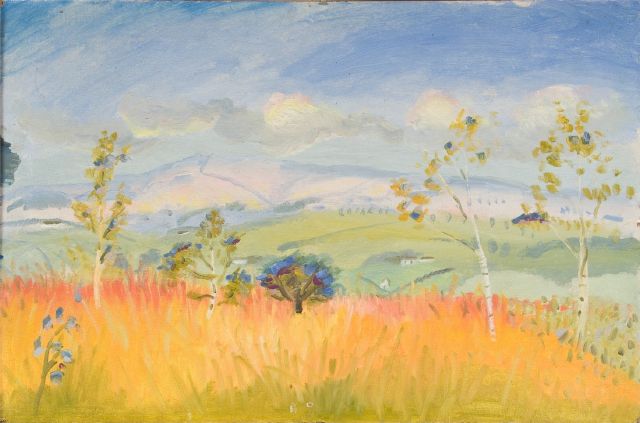
Bright Autumn Sun (1950s)
The third element is Winifred’s religious faith, Christian Science, which not only brought her physical healing and helped her navigate life’s challenges, it contributed to her sense of deep joy and inspiration. Her friend, the poet Kathleen Reine’s description of Winifred gives a sense of her character:
‘The present was, for her, first and last, an unfailing source of wisdom and delight, bringing with it possibilities of new ways of painting, new ways of seeing and of being, in a world which holds the promise and fulfilment of inexhaustible life.’
Here I focus on this third element, because it is often undervalued in works on her life and art.
Faith and Inspiration
Christian Science is a Christian denomination founded in New England in the late 19th century by Mary Baker Eddy. She was a self-taught theologian who focused on biblical healing. She became a healer herself and taught others through her writings, sermons, classes and the formation of a church in 1879. Christian Scientists believe that lives can be healed and saved through a deep faith in God and an understanding of His nature and power as illustrated in the healing works of Jesus. Their focus, in study and prayer, is on the biblical view of God and His harmonious creation – the spiritual universe – and this leads to moral and spiritual regeneration as well as physical healing. Christian Science spread to Britain and by 1910, when Mary Baker Eddy died, there were already more than 55 churches throughout the British Isles and Ireland.
One of Winifred’s early encounters with Christian Science was attending a lecture about it at First Church of Christ, Scientist, London, off Sloane Square. It left her in tears. When a woman approached to comfort her she said:
‘No I am not crying because I am sad, but because I am happy to know that Love is not me loving somebody and them not loving me back, but Love, God, loving all the time, me and everybody.’
This insight likely helped her in her relationship with the artist Ben Nicholson. They married in 1920 but began to separate in 1931 when Ben left her for the sculptor, Barbara Hepworth.
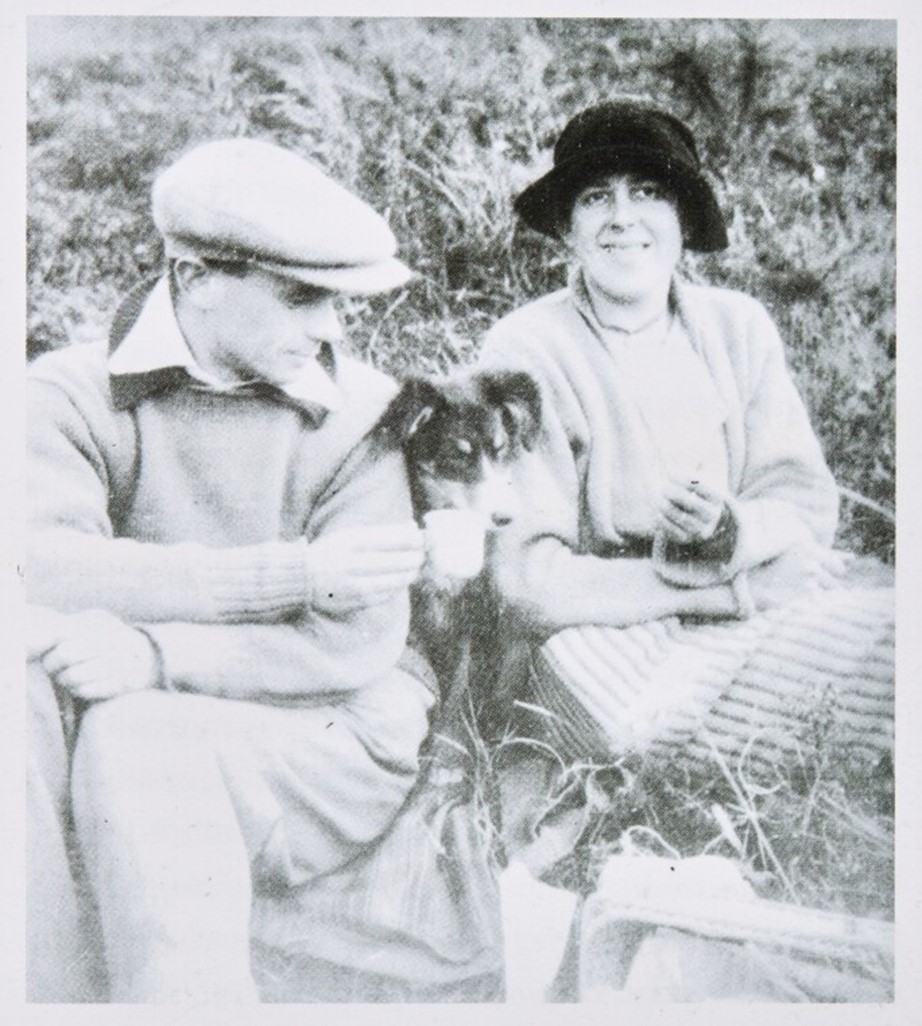
Ben and Winifred Nicholson circa 1923[1]
In the first flush of their marriage, their artistic life engrossed them both. When Winifred and Ben settled in London, she was introduced too Christian Science by her friend Bunty (Margaret) Nash, the wife of the artist Paul Nash who had been at Slade with Ben. Winifred wrote that she too looked into it and found that ‘this was really it’.
During those early years in London, Winifred wrote that she spent ‘long inspired hours’ reading Science and Health with Key to the Scriptures, the Christian Science textbook written by Mary Baker Eddy. She and Ben wanted to have children, but she had been told by a surgeon after a childhood operation that she was no longer able to have them. She describes how, after commiserating with Bunty Nash about Bunty’s unfortunate miscarriage and sharing biblical ideas, she herself became pregnant with her first son, Jake. Winifred saw this as a Christian Science healing.
At seven months pregnant, she found that she needed the help of a Christian Science practitioner. This is an experienced Christian Scientist who works on a professional basis in the ministry of healing through prayer as Jesus taught. He/she prays with individuals who have asked for help. Winifred had fallen backwards through a trap door while hanging an exhibition and when she woke up in hospital she was told she had a broken back. Later she wrote that the Christian Science practitioner was a ‘strong help …on the fifth day they sent me home, having first sent for specialists to know that this was safe as they could not understand why I had got well’. Though it took a few more weeks to recover completely, Jake was born safely two months later.
Winifred continued to be deeply inspired by the ideas she was discovering in Christian Science. She alludes to it many times in her letters and writings, for example she wrote to Kathleen Reine: ‘Hold on- don’t be concerned – wonderful things are happening – just stay composed and watch God work it out…God is the source of our being. We are God’s expression. From our source comes our power, our inspiration, our freedom, our motive power…’ She might almost have been writing that for herself. These ideas are well known to Christian Scientists and taken from their literature.
Achievement
During Ben and Winifred’s marriage they mutually supported each other’s work and continued to do so for the rest of their lives. At the beginning, it was a time of immense artistic discovery for them. Winifred writes of the ‘New Vision’ in painting, shared with their modernist contemporaries, where ‘the old theory which had been since the Renaissance of ‘Truth to Nature’ was swept away, or being swept away, and we were sweeping it.’ Winifred and Ben’s first exhibition was a joint one at a bookshop in Bloomsbury in which all of Winifred’s paintings sold, but Ben’s work did not, suggesting that her work was better understood at the time. Ben later went on to dominate British modern art, along with his second wife Barbara Hepworth, but Winifred’s work was also regularly exhibited and continues to be.
While Winifred travelled to the Hebrides, Greece, and France, she mainly lived at Bankshead from the 1950s onwards. She helped to create an artistic community around her, such as with the Chinese artist Li Yuan-chia and his LYC Museum. She also worked with a local team of knotters, braiders and weavers to reinvigorate the traditional craft of making rag rugs. This team included neighbouring farming women and Winifred’s family. Their work is currently celebrated in a touring exhibition: Winfred Nicholson: Cumbrian Rug Rags – now at Sleaford, Lincolnshire, until November 16th, 2025. There is another exhibition: Winifred Nicholson and Andrew Cranston: Dreams of the Everyday – taking place at the The Pier Arts Centre, Stromness, Orkney: 21 June–13 September 2025 before it moves to The Holburne Museum, Bath: 3 October 2025–11 January 2026.
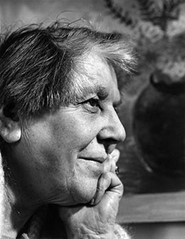
Photo of Winifred Nicholson by Pamela Chandler © Jovan Nicholson
For more on Winifred Nicholson and her work:
https://www.winifrednicholson.com
[1] Ben and Winifred Nicholson, c.1923, Private Collection (in Jovan Nicholson, Art and Life: Ben Nicholson, Winifred Nicholson, Christopher Wood, Alfred Wallis, William Staite Murray, 1920-1931, 2013, Fig. 11)
Christipher Andreae, Winifred Nicholson (Lund Humphries, 2009)
/https://artuk.org/discover/artworks/search/actor:nicholson-winifred-18931981/page/3
For more on the influence of Christian Science in British Art:
https://artlyst.com/features/christian-science-connection-within-british-modern-art-movement/
Copyright for paintings ‘© Trustees of Winifred Nicholson’
Photo of Winifred Nicholson by Pamela Chandler ‘© Jovan Nicholson’.
Any other images wiki commons.