
Feedback from Ask the Audience at our Autistic Thriving in Education and Beyond Event 6th May 2026
On the 6th May we were delighted to welcome around 600 people online and in person to our Autistic Thriving at School and Beyond event. The evening brought together autistic young people, families, professionals, researchers and students to explore autistic wellbeing in school, with Andy Smith of Spectrum Gaming providing the keynote speech about prioritising wellbeing when autistic children struggle to attend school.
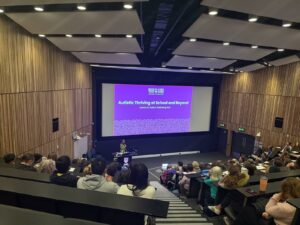
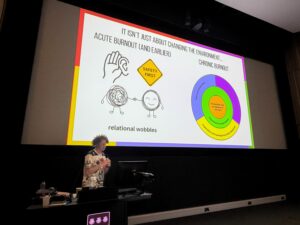
As part of the event, we asked the audience to share their views with us by answering two important questions:
What one change would most help autistic children and young people to thrive at school?
What should the Centre for Autism Wellbeing Hub focus on next to best support autistic children, young people and their families?
We were thrilled to receive hundreds of responses and want to extend our thanks to everyone who took part in answering our polls. Your ideas were interesting and insightful, and will be essential in shaping our future work at the Wellbeing Hub.

Question 1: What one change would most help autistic children and young people to thrive at school?
We received 540 responses from 330 respondents. While there are too many suggestions to list individually, we have grouped them into themes, with the most frequently suggested ideas appearing at the top of this diagram.
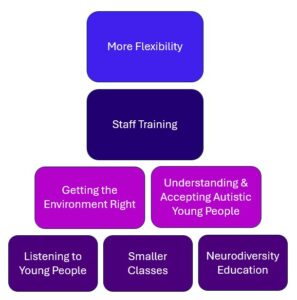
Flexibility was the most frequently raised theme. Respondents called for greater flexibility in the curriculum, including more diverse learning opportunities, support for individual interests, and options to learn some subjects from home. They also highlighted the need for flexible timetables, attendance arrangements, homework expectations, participation in lessons and activities, and school uniform policies. Overall, respondents wanted schools to be more adaptable and responsive to individual needs.
Staff training was the next most common theme. Respondents advocated mandatory autism and neurodiversity training for all school staff, embedded in teacher education and ongoing professional development. Training should be neuroaffirming, strengths-based, and improve understanding of the diverse ways neurodivergence presents. Many also called for greater specialist expertise within schools, including better-trained SENCOs and staff with practical inclusion strategies.
Respondents also emphasised the importance of creating calm, low-arousal environments. Suggestions included reducing sensory overload through improved lighting, lower noise levels, less visually busy classrooms, quieter spaces, sensory audits, and practical supports such as fidgets and regulation breaks.
A strong theme was the need for greater acceptance, understanding and empathy towards autistic children and young people. Respondents highlighted the importance of recognising individual differences, avoiding judgement, and improving awareness of how autism can present in different ways.
Other frequently mentioned themes included listening to and believing young people, reducing class sizes, and providing neurodiversity education for peers. Respondents also suggested wider use of non-punitive, child-centred approaches, reduced academic pressure, and improved access to specialist support.
Question 2: What should the Centre for Autism Wellbeing Hub focus on next to best support autistic children, young people and their families?
At the Wellbeing Hub it is essential that we are developing projects which we know are wanted and needed by autistic people, their families, and the professionals who support them. There were 297 suggestions from 178 respondents, and we loved hearing your ideas! There are too many to list them all, but we have grouped them into themes, with the most frequently suggested ideas at the top of this diagram.
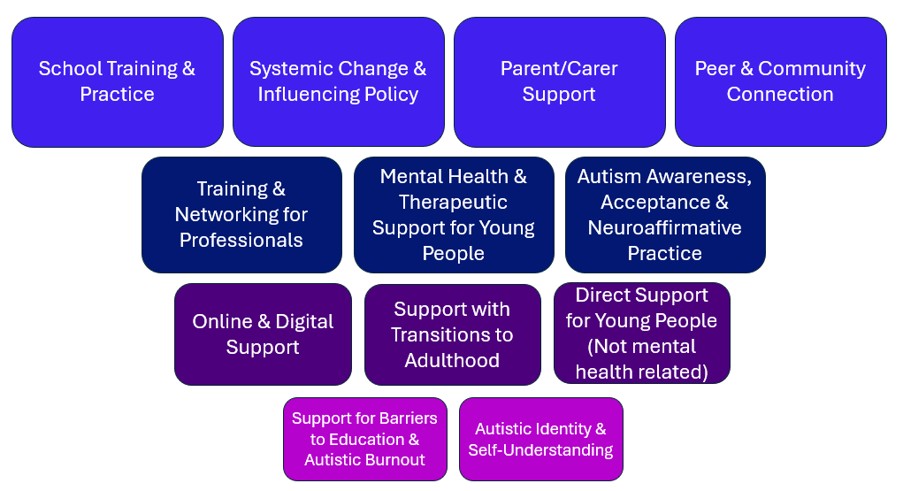
Your responses strongly emphasise a need for better autism understanding and inclusion in schools, with suggestions of training for school staff, better recognition of the challenges autistic children face at school, and the need for whole-school cultural change (e.g. autism-friendly environments, nurturing school policies, and better collaboration between families, schools, local authorities, and autism professionals). You told us that you want to see changes across the system, such as within the local authority, Ofsted, and at government level. Autistic children should be able to access support without an EHCP or formal diagnosis, with support available on a needs-led basis.
Support was requested for parents and families, including connecting with other parents and carers, guidance for navigating school systems, and recognition of the ongoing emotional burden that is experienced by parents and wider family members. Similarly, there was a strong emphasis on social connection for autistic young people, such as social groups (online and in person), and the opportunity to be part of a community of other autistic young people.
Support offered by the Wellbeing Hub
More information about the support we currently provide can be found on the website. This includes Family Wellbeing Courses, Parent & Carer meet ups, NeuroBears and NeuroCubs (autistic identity support) for children, monthly talks from autistic speakers, and a Special Interest Group (SIG) for professionals.

The Autism Wellbeing Hub, 06/29/2026