Exploring Place, Participation and Justice: An Upcoming Moment for Just Neighbourhoods?

Exploring Place, Participation and Justice: An Upcoming Moment for Just Neighbourhoods?

As the Just Neighbourhoods? project moves into its final phase, we’re preparing to bring together practitioners, policymakers, and academics a dedicated conversation about what our research has revealed.

Across the past two years, we have been working with neighbourhoods in the UK and Northern Ireland to understand why community-led planning remains unevenly taken up, what supports or hinders involvement, and how communities experience justice, voice and value as they engage with planning systems.

What is becoming increasingly clear is that community-led planning (in its broadest sense) does far more than shape local environments, it exposes the deep relationships between place, power, opportunity, and (in)justice. It shows us what communities strive for, what they struggle against, and what conditions help people feel able to influence the future of their neighbourhoods.

To support reflection on these questions, we’re hosting a small, invite-only policy symposium. This gathering will allow us to:

  • share our findings and tentative conclusions,

  • explore their implications for planning practice and policy,

  • consider what more equitable participation could look like, and

  • connect with others committed to creating fairer, more inclusive neighbourhoods.

Although the event itself has limited capacity, we are keen to ensure that the learning reaches as widely as possible.

Over the coming months, we will be sharing insights, resources, and reflections from the project here on our website.

If you are interested in the themes of the symposium or would like to hear more about our work, please feel free to get in touch:
tessa.lynn@henley.reading.ac.uk

Just Neighbourhoods? – What’s Coming Up

Just Neighbourhoods? – What’s Coming Up


As the Just Neighbourhoods? project moves into its final stages, our focus is shifting towards sharing emerging findings and building conversations with a range of audiences. Over the coming months the team will generate workshops, insight sessions, and ultimately a policy symposium that brings together insights from across the UK and Northern Ireland and  feature our findings.

Throughout these activities, we will be aiming to test ideas, spark debate, and support learning across neighbourhoods, practitioners, policymakers, and academics. Here’s an overview of what’s happening:


JN Collaborative Workshops (Autumn 2025)

This autumn, we’ll be holding four online workshops with neighbourhoods in England, Scotland, Wales, and Northern Ireland. These events will bring together participants from our case study communities to reflect on the realities of community-led planning (CLP) and to feed-back some initial thoughts and  findings.

These workshops will:

  • Share emerging findings from our fieldwork.
  • Explore the possibilities and limitations of CLP in addressing local injustices.
  • Create opportunities for cross-country learning between communities.
  • Invite participants to shape how project findings are disseminated back into neighbourhoods.

We hope that these discussions will provide invaluable feedback and help ensure that the project speaks directly to the lived realities of under-represented communities.


JN Practitioner Insight Seminar (January 2026)

Alongside the collaborative workshops, we are planning an insight seminar with the  UK and NI Planning Aid organisations. This will be an online event, which will record for wider access, aimed at professional planners and community development workers and  volunteers.

The seminar will:

  • Present comparative findings from across the four nations.
  • Highlight common challenges and opportunities for supporting underrepresented areas.
  • Explore actionable policy recommendations.
  • Open the door to possible cross-UK networks for knowledge exchange.


End-of-Project Symposium (February 2026)

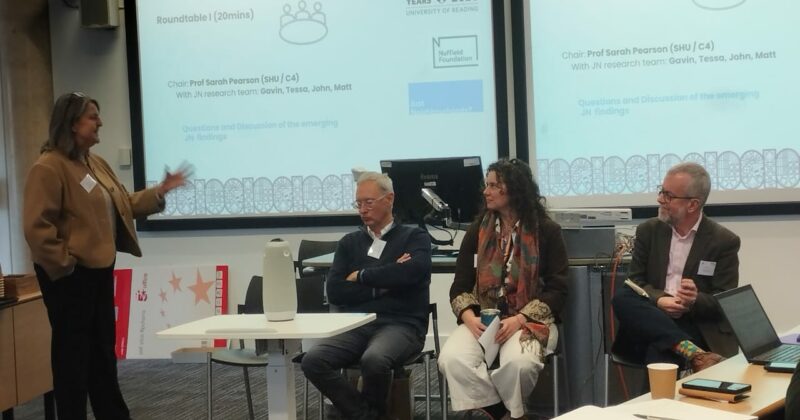
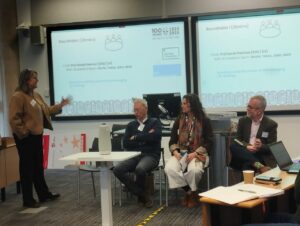
In early 2026, we will host a policy symposium to share the final findings of the project. This one-day event will gather invited participants across our audiences, including policymakers, practitioners, academics, and support organisations.

The symposium will:

  • Launch the project’s final report and associated outputs.
  • Convene roundtable discussions on planning and social justice.
  • Explore policy responses to the needs of underrepresented neighbourhoods.
  • Provide space for dialogue across research, practice, and policy communities.

This event will mark an important moment for consolidating the learning from Just Neighbourhoods? and identifying where it might go next.


Stay tuned to our website and social media channels for updates, blog posts, and resources as these activities unfold and  our findings emerge.


Back to the future? The Civil Society Covenant: a new era of civic values or business as usual?

Back to the future? The Civil Society Covenant: a new era of civic values or business as usual?

Back to the future? The Civil Society Covenant: a new era of civic values or business as usual?

Authors: Prof Gavin Parker and Dr Mark Dobson, University of Reading

On the 17th July 2025 the UK Government announced their policy for a ‘Civil Society Covenant’, setting out a ‘new principles-based arrangement for re-setting the relationship between UK Government and civil society’. This centres on a commitment to value a range of inputs made on a voluntary basis, whether this be in terms of time, money or knowledge. Such announcements relating to active citizens and the role of voluntarism are often presented by government to position civil society actors as “part of the fabric of our nation” and included in this embrace are a wide range of volunteers, groups, charities, faith organisations, co-operatives, trade unions, philanthropists, social enterprises and social investors. A very large chunk of society overall.

The ‘Covenant’ states that government will “promote participation and inclusion by involving people in decisions that affect their lives, ensuring their voices are heard and removing barriers to democratic participation”. This sets up a strong position, which appears to promote greater democratic engagement. Cutting to the chase then, the concern is that this type of political rhetoric can mask the reality of the main policy goals and agendas being pursued by administrations. The present government have made it clear that they intend to pursue a growth agenda – so how does this dovetail? The policy agenda of the David Cameron Conservative-led coalition government in 2010 brought us ‘Big Society’ and the Localism Act 2011 but this was accompanied by a wide and deep public sector austerity agenda and push to drive growth.

The Starmer-led Labour government – and its overall mission to deliver economic growth and 1.5 million homes by the end of the Parliament, and now this Covenant, is in many ways a continuation. If we take local environment and development as a focal point here, then we can see the ongoing discrepancy. The recent Planning and Infrastructure Bill has focussed on speed and delivery to unlock growth, and includes several measures that seek to actively reduce opportunities for public consultation and inputs (such as for large infrastructure projects and housing schemes), as well as limiting representative democracy, for instance by reducing the role of elected councillors. Something isn’t adding up somehow.
We can also note the recent withdrawal of funding for statutory neighbourhood planning – an important plank of the 2011 Localism Act. This has been a means for local people to have some control over development in their local area (but only where this supported additional development). A debate was held on the practical demise of this policy in Westminster just last week.​​While the Covenant contains a welcome message from government about the value of active civic engagement, the use of ‘community empowerment’ rhetoric and policy can be a cynical salve to avoid criticism for other more ‘important’ government objectives. The virtues of civic society are extolled by many politicians, these appear contingent and are typically channelled via pre-determined activities. And so, it is important to keep in view the broader system-wide policy agenda being pursued by the present UK government. While the recently published Devolution and Community Empowerment Bill will provide more opportunities for local representation through mayors, the reintroduction of strategic planning and local government reorganisation raises further questions around how ‘effective neighbourhood governance’ and ‘democratic participation’ will fit; more work for the ongoing Independent Commission on Neighbourhoods to consider.

​Beyond questions of the relative importance placed on active citizenship and community engagement, we might also be concerned about the increase of unpaid labour among the population in the face of growing economic insecurity and inequality. There is a clear ethical and moral dimension here – the encouragement of voluntarism appear benign but unfulfilled claims regarded democratic engagement and exploitation of volunteer time will only further serve to undermine public trust. Rather than ‘resetting’ the relationship between people and government this can deepen a worrying divide. Following sustained government promises that have often fallen short of the mark over the past half century we would advise a very cautious scepticism here and simultaneously encourage civil society actors to voice about the need to keep government accountable across policy fields given such offerings.

Both authors are based in the Department of Real Estate and Planning, University of Reading and have been researching neighbourhoods, citizenship and planning matters extensively. Their contact details are:
Gavin Parker: g.parker@reading.ac.uk
Mark Dobson: m.e.dobson@reading.ac.uk

Also published here: CPA Blog | Community Planning Alliance

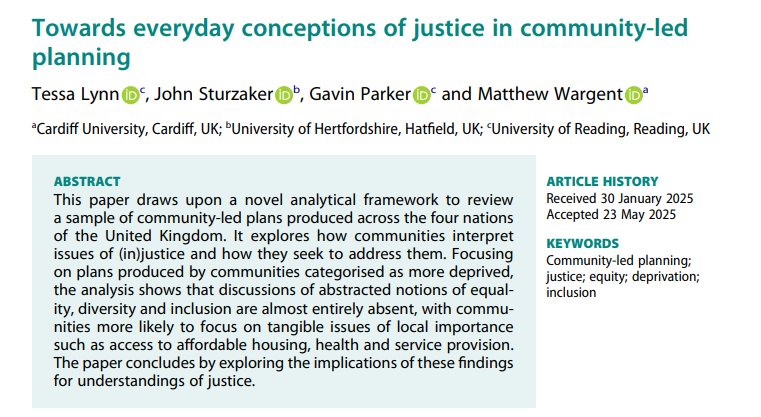
Journal paper: Towards everyday conceptions of justice in community-led planning

Journal paper: Towards everyday conceptions of justice in community-led planning

Our latest article has been accepted—post peer review—for publication in Planning Practice & Research:

The paper draws upon a novel analytical framework to review a sample of community-led plans produced across the four nations of the United Kingdom. It explores how communities interpret issues of (in)justice and how they seek to address them. Focussing on plans produced by communities categorised as more deprived, the analysis shows that abstracted notions of equality, diversity and inclusion are almost entirely absent, with communities more likely to focus on tangible issues of local importance such as access to affordable housing, health and service provision. The paper concludes by exploring the implications of these findings for understandings of justice.

Keywords: Community-led planning, justice, equity, deprivation, inclusion.

Link to paper, coming soon.


Think Neighbourhoods, ICONs interim report

Think Neighbourhoods, ICONs interim report

The Independent Commission on Neighbourhoods has worked with Oxford Consultants for Social Inclusion (OSCI) to identify which neighbourhoods are most at risk of not achieving the government’s missions.

In this report ICON explores attitudes in these neighbourhoods through polling done by Public First, arguing that a targeted approach is needed to improve disadvantaged neighbourhourhoods and achieve national renewal.

The report can be found here:

Frontier Economics – The Evidence for Neighbourhood Focused Regeneration

Frontier Economics – The Evidence for Neighbourhood Focused Regeneration

A publication published in March 2025 by ICON combines the findings from the reviews that answers the following questions:

1. How should a neighbourhood and a neighbourhood intervention be defined?
2. Why do neighbourhoods matter?
3. How do people experience living in the most deprived neighbourhoods?
4. What are the interventions and/or delivery mechanisms that have had most social and economic impact at the neighbourhood level?
5. What does this mean for building an effective neighbourhood policy both nationally and at regional and local authority levels?

You can access there report here.

Launched in September 2024, the Independent Commission on Neighbourhoods will review the current state of neighbourhoods across England.

You can find out more here – Independent Commission on Neighbourhoods

Planning reforms – Planning and Infrastructure Bill 2025

Planning reforms – Planning and Infrastructure Bill 2025

The Planning and Infrastructure Bill, which was introduced to Parliament on the 11th March 2025 introduces measures in an attempt to speed up planning decisions to boost housebuilding and the delivery of vital developments like roads, railway lines and windfarms. The government aims to l boost economic growth, connectivity and energy security whilst also delivering for the environment, with this new Bill.

‘Biggest building boom’ in a generation through planning reforms – GOV.UK

Plan for neighbourhoods – March 2025

Plan for neighbourhoods – March 2025

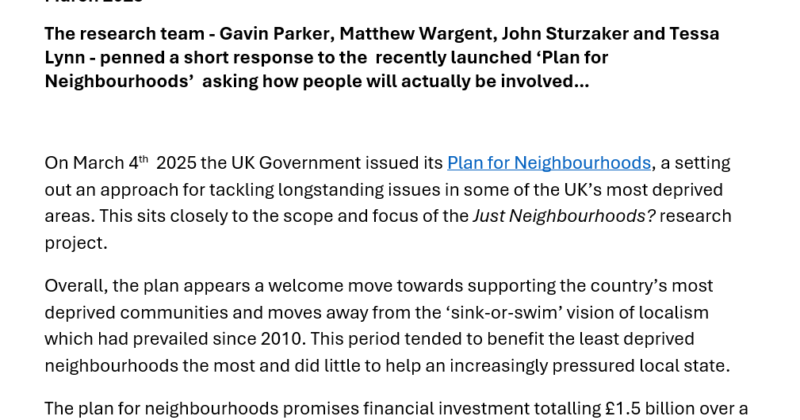
This week, the Government issued its Plan for Neighbourhoods, a prospectus for tackling longstanding issues in some of the UK’s most deprived areas. The plan promises up to £20 million for each of the selected 75 neighbourhoods. This amounts to a significant injection of funds designed to rejuvenate physical infrastructure, repair fractured and mistrustful communities, and drive economic growth.

Overall, the plan is a welcome one. It promises significant investment totalling £1.5 billion over a 10-year timeframe. It also signals a welcome return to supporting the country’s most deprived communities, moving away from the sink-or-swim vision of localism witnessed since 2010.

https://www.gov.uk/government/publications/plan-for-neighbourhoods-prospectus-and-tools/plan-for-neighbourhoods-prospectus

Content review: What Plans to consider?

Content review: What Plans to consider?

Content review: What Plans to consider?

Our content review is well underway now. The sample of plans selected are made up of under-represented places in the UK’s four constituent nations. The aim is to assess the coverage of issues in existing plans and identify and understand key issues and policies as developed by communities. 

So far, the review process has involved two stages: 

Stage 1: Sift 

This is where the scoping and nominating areas formed the first stage or Local Authority ‘sift’. We adopted a slightly different approach for the four nations. This was a necessary and pragmatic approach given the scale of CLP activity across England, the smaller number of Local Authorities across Wales, NI and Scotland means we have had the capacity to assess all local authority areas in the stage one sift.    

For England, in addition to the IMD data, we drew on the work by OCSI and Local Trust (2019) who identified 225 left behind neighbourhoods (wards) in England – although such categorisation is imperfect and a wider debate over contested framings of ‘left behind’ places (Natarajan and Cho, 2022; Pike et al., 2023) is recognised. We created a long list of Local Authorities that feature LBPs, as well as the top 20% of IMD areas to ensure that the review stayed in scope and was made manageable, this created a list of 98 Local Authority areas  We additionally searched for any NDPs beyond that sift which overtly discussed social / spatial (in)justice questions (see WP1a/b).   

Stage 2: Sample 

The initial preparatory work gave an initial estimate that the number of Plans to be reviewed in total (stage 3) across the four nations with around 45 in England; 25 in Scotland; Wales around 15 and a similar number in Northern Ireland.  

For stage 2, the intention was to identify neighbourhood planning activity within the most deprived Local Authority areas across England. For England, there were up to 49 eligible LPA areas who fitted the criteria of recorded disadvantage and who had been engaging in neighbourhood planning.  All 321 neighbourhood areas participating in NP in those LPAs were identified and correlated with the IMD LSOA data. Those that featured an LSOA which was located in a 10% (decile) or 20% (quintile) most deprived areas, were identified and this led neatly to the 45 plans to review. 

The sample across the other nations are: 

  • All Local Place Plans in Scotland (with a latter focus on the highest 20% of SIMD (2020)  
  • All Place Plans in Wales (with a latter focus on the top quintile according to WIND data)  
  • All 11 Local Authority areas in Northern Ireland (producing Community Plans), and particularly focusing on ‘Place Plans’, and a spot check sample of Neighbourhood Renewal Area (NRA) Plans.