
The KIARA project was delighted to see another successful field school take place on 12 May at the Experimental Agricultural Farm in Brody, operated by Poznań University of Life Sciences, one of KIARA’s key project partners.
Bringing together almost 80 participants, the event provided a valuable opportunity to explore how innovative regenerative agriculture practices and precision farming technologies are being applied in real-world farming conditions. The field school reflected the strong interdisciplinary collaboration between researchers from the Faculties of Mechanical Engineering and Environmental Engineering, and Agriculture, Horticulture and Biotechnology at Poznań University of Life Sciences.
Participants visited three thematic stations, each demonstrating different aspects of sustainable agricultural management. During the first session, farm manager Radosław Świergiel introduced the regenerative practices currently implemented at the Brody farm and explained how these approaches are integrated into everyday farm operations. Visitors also had the opportunity to tour the farm’s newly established vineyard and enjoy the unique historical surroundings of the estate.
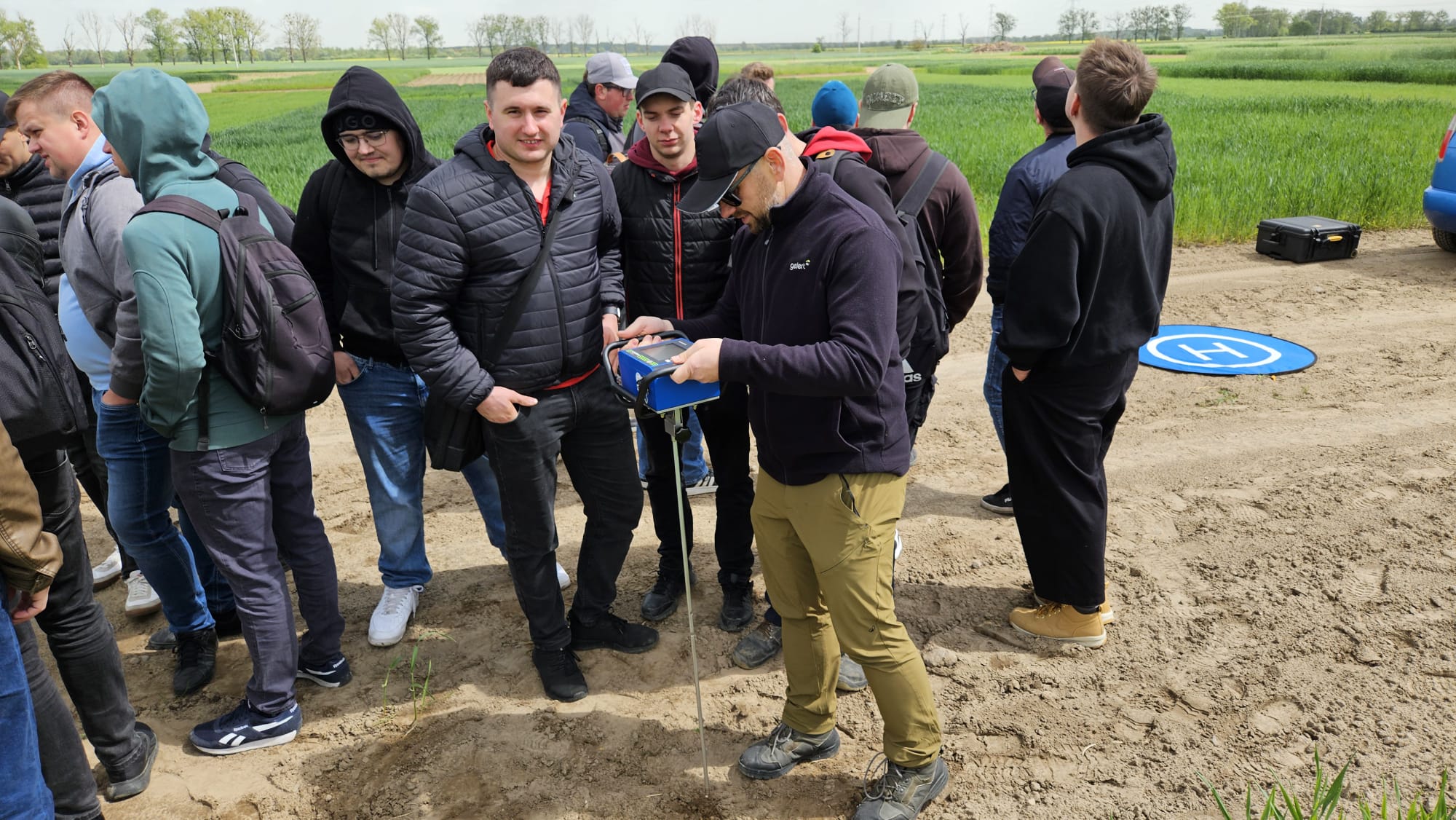
A second station focused on precision agriculture technologies. Through collaboration with Agrotechnology, participants were able to observe how modern tools, including satellite imagery, drones and soil scanners are used for soil sampling, field mapping and crop monitoring. Practical demonstrations allowed visitors to engage directly with the equipment and gain first-hand insight into how technologies such as NDVI analysis can support more informed decision-making in regenerative farming systems.
The final thematic area explored nutrient management and crop rotation strategies. Drawing on long-term field experiments conducted at Brody, researchers demonstrated the importance of balanced fertilisation, natural nutrient sources and carefully designed crop rotations for maintaining soil health and supporting sustainable crop production.
The University of Reading is proud to see the outstanding engagement and expertise demonstrated by our Polish partners in delivering events such as this. The field school showcased not only innovative research and practical farming solutions, but also the collaborative spirit that lies at the heart of the KIARA project. By bringing together researchers, practitioners and stakeholders, these activities help accelerate knowledge exchange and support the transition towards more resilient and sustainable agricultural systems across Europe.
We congratulate the entire team at Poznań University of Life Sciences and all contributors for organising such a successful and inspiring event.