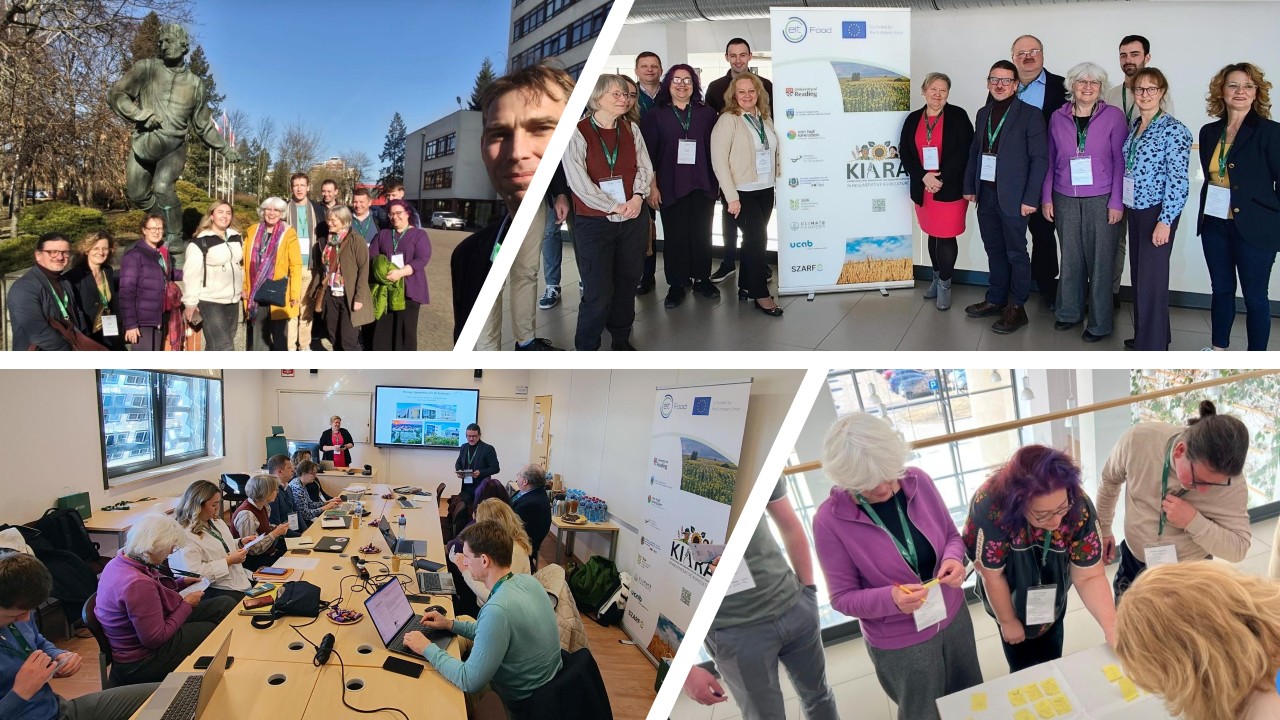

From 3rd to 5th March 2026, the KIARA project team were delighted to take part in the latest KIARA (Knowledge and Innovation for Advisory Services in Regenerative Agriculture) project meeting, hosted by the Faculty of Agriculture, Horticulture and Biotechnology at Poznań University of Life Sciences (PULS).
The University of Reading team was pleased to come together with partners from Ireland, the Netherlands, Germany and Ukraine to reflect on progress and plan the final phase of this initiative funded by the EIT Food.
We would like to extend our sincere thanks to our hosts at PULS for their outstanding hospitality, warm welcome and excellent organisation throughout the visit. The facilities provided created an ideal environment for productive discussions, collaboration and knowledge exchange. The carefully organised farm visits to Brody and Przybroda were a particular highlight, offering valuable, real-world insights into long-established sustainable practices, including effective crop rotation systems.
Alongside the main meeting, activities taking place between 2–6 March 2026 helped set the scene for the development of the VPA (Virtual Peer-to-peer Academy) as a space for learning. These included a kick-off session designed to activate existing knowledge and support stakeholder selection, as well as a dedicated workshop which led to the formulation of diversity criteria to be embedded in the VPA design.
These visits and sessions brought the principles of regenerative agriculture to life, reinforcing the importance of practical, field-based learning alongside academic and advisory development.
The KIARA project continues to focus on strengthening the role of agricultural advisors, who are central to supporting farmers in transitioning towards more regenerative and sustainable practices.
The meeting at PULS marked an important milestone as we move into the final year of the project. The University of Reading team looks forward to continuing this strong collaboration with all partners and delivering impactful outcomes that will support the future of regenerative agriculture across Europe.
Once again, we are very grateful to our colleagues at PULS for hosting such a successful and inspiring meeting.