

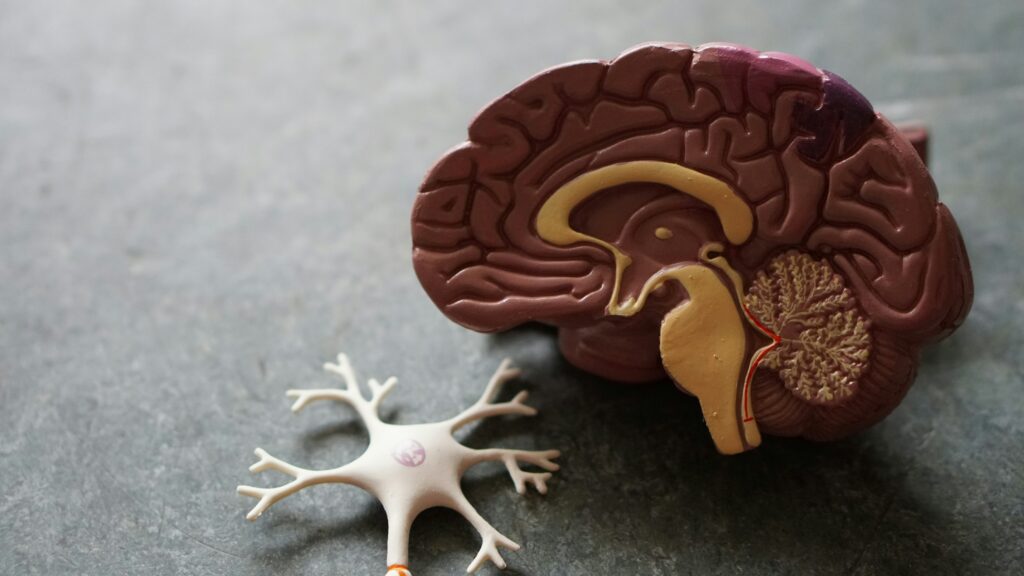
In this blog for World Alzheimer’s Day, Samrah Ahmed, Associate Professor in Clinical Neuroscience, explains how young-onset Alzheimer’s disease often goes undiagnosed and how simple bedside tests could help identify it earlier.
When most of us hear “Alzheimer’s disease”, we imagine an older person forgetting names or misplacing keys. But young-onset Alzheimer’s disease, diagnosed before age 65, presents with a wider range of symptoms than late-onset dementia and often without the memory problems we typically associate with Alzheimer’s disease. This difference can delay diagnosis, disrupt lives and leave families in limbo. It also means those affected are likely to need different support to older people.
In the UK today, approximately 70,800 people are living with young-onset dementia – that’s about 7.5% of all people with dementia. This figure has surged since 2014, highlighting both growing recognition and the scale of unmet need. Younger individuals face, on average, 4.4 years from the onset of symptoms to receiving a diagnosis, almost double the time it takes for older people. In the meantime, many see up to five different consultants before finally gaining the clarity of a diagnosis. In England alone, it is estimated that over 19,000 people with young-onset dementia remain undiagnosed and unsupported.
The diagnostic blind spot
One of the central challenges is that young-onset Alzheimer’s disease does not always look like the “textbook” version of the disease. For many people, memory is not the first or even the most troubling symptom. Instead, younger people may initially experience changes in vision, language, movement, balance or coordination.
While young-onset Alzheimer’s disease can present in many ways, there are two forms that are more common and that we have a deeper understanding of. Between 5 –10% of people with young-onset Alzheimer’s disease present with Posterior Cortical Atrophy (PCA), a form of Alzheimer’s disease that primarily affects the back of the brain, disrupting visual and spatial processing. Everyday activities that rely on sight, such as reading, navigating or judging distances, can suddenly become confusing or unreliable, even when a person’s eyes are perfectly healthy.
A second form of young-onset Alzheimer’s disease is called Logopenic Primary Progressive Aphasia (LvPPA), and here the earliest changes are in language. Conversations may feel harder to follow, stories may become disjointed, or word-finding difficulties creep in long before memory noticeably falters. In some cases, changes in planning, decision-making or even behaviour dominate the early picture.
Because these symptoms do not match the stereotype of forgetfulness, people are often misdiagnosed – sometimes their symptoms are attributed to stress and other times to depression or anxiety. One study found that over a quarter of people with young-onset dementia were first told they were experiencing changes in their mental health , prolonging the uncertainty and delaying access to vital support.
Capturing the early clues
Young-onset Alzheimer’s disease often strikes at a profoundly challenging stage of life – when people are in the middle of their careers, raising children or caring for elderly parents. A delayed or inaccurate diagnosis can have devastating consequences: jobs may be lost, family dynamics upended and access to support delayed or denied altogether. Without a clear explanation, people are left to navigate these difficulties alone, often feeling disbelieved or dismissed.
At Reading, my lab is working to better understand the atypical changes that can mark the earliest stages of young-onset Alzheimer’s disease. Our goal is to identify how these symptoms first appear and to develop practical tools and guidelines to support early diagnosis in clinics. By profiling signs that are too often overlooked, we aim to give clinicians and families a clearer picture of how Alzheimer’s disease can begin in younger people and, ultimately, to improve diagnosis.
One recent focus has been limb apraxia – the loss of skilled movements and the ability to plan or sequence them. Despite being straightforward to assess, apraxia has received little attention in either clinical practice or research. Testing requires almost no resources or specialist training. A doctor might simply ask a patient to mimic gestures such as giving a thumbs-up, waving goodbye or raising only the index and little finger.
We investigated this in a retrospective study of patients at their very first visit to a cognitive disorders clinic (sometimes called a memory or dementia clinic). The cohort included people with amnestic Alzheimer’s disease (where memory loss is most prominent), posterior cortical atrophy (marked by visual difficulties), logopenic primary progressive aphasia (characterised by language changes), and a comparison group whose cognitive concerns were related to healthy ageing rather than Alzheimer’s disease.
The results were striking. Limb apraxia was common across the Alzheimer’s spectrum – in typical amnestic Alzheimer’s, posterior cortical atrophy and logopenic aphasia – appearing alongside each group’s more characteristic difficulties in memory, vision or language. This shows that while these forms of young-onset Alzheimer’s disease each have their own clinical signature, they also share an overlooked overlap in limb apraxia. In other words, apraxia can serve as a unifying marker of Alzheimer’s disease, even when memory problems are not the first symptom. This makes sense when we consider the underlying brain systems. Apraxia depends on healthy function of the parietal lobes, located towards the back of the brain. These regions are affected very early in Alzheimer’s disease, as well as in posterior cortical atrophy and logopenic aphasia.
Furthermore, our study showed that the presence of limb apraxia alone could distinguish Alzheimer’s disease in its typical amnestic form and less common posterior cortical and logopenic forms, from other dementias. In particular, we could distinguish our Alzheimer’s patients from patients with frontotemporal dementia with 83% accuracy. That means a simple, low-cost bedside test could be a powerful tool for differential diagnosis. While apraxia is not usually thought of as an Alzheimer’s symptom, our findings suggest that in the majority of young-onset cases, it signals the very earliest stages of the condition.
A call for awareness
This World Alzheimer’s Day is an opportunity to broaden our understanding. Alzheimer’s disease is not always about memory loss, and in younger adults it often looks very different. By recognising the importance of changes in motor skills, language and vision, alongside the more familiar memory symptoms, we can begin to shorten the long diagnostic journey faced by so many. Greater awareness will mean earlier referrals to specialist services, better assessments that capture more than memory, and families who feel validated in their concerns.
Support and resources for individuals and families are available through:
- Dementia UK
- Young Dementia Network
- Younger People with Dementia
- Alzheimer’s Society
- Alzheimer’s Research UK
Cover photo by Robina Weermeijer on Unsplash