
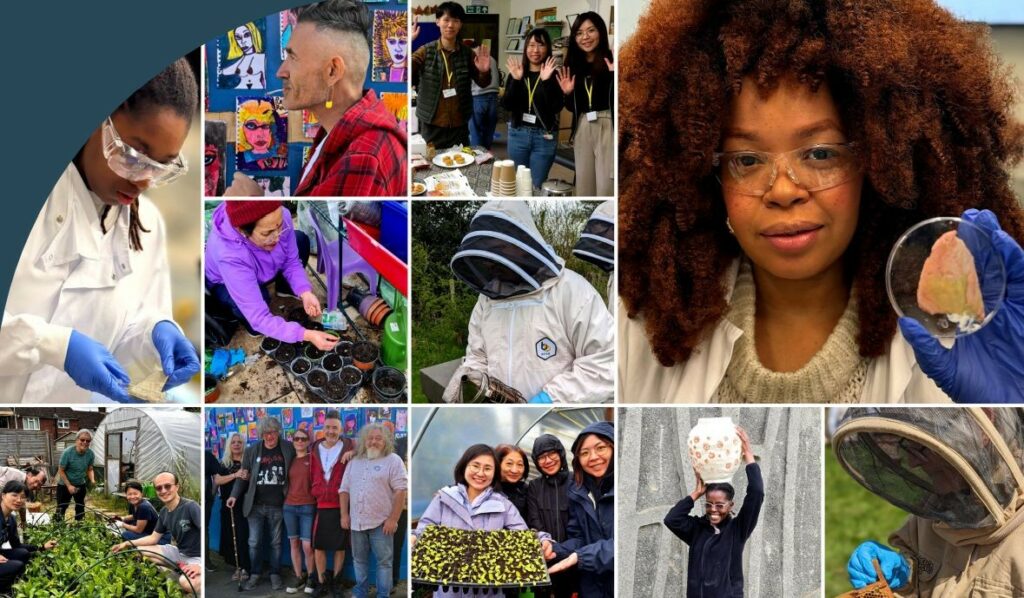
Across Reading and Slough, community groups spent the past three years leading research on issues that matter to them and, in doing so, reshaped how we think about ethics and impact. In this blog, Dr Alice Mpofu-Coles and Dr Sally Lloyd-Evans reflect on the lessons they learned from this experience and years of work in community-led research.
Over the past three years, we’ve been working with community organisations in Reading and Slough through the Community Led Research Pilot (CLRP). Together with community leaders, researchers, funders and local partners, we explored what it really takes to put communities in the driving seat of research, not as participants, but as decision-makers, knowledge holders and leaders.
The pilot offered us space to reflect on and revisit two enduring questions that have framed our practice over the years:
- What does good ethical practice actually look like in community-led research?
- And what needs to change if this way of working is to become the norm rather than the exception?
This blog brings together our reflections on ethics, power and lessons learned – not as a checklist of “best practice”, but as an honest account of what community-led research asks of institutions, researchers and funders.
Ethics is not just a form – it’s a daily practice
In universities, ethics is often treated as a procedural step: a form completed at the start of a project, reviewed by a committee, then filed away. But in community-led and participatory action research, ethics doesn’t work like that.
When research is rooted in people’s lived experiences – often involving inequality, health, migration, identity or community trauma – ethical challenges don’t appear once. They emerge every day, in conversations, decisions, relationships and moments of uncertainty.
For us, ethical practice in community-led research is less about compliance and more about care. It means asking difficult questions repeatedly: ‘Who holds power here?’, ‘Whose knowledge is being valued — and whose is being overlooked?’, ‘Who benefits from this research, and who takes the risks?’
Good ethics, we’ve learned, is relational. It’s built through trust, honesty, humility and time. It shows up in how we listen, how we share decisions, how we handle conflict, how we pay people for their work, and how we acknowledge contributions.
This kind of “everyday ethics” can’t be imposed from above. It has to be co-created with communities, shaped by their priorities, histories and expectations and revisited as projects evolve.
Learning to slow down
One of the strongest lessons we’ve learned is about time. Building meaningful relationships with communities, especially those who have experienced extractive or tokenistic research in the past, cannot be rushed. Trust takes time. Co-design takes time. Understanding place, culture and context takes time.
Yet many research programmes are shaped by short funding cycles, rigid milestones and pressure to produce quick outputs. Over the years, we saw how this tension played out: projects thrived where there was space to build relationships early and struggled where timelines compressed co-design into a narrow window.
Community-led research requires a different rhythm. It asks institutions to value process as much as outcomes, and to recognise that time spent listening, reflecting and adapting is not a delay – it is the work.
Valuing lived experience as expertise
A central aim of community-led research is to challenge the idea that expertise sits only within universities. Community leaders bring deep knowledge of their contexts whether that is cultural practices, environmental challenges, health inequalities or everyday barriers faced by their members. When communities lead the research questions, the work becomes more relevant, grounded and actionable.
But valuing lived experience isn’t just about saying the right things. It has practical implications: who is paid, who is named as an author or creator, who owns the outputs, and who decides how findings are shared.
Across the work we do, we’ve seen how uncertainty around ownership, credit and intellectual property could create anxiety or friction, especially where institutional systems default to academic norms. Clearer conversations earlier on about ownership and recognition would have helped everyone feel more secure and respected.
Place matters, and local partners make it possible
Another key lesson is that community-led research is always place-based. Even places that are geographically close, are socially and culturally distinct. What works in one place doesn’t automatically translate to the other. Trusted local partners, such as voluntary and community sector organisations, play a vital role in bridging these differences, offering insight, networks and credibility that universities alone often lack.
Community-led research doesn’t happen in isolation. It depends on ecosystems of support, built on long-term relationships rather than project-by-project engagement.
Institutional systems can enable or block ethical practice
While community-led projects generate rich learning and positive experiences, they also reveal how existing university systems can unintentionally undermine ethical intentions.
Processes for payments, contracting, ethics approval and intellectual property are rarely designed with community partners in mind. Delayed payments, complex paperwork or inflexible procedures can place real strain on small organisations, even when everyone involved is acting in good faith.
If community-led research is to flourish, institutions need to change. That means rethinking systems so they are accessible, flexible and fair and recognising that ethical practice is shaped as much by infrastructure as by values.
Outcomes should serve communities not just institutions
Communities care deeply about what happens next. Traditional academic outputs like papers, reports and presentations matter within universities, but they are not always the most useful or accessible forms for communities. Creative outputs, practical tools and local actions often have greater value, especially when communities are credited and supported to use the findings beyond the life of a project.
Legacy doesn’t happen by accident. It needs to be planned for from the beginning, with communities shaping what success looks like and what sustainability means on their own terms.
What we’re taking forward
The Community Led Research Pilot showed us what’s possible when trust is prioritised and power is shared. It also showed us how much still needs to change.
Community-led research cannot rely on goodwill alone. It requires flexible funding, realistic timescales, supportive institutional systems, and a commitment to ethics as a living, shared practice.
If we want research that is more just, more inclusive and more impactful, we need to stop asking how communities can fit into existing research structures and start asking how those structures can change to support communities.
That’s the challenge we are left with. And it’s one we believe is worth taking seriously.
For a deeper dive into our learnings and reflections, please explore our articles:
Mpofu-Coles, A. & Lloyd-Evans, S. (2025) “What does ‘good’ ethical practice look like? Navigating everyday ethics in PAR & Community Led Research”, Available at: https://research.reading.ac.uk/community-based-research/what-does-good-ethical-practice-look-like-navigating-everyday-ethics-in-par-community-led-research/
Lloyd-Evans, S., Mpofu-Coles, A. & Burrows, M. (2025) “Community Led Research Pilot: Reflective summary & learnings”, Available at: https://research.reading.ac.uk/community-based-research/community-led-research-pilot-reflective-summary-learnings/
Mpofu-Coles, A. (2025) “Working with students on PAR: Reflections and recommendations”, Available at: https://research.reading.ac.uk/community-based-research/working-with-students-on-par-reflections-and-recommendations/
To find the CLRP evaluation resources and community project outputs, read more about the Community Led Research Project Evaluation.