


Professor Tom Oliver, applied ecologist and author of The Nature Delusion, argues that tackling ecological breakdown depends on rebuilding a deeper sense of connection between people, communities and the natural world.
It has become clear that modern civilisation is no longer a civilising force. Despite negative impacts on the natural world being well evidenced for decades, our modern society continues to destroy nature, through a highly extractive economy and the pollution it creates. Now, the damage has become so severe that the basis of our civilisation is at risk. Damage to nature is generating ‘systemic risks’ such as food insecurity, geopolitical strife, and creating a potentially uninhabitable climate.
From a dynamic perspective, we are locked into vicious cycles, since every disaster costs vast amounts to recover from, as well as reducing trust in governance, impacting health and well-being, and weakening ecosystems further. In technical parlance, our financial, social, human and natural capital are being eroded, meaning our capacity to respond to future catastrophes is weakened.
What are the current solutions to get us out of this dilemma? Governments around the world tend to focus their policies on technological innovation. For example, to enhance food production we seek to use precision farming, genetic modification, and robotic pollinators. We also see many economic solutions being touted, such as monetising biodiversity to inform biodiversity offsetting schemes and to inform global markets, which may (or may not) redirect financial capital from supporting ecocidal activities.
These solutions haven’t worked so far and may actually make things worse (particularly when they are not accompanied by deeper changes in culture). For example, it turns out that economic solutions that treat nature as a lifeless asset actually increase our psychological disconnection and make us care less. They replace doing things for the morally right reason, with a transactional relationship. Similarly, technological fixes just kick the can down the road, suggesting we don’t need to solve the root cause now.
Take geoengineering to address climate change, as an example. There are visions of storing carbon underground at a massive scale (incidentally, all the scenarios for limiting global warming to 1.5 degrees Celsius depend upon such wishful thinking). More recently, intercepting solar radiation is being explored by governments. These solutions delay dealing with carbon emissions now and distract from the underlying causes such as our extractivist and consumerist economy. They also generate massive risks because they will likely disrupt weather systems around the world, leading to further geopolitical strife.
So, how can we provide genuine solutions to deal with the proliferation of these systemic risks? A number of international science-policy agencies are beginning to reach consensus that we need a deeper shift in our mindsets and values- collectively, our culture– if we are to shift the dial on these wicked problems. For example, a recent report from the Intergovernmental Platform for Biodiversity and Ecosystem Services (IPBES) highlights three, interrelated, root causes of environmental crisis as “1) disconnection from and domination over nature and people, along with 2) concentration of power and wealth; and 3) prioritisation of short-term, individual and material gains”. All these relate strongly to the culture we live in. They suggest we need to ‘fix ourselves’ in order to make progress on the nature and climate crises.
Other reports from the, the UN Environment Programme, UN Development Programme, the European Environment Agency and many other credible bodies make similar conclusions. Yet, despite governments ratifying reports like the IPBES one, there is a near complete absence of concrete plans to catalyse these changes.
So, here’s the big question: how can we shift our modern culture from one that fuels a planet-wrecking economy (with its underpinning ecocidal finance, legal and governance systems), to one that enables us to live in a more harmonious balance with the Planet’s natural processes? Fortunately, there is growing understanding of ways by which we can deepen our sense of connection to each other and the natural world (something that is fully commensurate with modern science). What’s more, these approaches also enable a culture of sufficiency, that is less dependent on extrinsic material gains. Practical approaches range from meaningful experiences in nature (such as painting, photography, mindfulness), to knowledge-based and introspective activities (reading, group learning, meditation), and even include the cautious use of new technologies.
The biggest scientific challenge of our time, I believe, (even though it’s still off the radar of most governments and mainstream research funders) is how we can critically assess the evidence for these approaches, helping us to refine and combine them into evidence-based developmental programmes.
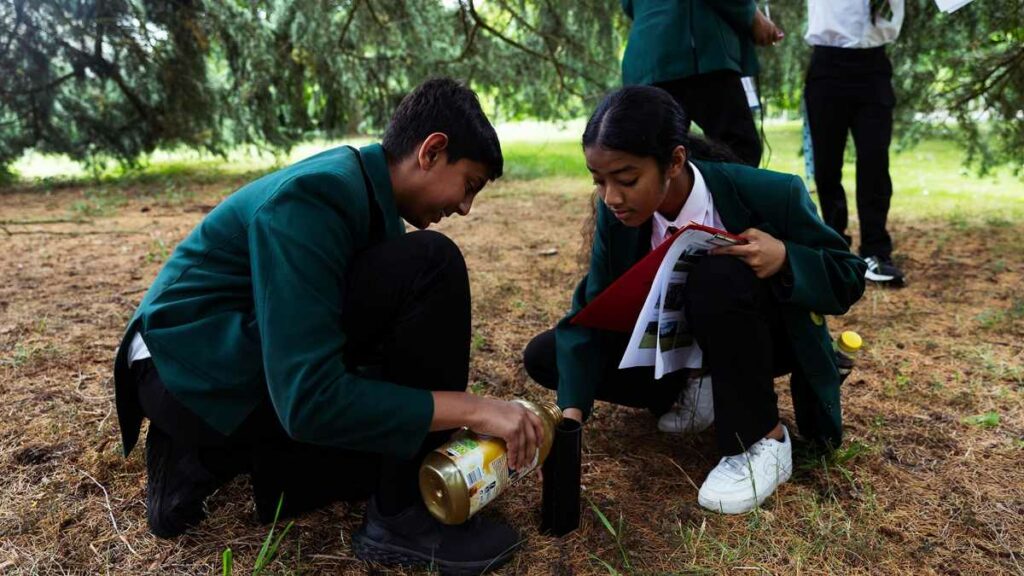
There are some promising developments that can be built upon. For example, to help reconnect children with nature there are excellent initiatives from the RSPB and Wildlife Trusts and many pioneering schools; to help businesses put nature at the heart of their organisational design, there are new frameworks emerging; and, to develop new governance approaches that move beyond a misplaced sense of human exceptionalism, there are exciting innovations exploring the legal Rights of Nature.
Learning from such bright spots, we may just be able to create a wiser culture, where behaviors to restore nature are the norm. These cultures also ‘cascade upwards’ to new structures for governing our economies. In my more hopeful moments, I believe we can learn lessons from older cultures, from modern science and from our own deep introspection, in order to reorient civilisation to be a civilising force once again.
Professor Tom Oliver’s book The Nature Delusion is out now. Read an extract or purchase the book through Bristol University Press.
Feature photo by Jessica Christian on Unsplash.