

Dr Jorge Avaria-Llautureo, Postdoctoral Research Associate at the University of Reading, tells how a novel method decodes ancient fossil records to reveal where our closest relatives truly began, and why it matters for understanding evolution and species’ responses to climate change.
For more than four decades, the textbook answer to where primates came from has been the same: warm, wet tropical forests. Known formally as the “warm tropical forest hypothesis”, this idea holds that our earliest ancestors originated, radiated and dispersed within lush tropical canopies at northern latitudes. It feels intuitively right – after all, most of the world’s primates today live in the tropics.
When I joined Professor Chris Venditti’s lab at the University of Reading in 2022 to work on primate evolutionary history, I read through stack after stack of books and papers making exactly this case. But our study overturns this foundational assumption, revealing that the primate story is far stranger, and far more interesting, than anyone imagined.
The warm tropical forest hypothesis rests on two main sources of evidence: the fossil record in northern latitudes, and plant and leaf impressions used to infer ancient climates.
Both, it turns out, have significant limitations. Fossils tell us where creatures were preserved – not necessarily where their ancestors actually lived. A sparse tropical fossil record may simply reflect poor preservation conditions rather than an absence of animals. Plant impressions, meanwhile, provide only point-in-time climate snapshots rather than the sustained picture needed to characterise a habitat.
At the time, I was working with Dr Andrew Meade (co-author) and Professor Venditti on the Geo Model: a revolutionary method to determine the precise locations of ancestral species. It was, I realised, exactly the tool needed to put the warm tropical forest hypothesis to a proper test for the first time.
A revolutionary method: The Geo Model and ancient paleomaps
For decades, biogeographers have studied where species lived using methods that divide the world into fixed “boxes” containing discrete areas such as continents. While useful for many questions, these approaches have fundamental limitations: they ignore the spherical nature of our planet, do not consider the reality of drifting continents, assume similar dispersal ability for most lineages, and cannot provide the precise location of ancestral species within the fixed “boxes”.
The Geo Model does something different, letting us address questions in a far more nuanced way. It models dispersal as a continuous process across a spherical Earth while explicitly incorporating ancient paleomaps and allowing variable dispersal rates across lineages and time. For the first time, we could reconstruct ancestral locations as precise latitude and longitude distributions, extract the paleoclimate data those ancestors experienced, and quantify how far and how fast lineages moved through evolutionary time.
Cold comfort: what the data actually showed
When we applied the Geo Model to the most comprehensive primate phylogeny assembled to date, covering 404 primate species including 361 fossils, the results stopped us in our tracks. The plot showed the most recent common ancestor of primates – living in North America, 66 million years ago – experiencing what appeared to be a distinctly cold, seasonal climate, with mean annual temperatures of around 10 degrees Celsius. I still remember my co-author Dr Thomas Püshel looking at one of my first plots and saying, “I think that is not right.” I had my doubts too. After all, every textbook and scientific paper told us that primates originated in hot, humid tropical jungles. But the data told a different story, and we kept following it.
The core problem was that nobody could agree on how to define ancestral climates for primates. I discovered at least 10 different definitions scattered through the literature, from “tropical rainforest” to “lush forest” to “wet forest”. Eventually, I found the Köppen-Geiger climate classification system combined with rich paleoclimate data on monthly temperature and precipitation. Using this rigorous framework, I extracted the actual Köppen-Geiger climate for every ancestral primate location.
When I showed these results to Chris, I couldn’t contain my excitement: “Look what I found! Most ancestral primates were in cold and temperate climates.” He asked the critical question: “Do you get tropical climates when applied to living primates?” The answer was yes.
That consistency was the breakthrough, and we started to think about a new hypothesis to connect the chain of events.
The struggle to publish
Publishing this finding proved to be one of my career’s most challenging and discouraging – but ultimately rewarding – experiences. Some reviewers seemed to dismiss the work outright, arguing that four decades of accepted wisdom could not be wrong. Others engaged constructively but pushed hard on methodology and data quality, expressing concerns about the Geo Model, the phylogenies we were using, and the bias in the fossil record.
I was convinced that our study was sound, and I remained committed to the principle that robust evidence must take precedence over long-standing, non-evidence-based opinions. So, we got ready to work on additional ways to test the robustness of our result to many sources of uncertainty. We conducted many additional analyses, tested for potential biases and explored uncertainties in the fossil record.
The manuscript evolved to be stronger, and when looking at what drove species movement, we discovered something truly remarkable. As the local climate changed rapidly in the north, only the primates that could move fast survived. They headed south into tropical areas. The ones that couldn’t keep up died out. And that is why most of the world’s extant primate diversity is found in the tropics today. The paper was finally accepted at PNAS in June 2025, more than a year after first submission.
Big implications
Since publication, the response has been extraordinary, spreading through news outlets, blogs, social media, podcasts, radio, and television. The scientific community shows tremendous enthusiasm for both the discovery and the Geo Model methodology. Researchers are already applying it to other groups, from plants to animals, to answer similarly intractable questions.
This work demonstrates that climate and environment are fundamental drivers of evolution, speciation and extinction. The evidence allows us to conclude that species with greater capacity to disperse and adapt persist when climates change rapidly. For conservation, this has big implications: which species can move fast enough to track shifting habitats? The primate story suggests rapid environmental change acts as a filter in which only the most mobile and adaptable populations survive.
I am profoundly convinced that methodological innovation like this is essential if we are to understand and protect biodiversity in an era of rapid change. The Geo Model brings the opportunity to answer questions that were previously out of reach. As climate change accelerates and biodiversity declines, understanding how organisms respond through dispersal, adaptation, and speciation has never been more urgent.
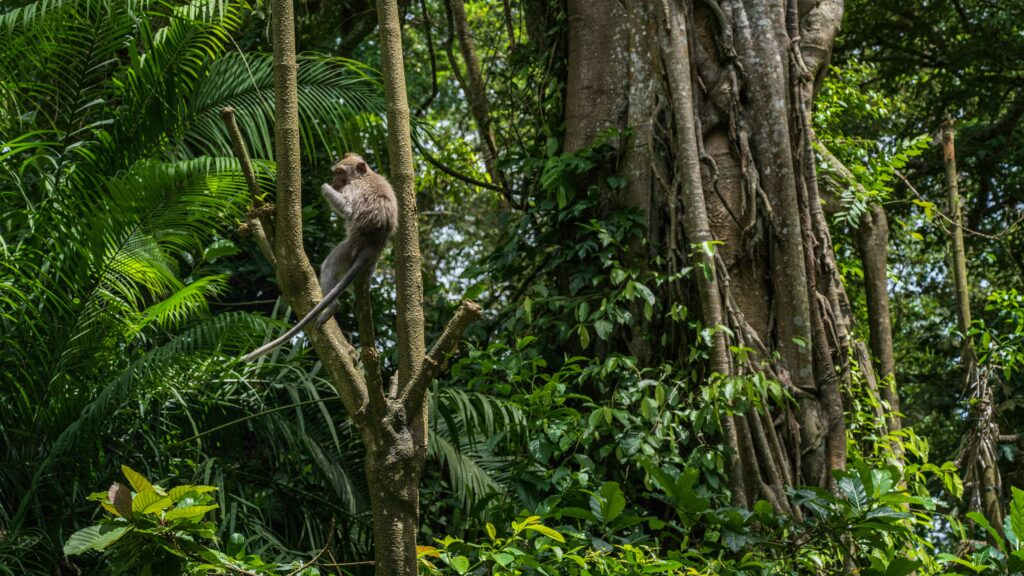
Feature photo by Kevin Goodrich on Unsplash
Article photo by Evelin Magnus on Unsplash