
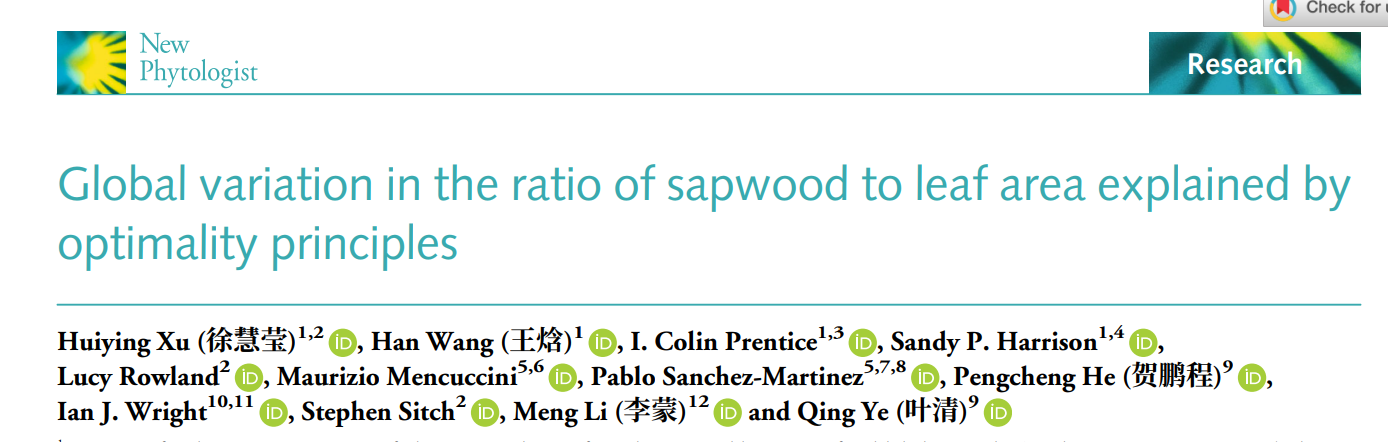
A new paper from SPECIAL group PI Sandy Harrison has recently been published in New Phytologist. The paper looks at the ratio between sapwood to leaf area in plants using optimality theory. This addresses the important trade off between water acquisition and the costs of carbon construction. Plants face a fundamental coordination problem: how much carbon to invest in water transport tissues to support a given leaf area. Too little sapwood, and water supply limits photosynthesis; too much, and carbon is wasted on unnecessary hydraulic infrastructure.
This balance is captured by the Huber value (vH), the ratio of sapwood area to leaf area.
The new study by Huiying Xu and colleagues (including Prof. Harrison), shows that global patterns in vH can be explained by a simple organising principle: plants allocate sapwood and leaves to optimally balance water supply and water demand under local environmental conditions.
_____________________________________________________________________________________________________________________________________________________
You can read the full manuscript here: Xu et al. 2026
Alternatively for a full summary see the blog post on the LEMONTREE project website, or read on below for the highlights from that post.
_____________________________________________________________________________________________________________________________________________________
A simple optimality idea
The study is built on one key assumption:
-
A plant’s maximum water transport capacity should match its maximum water loss during photosynthesis.
Using an eco-evolutionary optimality (EEO) framework, the authors derive an expression for optimal vH that links:
- Atmospheric dryness (vapour pressure deficit)
- Light availability
- Temperature
- Sapwood hydraulic efficiency (how easily water moves through xylem)
Photosynthetic traits are not fixed or tuned, but predicted using existing optimality models, allowing sapwood–leaf area ratios to emerge naturally from climate and trait coordination.
Does the theory match real plants?
When tested against large global datasets spanning species and climates, the model:
- Explains nearly 60% of global variation in sapwood–leaf area ratios
- Reproduces observed patterns across major climate types
- Requires only climate variables and a single fitted intercept
How climate shapes sapwood–leaf area ratios
The theory predicts clear and intuitive climate responses, all supported by data:
- Higher vapour pressure deficit increases vH, reflecting greater investment in sapwood to sustain water supply under dry air conditions.
- Higher irradiance also increases vH, as greater photosynthetic capacity raises transpirational demand.
- Warmer temperatures, by contrast, tend to reduce vH, largely because warmer conditions enhance hydraulic efficiency and reduce the sapwood area needed to support a given leaf area.
Across all environments, sapwood-specific hydraulic conductivity is the dominant control on vH.
Why this matters
Most vegetation models currently treat the Huber value as fixed, ignoring its sensitivity to climate. This study provides:
- A mechanistic, theory-based alternative to fixed sapwood allocation
- A clearer way to represent plant water use and carbon uptake
- New insight into drought vulnerability under climate change
The take-home message
Global diversity in plant hydraulic strategies is not arbitrary. It reflects a simple principle: plants balance leaves and water-transport tissues to maximise performance under climatic constraints.
You can read the paper here:
Xu, H., Wang, H., Prentice, I.C., Harrison, S.P., Rowland, L., Mencuccini, M., Sanchez- Martinez, P., He, P., Wright, I.J., Sitch, S., Li, M. & Ye, Q. (2025). Global variation in the ratio of sapwood to leaf area explained by optimality principles. New Phytologist, https://doi.org/10.1111/nph.70916
Blog post adapted, with permission, from the full blog post summary by Natalie Sanders –> https://research.reading.ac.uk/lemontree/sapwood-leaf-area-ratios/