

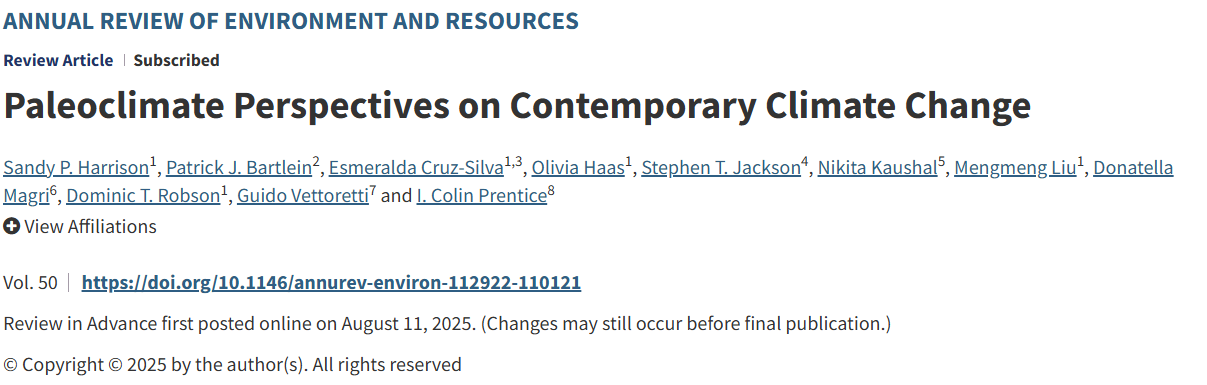
How can the deep past help us understand today’s climate crisis? A new review in Annual Review of Environment and Resources (led by S.P.E.C.IA.L. group PI Sandy Harrison) pulls together insights from palaeoclimate and palaeoecology to show just how much the past can teach us. From abrupt Dansgaard–Oeschger warming events to the resilience of plant communities under shifting climates, the record of past changes reveals tipping points, feedbacks, and responses that remain directly relevant to conservation and climate science today. The review also involves contributions from group PDRAs Olivia Haas, Mengmeng Liu and Dominic Robson and group associate Esme Cruz-Silva.
In the latest LEMONTREE project blog, Colin Prentice, an author on the review, unpacks the review’s key messages. This includes why palaeoclimate science has been underused in ecology and policy, to how ancient DNA, fire records, and CO₂ reconstructions reshape our understanding of ecosystems. He also tackles common misconceptions (“past change was always slow”, “data aren’t good enough”) and explains why collaboration between palaeoscientists, ecologists, and modellers is essential. You can read Colin’s full post here.
We encourage you to read both the blog delving into this paper as well as the original article itself which can be found here.
Harrison, S.P., Bartlein, P.J., Cruz-Silva, E., Haas, O., Jackson, S.T., Kaushal, N., Liu, M., Magri, D., Robson, D.T., Vettoretti, G. & Prentice, I.C. (2025). Paleoclimate perspectives on contemporary climate change. Annual Review of Environment and Resources, 50,