
A new study on Dansgaard-Oeschger events
A new publication led by SPECIAL group post-doctoral researcher Mengmeng Liu has recently been published in Climate of the Past. This paper “A global analysis of pollen-based reconstructions of land climate changes during Dansgaard–Oeschger events” highlights the paleoenvironmental reconstruction work that is central at SPECIAL. This paper is also important as it features two of the databases produced by the SPECIAL team, SPECIAL Modern Pollen Database (SMPDS v3) and ACER2. You can learn more about the SPECIAL Modern Pollen Database on other pages on this website.
_______________________________________________________________________________________________________________________________________________________________________________________________________________________________
_______________________________________________________________________________________________________________________________________________________________________________________________________________________________
What is a Dansgaard-Oeschger event?
Dansgaard–Oeschger (D-O) events is a rapid fluctuation in the climate seen during the last glacial period. They are best characterised in the Greenland ice cores by a transition from cold Greenland Stadial (GS) to warmer Greenland Interstadial (GI) conditions. These conditions included increases in air temperature of 10–16 °C over a period of 50-200 years.
Why are D-O events useful for climate research?
D-O events reflect events in the past climate record where we saw change in climate at a similar rate and magnitude to the current climate change our planet is undergoing. This means we can analyse D-O events to gain further insights into how our planet might change under future warming. Further, if our current models can accurately predict the warming seen in D-O events we can have more certainty in their ability to predict the changes and impacts of future climate scenarios.
Key results and takeaways from the study
This paper reconstructed three key climate variables: mean temperature of the warmest month, mean temperature of the coldest month and a measure of plant available moisture content. Crucially these can be reconstructed independently. This study combines datasets and of the available D-O event records, there was a 78% success in detection of DO events in the data.
The study found differences in regional patterns of warming and cooling with no overarching global signal detected. The change in the temperature of the mean coldest month was greater than that of the warmest month for the northern extratropics and tropics which indicates a reduction in seasonality. Whilst this pattern was observed in the southern extratropics it was not significant. The largest warming signals are observed in Eurasia and Western North America. The southern extratropics show a cooling effect. Changes in plant available moisture are less clear, there are observed wetting and drying events in areas of both warming and cooling. This lack of cohesion in spatial patterns could be due to the fact that there is more variability between DO events of plant available moisture than for the temperature variables.
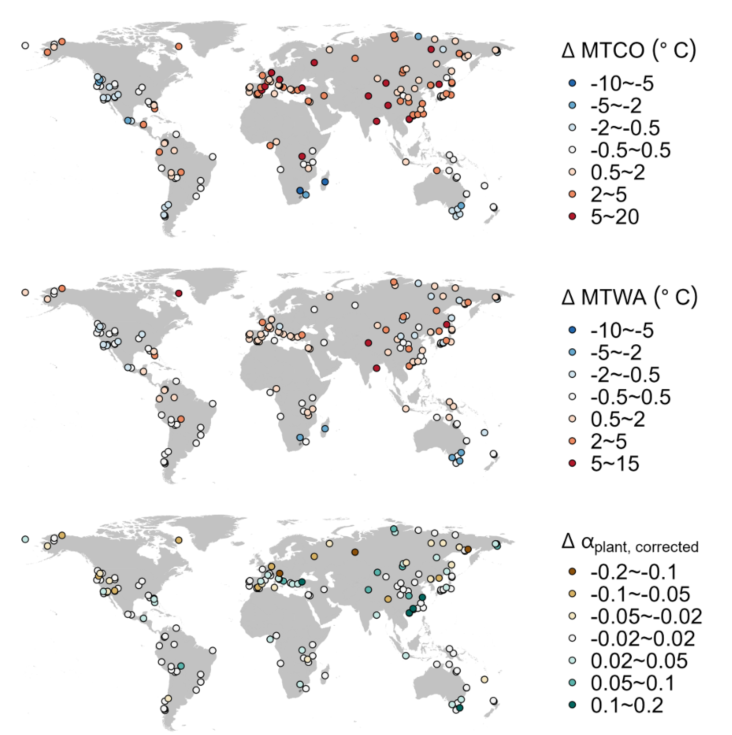
Figure 1: median change of site-based reconstructions for D–O events 5 to 12. The panels from top to bottom show the changes in mean temperature of the coldest month, mean temperature of the warmest month, and CO2-corrected plant-available moisture (from Liu et al. 2026, Figure 6).
Generally, consistency in the key variables in their spatial patterns across the D-O events was observed although the strongest events were most consistent with one another.
Conclusion:
These findings are supported by other studies which looked at other forms of data or used alternative reconstruction methods, supporting the robustness of these findings. Specifically, other studies show changes in winter temperature that are larger than the summer temperatures supporting the magnitude of the changes seen in this study (comparatively between variables) as well as the conclusion that seasonality was reduced during D-O events.
These reconstructions can also be used to evaluate simulations of D-O events from model. Future modelling runs can use the results as targets, particularly the warming observed in Western North American which not all models are currently able to capture.
You can read the full text and see all of these results in more detail at the following citation:
Liu, M., Prentice, I. C., and Harrison, S. P. A global analysis of pollen-based reconstructions of land climate changes during Dansgaard–Oeschger events, Clim. Past, 22, 205–226, https://doi.org/10.5194/cp-22-205-2026, 2026.