
The SPECIAL group was pleased to welcome Sander Veraverbeke to give a guest seminar at the University of Reading in mid-November. Sander is an Associate Professor at the VU in Amsterdam, where he studies the interactions between climate change, terrestrial ecosystems, and the carbon cycle. His research focuses on how climate change affects ecosystem disturbances and carbon fluxes, and how these processes feed back into the climate system. You can read more about his work here.
What are Arctic-Boreal fire regimes?
For this seminar, Sander spoke about Arctic-Boreal fire regimes and the work his group has been doing on their spread, interactions with climate, and future management. Arctic-Boreal regions are experiencing increased fire activity compared to the rest of the world, with large fires occurring in Siberia, Alaska, and Canada over the past decade. These fires are typically ignited by dry-lightning storms and often grow into large events by merging from multiple smaller ignitions. There are also clear differences in intensity between the fires in the pine forests of Siberia and those found in the high latitudes of Canada.
Although understanding Arctic-Boreal fires is complex, we do know that vegetation and climate are key drivers of the spatial patterns of fire. Attributing recent extreme fires to climate change, as well as understanding these spatial dynamics, are central topics of interest in the field. For example, warming in northern regions is occurring at a rate seven times higher than the global average (Li et al., 2024). Human management also plays a role in shaping the spread and location of fires in boreal regions, making it an important factor to consider when studying these regimes.
Considering the limits to boreal fire growth
One particularly interesting question Sander addressed was why these fires eventually go out. To understand how boreal fires spread in the future, it is crucial to examine the limits to their growth. A paper published in 2025 by Sander’s group investigates this question by analyzing fire perimeters to determine what halts fire spread. Their findings show that changes in fire drivers (e.g. landscape cover, infrastructure, or water bodies) constrain fires either in space or in time. Weather changes define the temporal constraints, while landscape features impose spatial limits. This snippet of Figure 4 from Janssen and Veraverbeke (2025) shows the different drivers of fire that caused the halting of one fire in these Arctic-Boreal Regions.
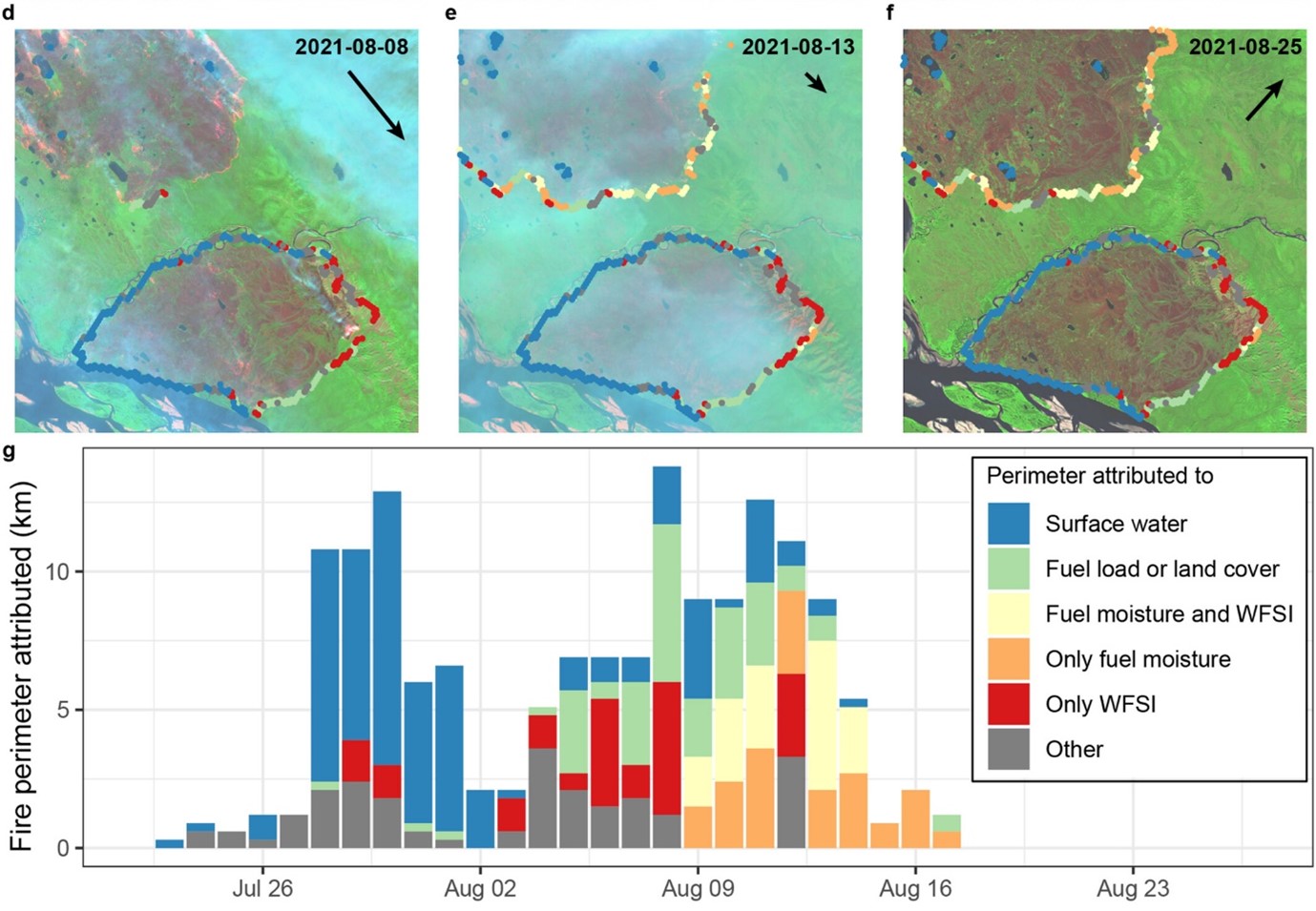
Figure taken from Janssen and Veraverbeke (2025, Figure 4) showing the attribution of extinguishing fire pixels to the drivers of fire.
We also had the opportunity to discuss:
- The feedbacks between climate change, sea ice retreat in the Arctic, and Arctic-Boreal fires à see here: Zhong et al. 2024
- How lighting ignition event changes are occurring in the Arctic-Boreal regions à Hessilt et al. 2022
Lastly, we finished the seminar by considering, what can we do about an increase in fire in the Artic-Boreal regions? This is still an open question, but left guests pondering the roles of soils as well as the use of satellite monitoring for management in these regions.
We would like to thank Sander for taking the time to give this seminar to the SPECIAL group and our department. Finally, Sander was also in attendance at Reading University for the viva of Yicheng Shen who we are proud to announce has passed and is now Dr Shen! Congratulations to Yicheng on this wonderful achievement.
References:
Hessilt, T. D., J. T. Abatzoglou, Y. Chen, J. T. Randerson, R. C. Scholten, G. van der Werf, and S. Veraverbeke. 2022. Future increases in lightning ignition efficiency and wildfire occurrence expected from drier fuels in boreal forest ecosystems of western North America. Environmental Research Letters 17(5):054008. doi: 10.1088/1748-9326/ac6311
Janssen, T. A. J., and S. Veraverbeke. 2025. What Are the Limits to the Growth of Boreal Fires? Global Change Biology 31(3):e70130. doi: 10.1111/gcb.70130
Li, Y., Y. Zhang, X. Quan, B. He, S. Veraverbeke, Z. Liao, and T. A. J. Janssen. 2025. Estimating forest litter fuel load by integrating remotely sensed foliage phenology and modeled litter decomposition. Remote Sensing of Environment 317:114526. doi: 10.1016/j.rse.2024.114526
Zhong, Q., N. Schutgens, S. Veraverbeke, and G. R. van der Werf. 2024. Increasing aerosol emissions from boreal biomass burning exacerbate Arctic warming. Nature Climate Change 14(12):1275-1281. doi: 10.1038/s41558-024-02176-y