
Strand 3b: 2000 – 2029
Refugee movements to Britain from 2000 to current day
Ellen leads on this strand of the research alongside Anenechukwu. Where Anenechukwu focuses on how today’s refugees tell their own stories, Ellen looks at how refugees have been imagined by British people who do not identify as refugees.
Ellen’s research examines how refugees have been represented, perceived and talked about by the British public and British institutions in the period from the late 1990s to the present day.
Analysing how legal frameworks and public discussions about people seeking asylum have changed over this period reveals that the idea of a refugee is constructed in different ways in different cultural and historical contexts.
Key ideas and themes that emerge in this period are:
- the ideas of ‘genuine’ vs. ‘bogus’ refugees.
- asylum is increasingly seen within the broader context of immigration, rather than as a separate humanitarian concern.
- attitudes to multiculturalism influence ideas about asylum seekers.
- Ideas about Islam and Islamophobia, especially since the ‘War on Terror’.
- concerns about Britain’s economic context: the question of ‘can we afford to offer asylum?’
- the influence of memories and myths of the past in determining whether today’s refugees are ‘genuine’ or not by comparison.
- Offering asylum is seen as part of Britain’s ‘moral mission’ and a part of its ‘proud history’.
I am interested to see how these different ideas rise and fall in public discourse across this period, and the areas of conflict and contradiction between them.
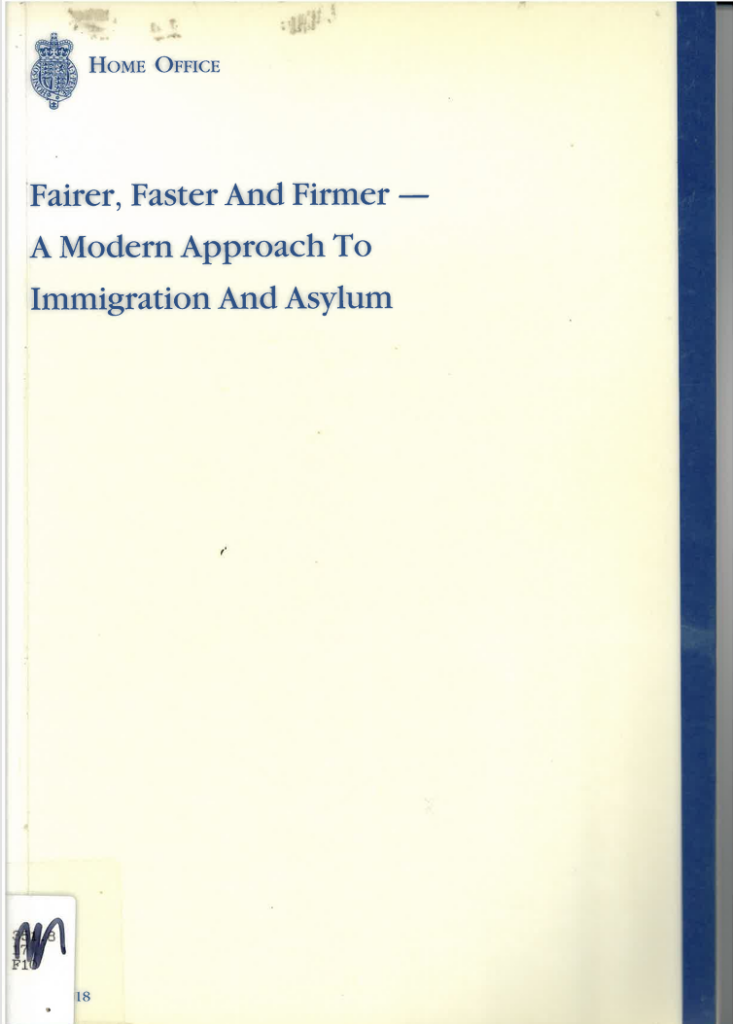
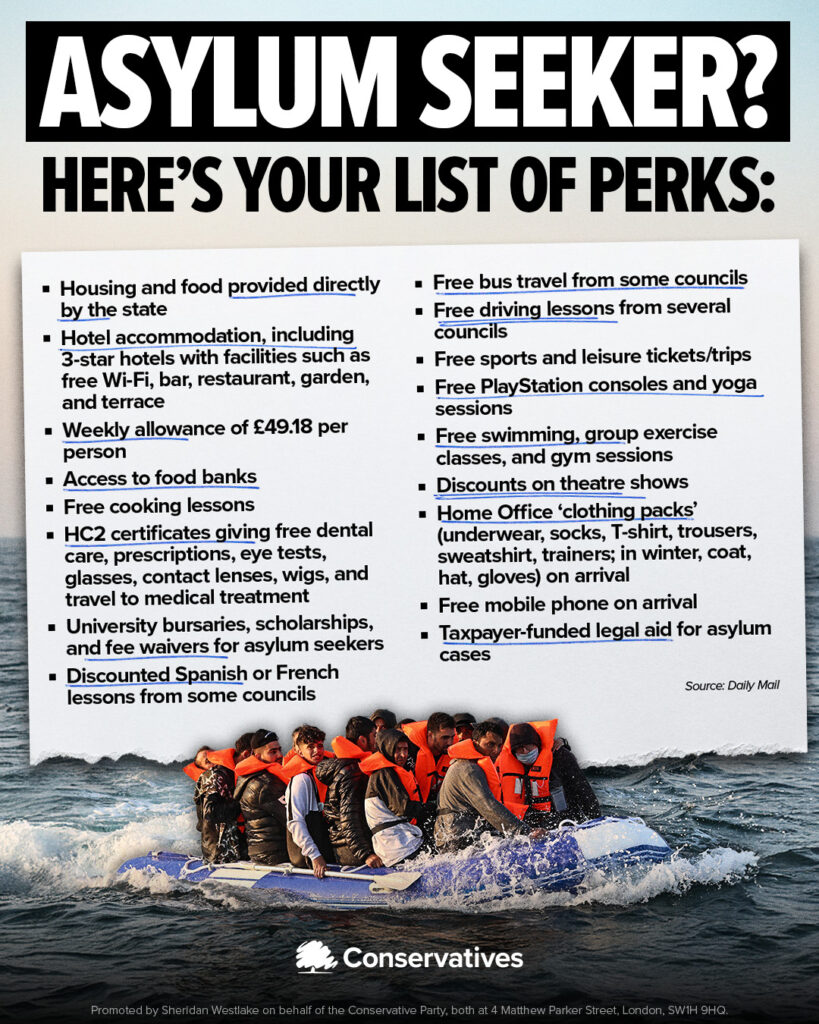
This is a major strand of research within the 4-year Nation of Refuge project
Ellen’s research strand will complete the project’s historical approach by focusing on our most recent history. The most commonly recurring ideas and assumptions about asylum-seekers will be identified, and placed within a specific historical and cultural context.
Seeing our contemporary moment as the product of a certain set of historical circumstances might help us to gain perspective, and to imagine different and better ways of facing today’s reality.
There are an increasing number of people around the world seeking refuge, and the current international system has serious limitations. Britain could play a leading role in changing the conversation about refuge/asylum so that fewer people are forced to live in desperation and danger. We hope that our research can make space for an open conversation about what is currently a highly divisive topic, and perhaps help to inspire better ideas for the future.
This time period is important to the project because:
- In this period, as a result of increased legal/economic immigration over previous decades (particularly since the 1990s), the British population has become more ethnically diverse (‘white Britons’ currently make up roughly ¾ of the population.)
- While multiculturalism was celebrated under New Labour in the 1990s, since roughly 2000 there has been a growth of support for populist parties in Britain and other countries around the world.
- Globalisation and increased travel and connectivity have affected countries and cultures everywhere.
- Since the financial crisis of 2008, the cost of living in Britain has increased, and austerity policies have caused significant reductions to public services, the effects of which are still felt today.
- Concerns about immigration and multiculturalism played a large role in the ‘Brexit’ campaign that resulted in Britain leaving the European Union in 2020. The strain on public services was often blamed on increased immigration.
- This period has seen much violence around the world, and ideas about people seeking asylum in Britain have developed in response to some of these events, including, but not only:
-
- the 9/11 (2001) & 7/7 (2005) terrorist attacks in New York City and London
- The US and UK’s wars in Afghanistan (2001-13) and Iraq (2003), understood as part of the ‘War on Terror’
- Civil war in Syria and the movement of millions of refugees to Europe (ca. 2015-18)
- Russia’s invasion of Ukraine (2022) and the resulting refugee movements
- An increase of people coming to Britain in small boats from France since 2021, most of them originally from Iran, Afghanistan, Iraq, Albania, Syria, and Eritrea. Between 2018 and 2024, 68% of these arrivals were granted asylum, because their home countries are not safe.
Research Methods and Approaches
Since the 1980s, the Mass Observation Project has invited a national panel of volunteers to send in written responses to pre-set questions three times a year. Observers are ‘ordinary people’ writing anonymously about their personal experiences and ideas.
Ellen will undertake a qualitative analysis of discussions of asylum and refuge in the Mass Observation material, reading these texts alongside:
- Quantitative surveys and studies regarding immigration and public perceptions of asylum-seekers
- Discourse analyses conducted on online and traditional media (TV, news, social media)

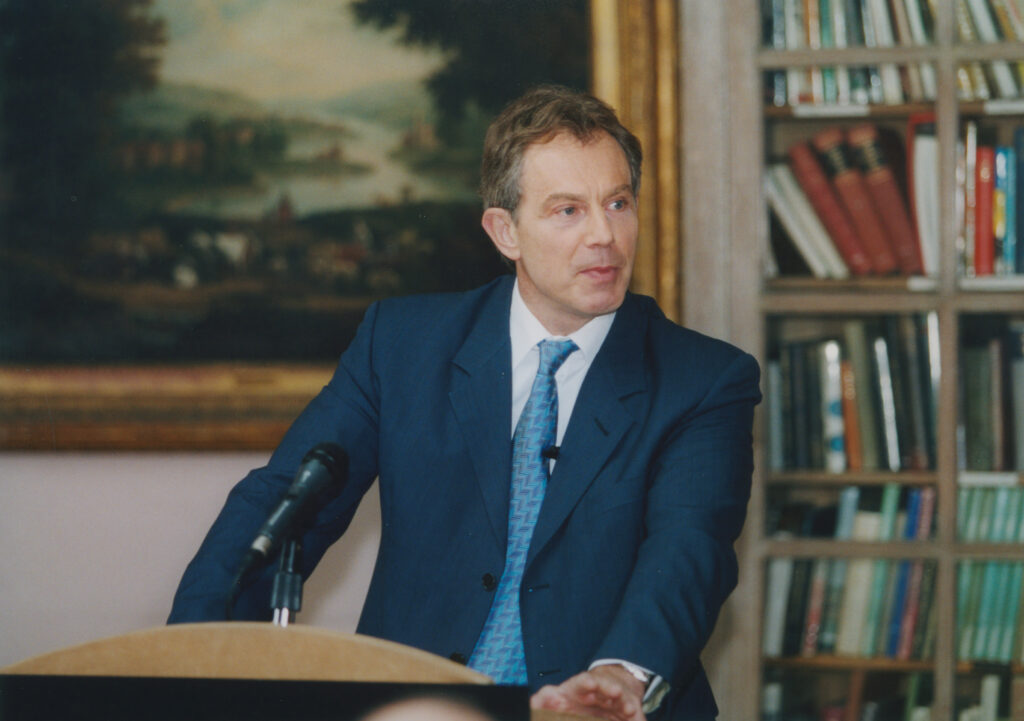
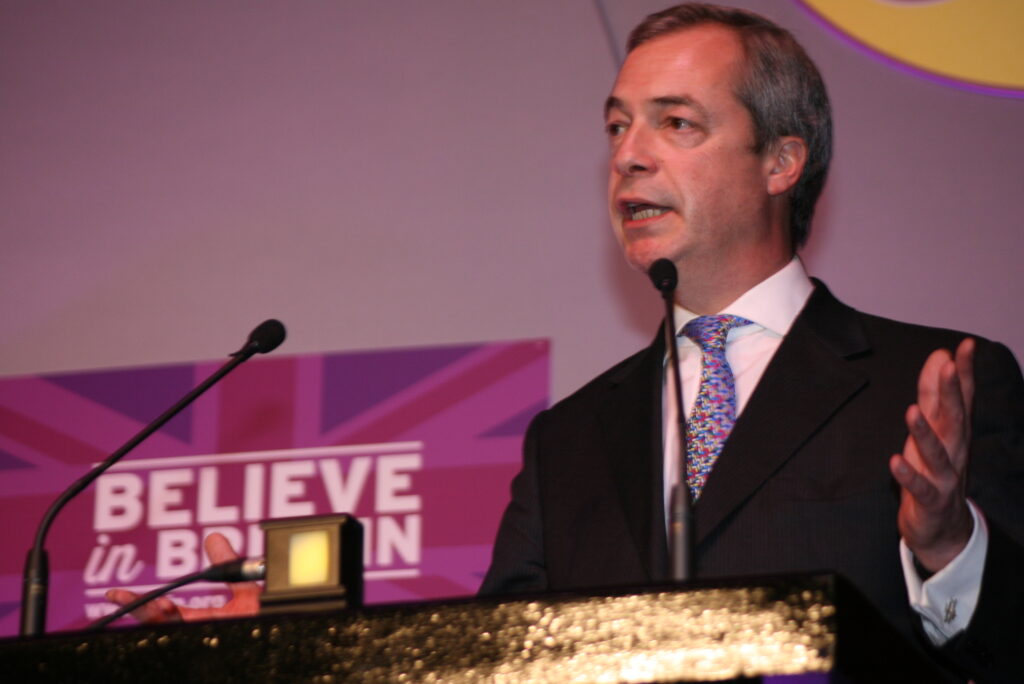
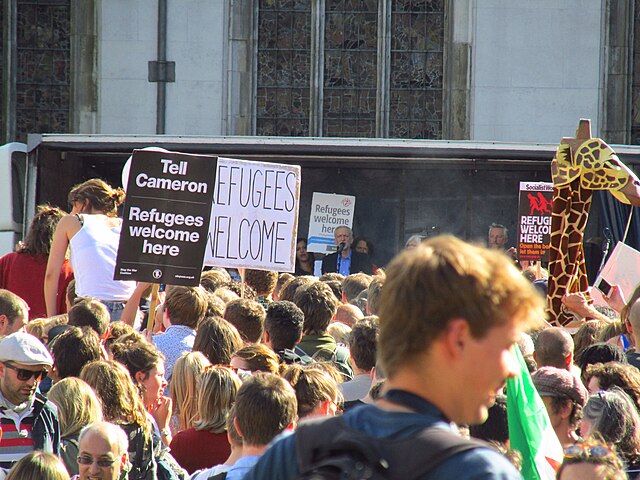
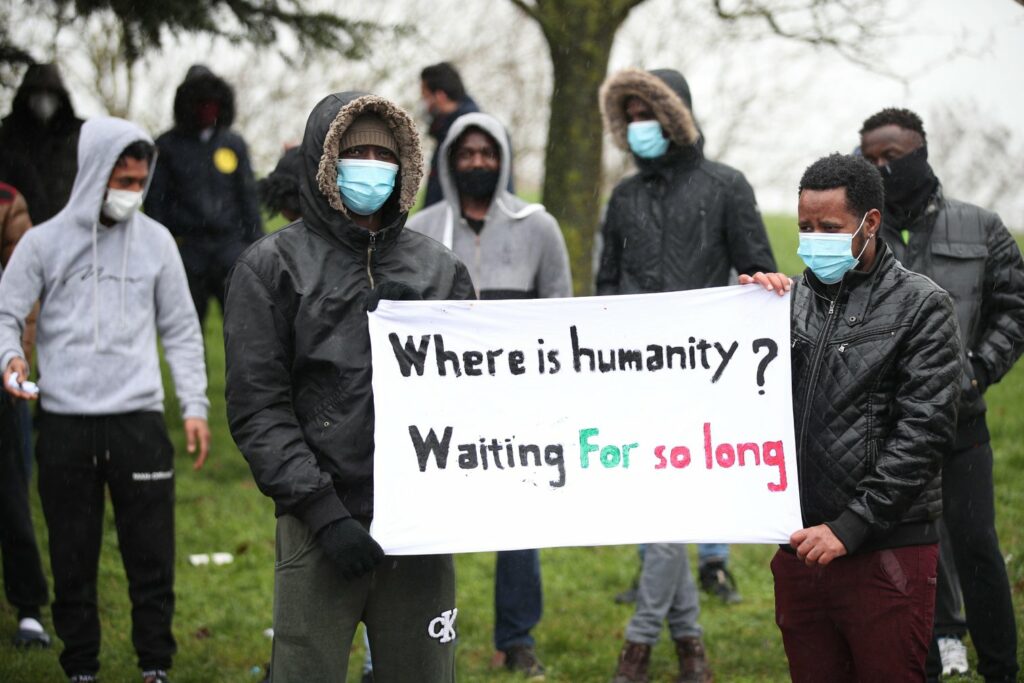
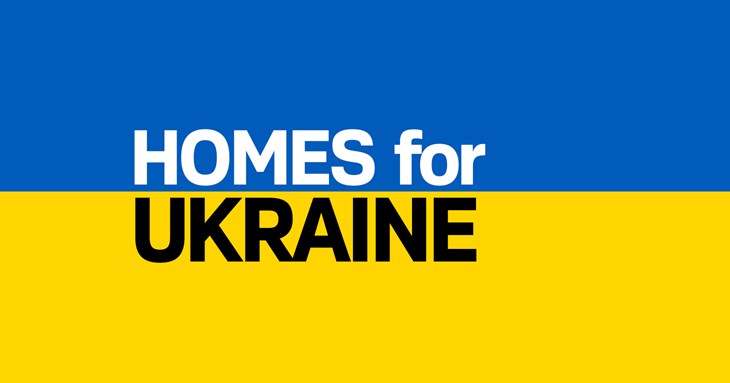
Image captions. 1) Former UK prime minister Tony Blair speaking on “The Next Steps for New Labour” at LSE, 12 March 2002. Author: LSE library, source: Wikimedia Commons
2) Former UKIP Leader Nigel Farage speaks at a political conference, 28 February 2015. Author: David Bennett, Source: Wikimedia Commons
3) Refugees Welcome Demonstration in London, Saturday September 12 2015. Author: David Holt, Source: Wikimedia Commons.
4) Protesters outside a west London hotel that was being used as accommodation for asylum seekers, August 2022. Author: PA Images, Source: Alamy Stock Photo.
5) Image representing the UK Government’s ‘Homes for Ukraine’ scheme to provide accommodation to refugees from Ukraine, ca. 2022.