
The European Geosciences Union (EGU) General Assembly 2025 (EGU25) took place from 27 April to 2 May 2025 in Vienna, Austria. As Europe’s premier geoscience conference, EGU25 brought together scientists from around the world to share the latest research across Earth, planetary, and space sciences.
This year, several members of the SPECIAL team attended and presented their work, covering topics from vegetation responses to climate change to post-fire ecosystem recovery. Presenters included two PhD students, two postdoctoral researchers, and group principal investigator Prof. Sandy Harrison.
Presentations
Below you can find links to the abstracts presented by the team:
- Sandy Harrison: Invited talk: Vegetation responses to climate change: lessons from the past 1Ma of Earth history
- Olivia Haas: Assessing the sensitivity of fire regimes to climate, atmospheric CO2 and human activity under past and future conditions.
- Theo Keeping: Understanding wildfire interannual variability using large ensembles.
- Mengmeng Liu: Land albedo feedback may have shaped the ‘fast-slow’ pattern of Dansgaard-Oeschger cycles.
- Yicheng Shen: Global drivers of post-fire ecosystem recovery: Insights from solar-induced chlorophyll fluorescence
The team was grateful for the enthusiastic engagement with their research and appreciated the opportunity to receive feedback and insights from the broader scientific community.
Reflecting on the experience, PhD student Yicheng Shen shared:
“I had a great experience presenting my post-fire recovery research (as part of the LEMONTREE project) at BG1.1! It was a large session in a spacious room, covering a broad range of fire-related topics, including fire traits, models, and fire emissions. The poster session was just as engaging. I had good conversations with many researchers, and I was thrilled to discover that one of the posters used resprouting data I published years ago. That felt especially rewarding!”
read Yicheng’s paper on post-fire recovery –> here.
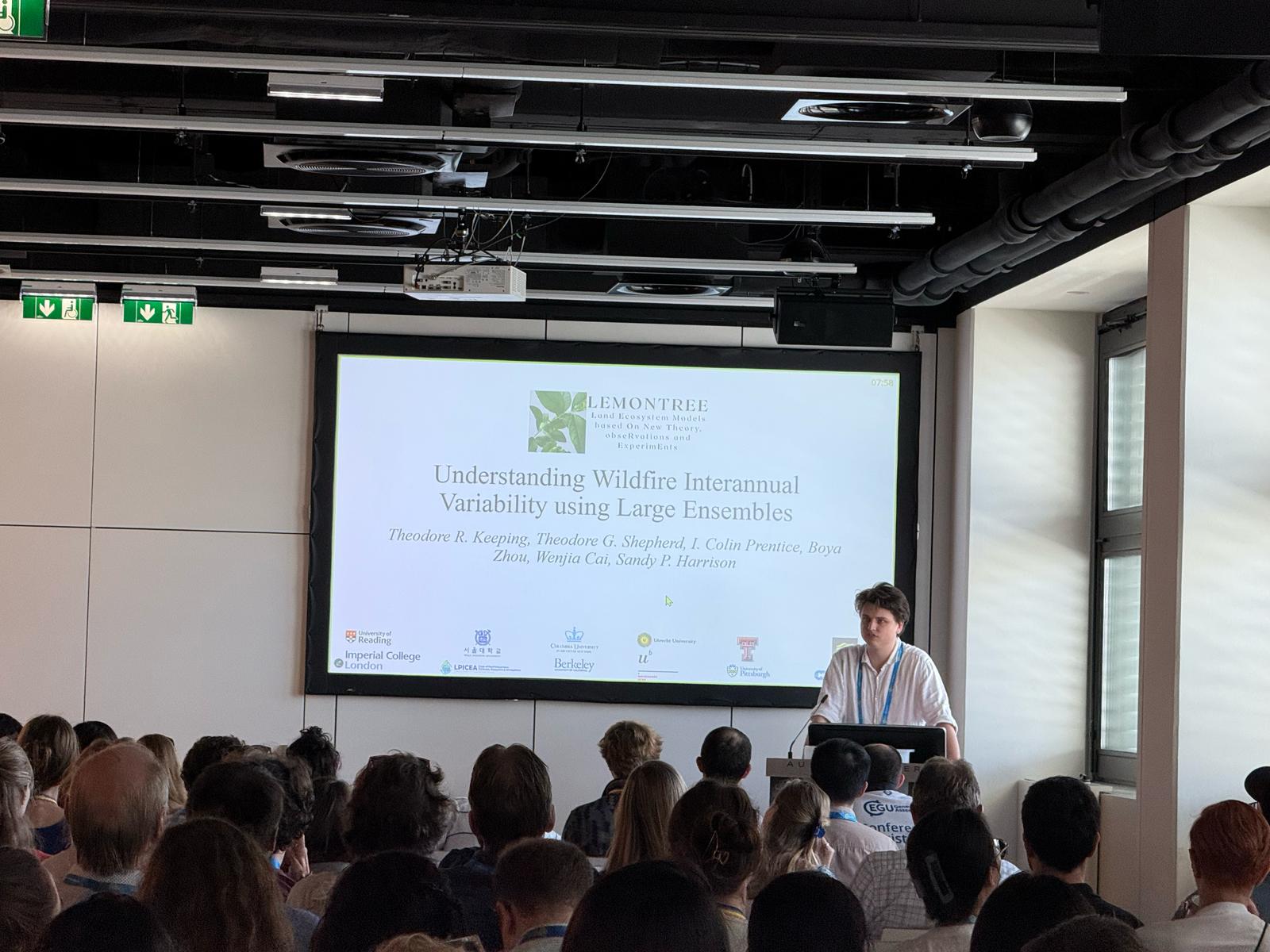
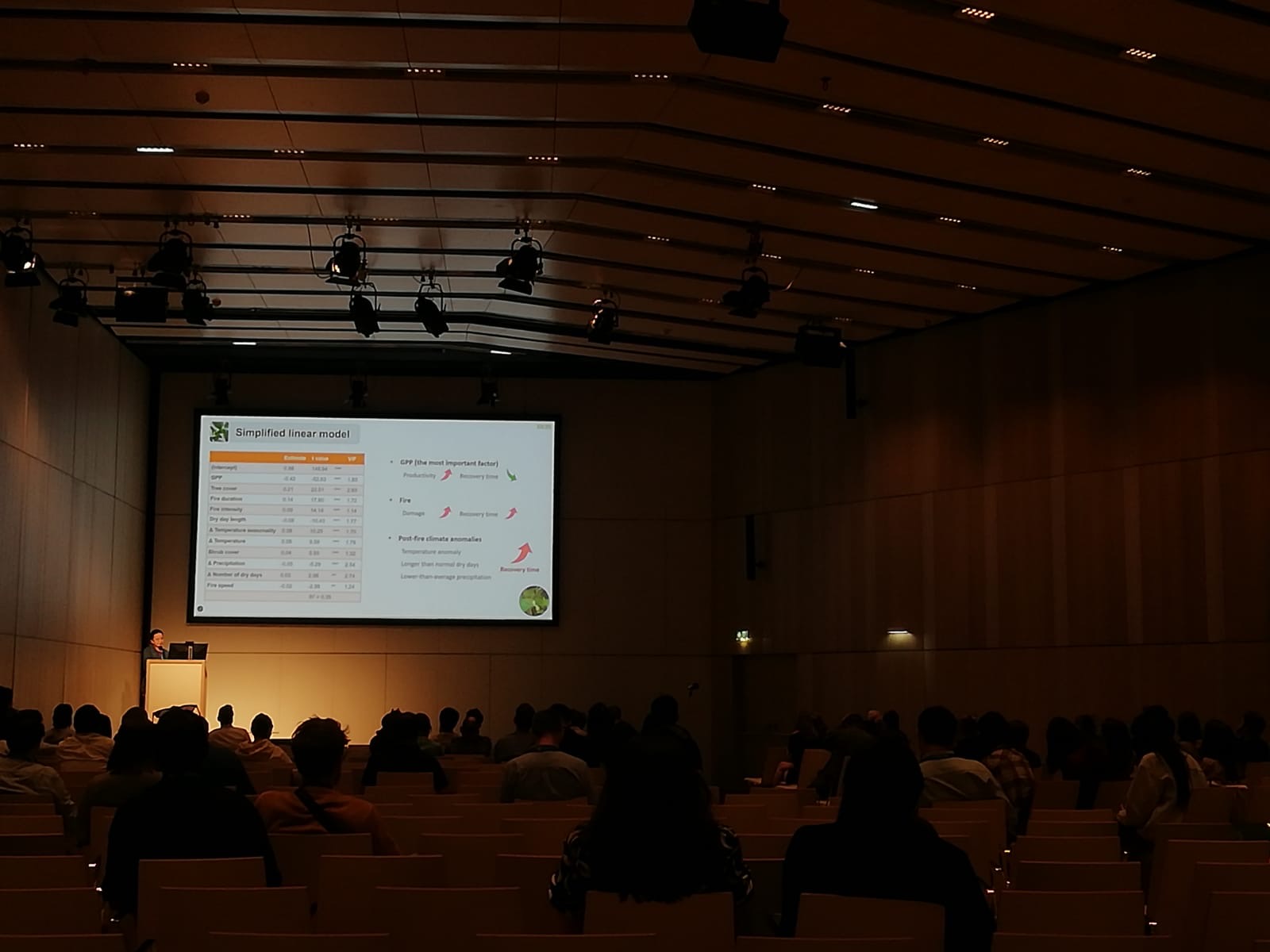
Above: Theo Keeping (top left), Yicheng Shen (top right), and Olivia Haas (bottom) presenting their research at EGU 2025.
Key Takeaways From The Group
📊 A Data Explosion
A major takeaway for the team was the growing availability of new, high-quality datasets. These include datasets on plant traits, land cover, river density, and biomass, as well as emerging resources on fuel loads, such as vegetation optical depth (VOD) and fuel characteristics, all of which are especially relevant to the team’s ongoing fire research. We look forward to digging into these datasets as a group!
🤖 The Rise of AI in Geoscience
Some personal highlights from the team at EGU this year included elements of the exhibition area. In particular, students in the group noted a real-time shift towards AI becoming a critical tool for geoscientific research.
🔥 Highlight Presentation: Deep Learning & Fire Modelling
PDRA Olivia Haas highlighted a great talk by Seppe Lampe on modelling global burnt area using deep learning. The presentation addressed the over tuning of our global models to savanna ecosystems and proposed a novel approach: training models on IPCC regions to enable region-based cross-validation. This is a useful concept for our group to think about as we continue to develop fire models that are applicable to all ecosystems.
💬 Session Highlight: Extreme Fires and Their Impacts
Another highlight was the session on “Extreme Fires and Their Impacts”, co-founded by Olivia Haas and PhD student Theo Keeping. It is great to see this session thriving and driving conversations on extreme fires at such a large scale.
Final Thoughts
The team from Reading came away from EGU25 feeling inspired and motivated. The opportunity to network, receive feedback, and stay at the forefront of geoscientific developments made this another successful year for the SPECIAL group. We’re already looking forward to EGU 2026!