
Fire and herbivory are two of the biggest consumers of biomass on Earth, having major impacts on vegetation distribution. Fire, a natural and often necessary part of many landscapes, consumes vast amounts of biomass annually. Meanwhile, the intensity of herbivore biomass consumption is driven by human activity and management. But what happens when these two forces interact?
A new study by Perkins et al., featuring research from SPECIAL group postdoc Olivia Haas, explores this very question. The study investigates how livestock grazing influences global fire activity, using a combination of satellite data, agent based model, and fire behaviour predictions. A key tool at in this study is Olivia Haas’ burnt area (BA) model developed during her PhD.
Grazing as a Fire Management Tool
One widely discussed theory is that grazing reduces the amount of available fuel (i.e., plant biomass), which could explain the observed global decline in burned areas. However, grazing is also associated with pastoral burning, which may increase overall burnt area. As such, it is difficult to disentangle the overall effect of livestock on fire globally. As climate change makes prescribed burning more difficult to control and less predictable, grazing is often put forward as a potential alternative, removing biomass and subsequently reducing fire risk. This has led to growing interest in using livestock grazing as a fire management strategy. Before this approach can be widely adopted however, scientists need to better understand how grazing currently affects fire patterns.
Missing Variables in Burned Area Modelling
In this study, the authors examined how much of the residuals (i.e. error) of the Haas et al. (2022) burnt area model could be explained by pastoral burning and grazing intensity. This biomass consumption from livestock and the fraction of pastoral burning was generated using WHAM! (Wildfire Human Agency Model, Perkins et al. 2024). Perkins et al. (2025) estimated global livestock biomass consumption in WHAM! using land carrying capacity, grazing intensity, and demand for animal products. Further detail on the data used to derive these predictions can be found in the paper.
Their results show that accounting for grazing intensity and pasture burning explains around 12% of the variance in the GLM model residuals globally. The results suggest that in some regions, the original model underestimates fire due to the presence of pastoral burns while in others, it overestimates fire where biomass is being reduced by grazing. In the absence of pastoral burning and grazing intensity, the results suggest fire would reduce by 65 Mha in sub-Saharan Africa but increase by 92 Mha outside of it.
Changing Relationships in Space and Time
Interestingly, the relationship between grazing and fire is variable. Globally, during 1990–1994, grazing appeared to increase burned area, but since then it has largely had a suppressive effect. However, the story isn’t consistent everywhere. In South Africa, for instance, burned area actually increases in the presence of grazing.
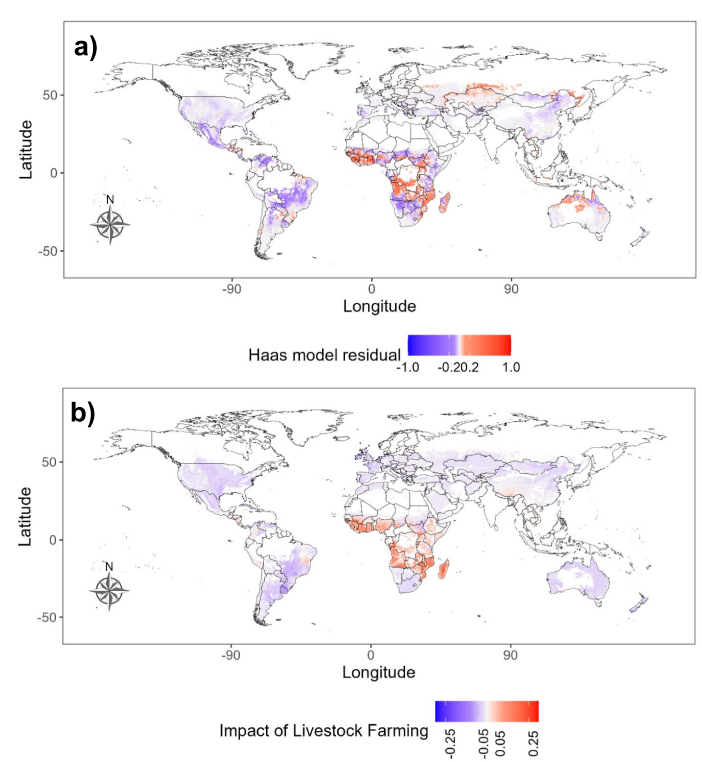
Figure 1: (a) Residuals of the GLM model against observed burnt area (a) the impact of livestock farming on burned area as modelled by WHAM. Results shown for grid cells where grazing land covers > 10%.
Implications for fire modelling
The results suggest that the strong spatial BA anomaly observed in African savanna-grasslands (where the largest burnt areas occur) may not be purely driven by ecological factors but may also be due to the presence of livestock. Given that this result is not accounted for in our modelling efforts, we may be underestimate the range of biophysical conditions conducive to vegetation fire in the absence of human intervention because the spatial anomaly may not be as large as previously imagined.
The Takeaway
This study highlights the complex relationship between fire and herbivory, showing that grazing can both reduce and increase fire risk depending on context. As fire regimes continue to shift under climate change, understanding these dynamics will be essential for sustainable land management and policymaking.
Read the full paper here! Perkins, O., Haas, O., Millington, J.D.A. 2025. The impact of livestock farming on global fire regime. Environmental Research Letters, 20, 084072. https://iopscience.iop.org/article/10.1088/1748-9326/adeff5/pdf