
A new paper from the LEMONTREE project has just been published in Nature Plants by formed LEMONTREE post-doc Xu Lian from Columbia University. The paper involves our S.P.E.C.I.A.L group PI Sandy Harrison. The review argues that leaf temperature (Tl), not air temperature (Ta), should be central to how we understand plant physiology, thermoregulation, and future carbon-climate feedbacks.

_______________________________________________________________________________________________________________________________________________________________________________________________________________________________

This review paper, Leaf temperature and its departure from ambient air temperature, synthesizes global observations across climates, ecosystems, and measurement scales to reveal how plants regulate heat, and why current models may be missing one of the most important pieces of the puzzle: leaf temperature

_______________________________________________________________________________________________________________________________________________________________________________________________________________________________

You can read on below for the highlights from this paper or check out our blog post on the LEMONTREE project website for a more in-depth look at this paper here.

Leaves Are Often Hotter Than the Air Around Them

Leaf temperature directly controls photosynthesis, transpiration, and heat stress — and it can differ substantially from air temperature. In sunny, dry environments and tropical forest canopies, leaves can become dangerously hot, sometimes approaching 50°C.

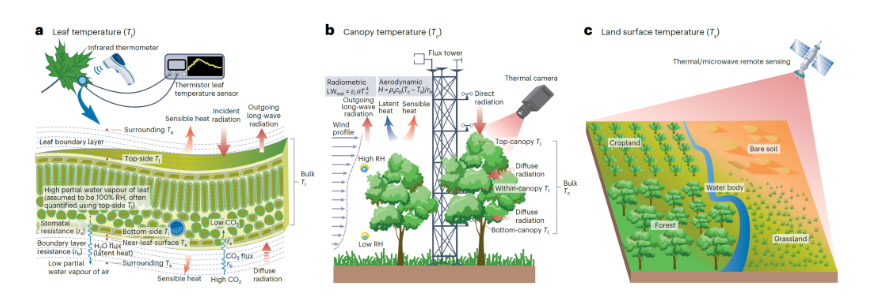
Leaf temperature depends on the balance between heat gain from solar radiation and cooling through transpiration, convection, and longwave radiation loss.

Figure 2. Schematic of the interactions between Tl and Ta from leaf to canopy and landscape scales.

Plants Show Different Temperature Strategies

This review found that plants do not regulate temperature in the same way everywhere.

Three main patterns occur:

  • Limited homeothermy — leaves warm more slowly than air
  • Poikilothermy — leaves track air temperature closely
  • Megathermy — leaves warm faster than air

Warm tropical and dry ecosystems often show megathermy, while colder or shaded environments tend to buffer leaf temperatures more effectively.

Stomata Help Prevent Overheating

The review suggests stomata are not only balancing carbon gain and water loss, but also helping regulate temperature.

Under extreme heat, some plants keep stomata open even when photosynthesis slows because transpiration provides evaporative cooling. This points to a “triple-target” strategy balancing:

  • Carbon uptake
  • Water conservation
  • Thermal safety

Why It Matters for Climate Models

Many climate models still use air temperature as a substitute for leaf temperature, which can underestimate heat stress and overestimate future carbon uptake.

This is especially important in tropical forests, where many species already operate close to their thermal limits.

Can Plants Keep Up With Warming?

Plants can adjust their heat tolerance to some extent, but acclimation appears limited. As warming intensifies, many species may lose their thermal safety margins, increasing the risk of heat damage and reduced carbon uptake.

Congratulations to Xu, Sandy and their co-authors on this exciting publication which raises important questions for ecosystem modelling, especially as we consider how our ecosystem models will perform in our simulations of future climate scenarios. Further developments are clearly needed to incorporate a better treatment of leaf temperature into earth system models (ESMs). Stay tuned with the LEMONTREE project as we continue to share our findings on incorporating new theory into ESMs.

Blog post adapted from original post by Natalie Sanders.

OR READ THE FULL PAPER HERE: Lian, X., Jiji, J., Fang, J., Han, J., Ryu, Y., Harrison, S.P., Jeong, S., Zhang, H., Novick, K., Benson, M.C., Dong, N., Green, J.K., Sandoval, D., Jiu, J., Keenan, T.F. & Gentine, P. (2026). Leaf temperature and its departure from ambient air temperature. Nature Plants. https://doi.org/10.1038/s41477-026-02304-w