

As part of the Progression in Primary Languages (PiPL) project, we have been exploring children’s attitudes towards language learning at Key Stage 2 (Years 3-6, ages 7-11) and how they may change over time.
Following Jasmin Silver’s blog about our children’s attitudes survey, here, we share some of our initial findings from our focus group interviews with children and what light they may shed on children’s attitudes towards language learning.
Methods and Sample
In addition to the attitudes survey, we conducted focus group interviews with small groups of Key Stage 2 children in each school to explore their attitudes towards language learning in more depth. In summer 2024, we conducted 83 focus groups with more than 320 children across Years 3, 4, 5, and 6 from 17 primary schools, who were learning French, German or Spanish at school. In particular, they were asked to share their views on:
- How they feel about language learning
- Whether they find it useful
- Their experience of language learning activities in the classroom

Preliminary findings so far
Across the schools, key themes relating to enjoyment and motivation in language learning are emerging from the focus group data.
Enjoyment of language lessons
Positive aspects
Across many of the schools, pupils commented on a variety of different activities which they enjoyed in their language lessons.
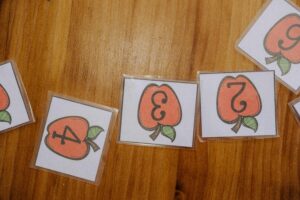
Activities that made vocabulary learning interactive and competitive were enjoyed by children. Games such as splat, bingo and word searches were highlighted as enjoyable, motivating and accessible.
“…what helps is the board games, especially the number board games. I love the number board games.”
Songs were also enjoyed by children, who appreciated how the musical elements made learning vocabulary easier.
“Spanish makes me feel really happy and calm because first we get to sing Spanish songs and then we get to write different words in our books.”
“…songs at the beginning of the lesson… get our minds going that we’re learning French.”
Visual and movement-based activities as well as craft-based tasks following language instructions were enjoyed by pupils.
“I’d draw the thing and then I could remember what it was by the picture.”
“When I see and hear the word, it’s easier to remember.”
Associating gestures with sounds was considered a helpful strategy for remembering challenging vocabulary and appreciated by pupils. Some pupils mentioned enjoying using tools like PowerPoint slides, iPads, and mini whiteboards, which they felt made learning and retaining vocabulary easier.
Many enjoyed speaking activities, for example role plays in a café or shop, which enabled pupils to have simple conversations for practical purposes and make connections with real world scenarios.
One pupil described it as “feeling like you were actually getting something in France.”
Some pupils also appreciated focusing on phonics in lessons.
“At the start of each lesson, we focus on the sound in French, so we know how to recognize more sounds.”
“We do Spanish phonics to like help you pronounce the words.”
Negative or more challenging aspects
Alongside these positive aspects, some pupils also commented on more challenging aspects:
Classroom activities
In some schools, pupils suggested they would enjoy a wider range of activities and more varied content and had clear ideas about what would interest them. This was particularly the case for older children:
“Maybe games, because it’ll get us engaged and it’s fun and it’ll make people more likely to listen.”
Some felt that topics, for example numbers and colours were revisited too often and more variety would keep them interested:
“We do colours again each year, and it’s kind of like boring when you already know them.”
Although, interestingly, others mentioned that they found it helpful to revisit previously learnt content, as they felt it helped them to remember and retain the language.
Some pupils said they would like more opportunities to practise speaking:
“…more talking, more speaking, less listening”.
Linked to this, some pupils highlighted that they would like to have opportunities to use vocabulary in complete sentences and simple conversations.
“They teach us just simple words; they don’t teach us how to like have an actual conversation.”
Pronunciation and spelling
Navigating pronunciation and spelling was perceived by many as a challenge in their language learning. Feeling self-conscious or worried about mispronouncing words was mentioned.
“Sometimes I struggle a bit because sometimes the words are a little bit too hard. It’s hard to pronounce.”
“If we said a wrong word there, it could be a rude word.”
“Writing down the words can be tricky.”

Grammar
Some pupils articulated the challenging aspects of grammar, for example:
“I get mixed up with le and la—is it this one or that one?”
Vocabulary
Some pupils found it hard to remember words between lessons when there was no reinforcement of the words. They felt that retaining new words outside the classroom was difficult, particularly after longer school breaks or where lessons did not happen regularly.
Usefulness of language learning
Practical use of language learning
Initial findings suggest that many children valued language learning for its practical use, in particular mentioning the benefit of learning a language for travel and holiday purposes.
“I feel good about it because it could come in handy in the future, like going to Spain and you can communicate with people there.”
“I like it because when I travel, I can speak to French people.”
“I think Spanish is very useful …if your parents are planning an upcoming trip to Spain or somewhere that speaks Spanish… it would be really good because then you can talk to them, make new friends, and … would be useful to see what’s on the menu.”
Linked to this some pupils talked about the transactional benefits of knowing another language:
“…we went to France, it was useful at the shops.”

Future learning and opportunities were also commented on:
“So then when you move into secondary school, you can learn a different language, maybe like Spanish. And because you learn German, learning other languages is probably easier”.
Older pupils in particular perceived language learning as beneficial for potential career opportunities.
Interest in countries and culture
Connecting with people
Pupils talked about the benefits of being able to connect with people, including family, and showing respect for others:
“It’s kind of impolite to just go to somebody’s country and assume they’ll speak your language.”
“It’s good to communicate with others in their own languages.”
“It’s fun to learn because my relatives live in France.”
They talked about making friends when on holiday, or making friends with peers who may speak another language:
“…maybe like a French person came to our school and was in our class and they found it a bit hard to speak English, so then it would help us to speak to them.”
“When people from Spain come here and they don’t know how to speak any English, you can maybe… help them”.
“I’d like to learn one of the languages my friends speak… then we could talk to each other in different languages.”
Interest in countries and cultures in which the language is spoken
Pupils not only wanted to connect with people from different countries and better understand them, they also showed an openness and interest in getting to know other cultures:
“I think that’s very important to be able to know a bit more of everybody else’s culture.”
“Learning another language helps you understand people better.”
Some children showed interest in deeper cultural connections, for example, imagining living in a different country,
“…or if you go to Germany even if you know a little bit and you’re talking to a German person that speaks German they could kind of teach you German and then you’d be able to live in a different country.”
Linked to this was the curiosity of some children to learn other languages such as Japanese, Chinese, Portuguese, Ukrainian, Italian, Arabic, Turkish. This was due to a variety of reasons, for example, prior exposure, personal or family connections, cultural interest and challenge.
“if we had some lessons in Ukraine, we would be able to help them better to understand what happens instead of using Google Translate.”
“I want to try speaking Chinese because I also have two Chinese friends… they can maybe help us.”
“I want to learn Arabic, because it’s really hard and I really want to challenge myself.”
Some children expressed the desire to learn multiple languages with one pupil saying:
“I feel like we should have a whole languages department.”
Another pupil mentioned that they would like their language valued in the school setting:
“Turkish because it’s my native language and it’s a bit tricky for some people and I would like them to learn about it.”
What’s next?
These initial findings help us to understand more about children’s attitudes, building on the results of the attitudes survey, and give us an insight into the aspects of learning languages which children find enjoyable and motivating versus aspects which are seen as more challenging. Our next step is to undertake, a more detailed, and longitudinal analysis of both the attitude surveys and focus groups, which will add contextual depth and reveal more nuanced reasons as to why children think the way they do about language learning and how this changes over time. We will update you as soon as we know more!
Your thoughts
As before we’d love to hear your thoughts and experiences. Do these initial findings resonate with your experience? Do let us know what you think by emailing us at PiPL@reading.ac.uk.
Sign up for our newsletter