


Exploring how vocabulary, phonics, and grammar develop in KS2 — and whether having a specialist teacher makes a difference.
The National Curriculum Programme of Study for Languages at Key Stage 2 (Years 3 to 6, ages 7 to 11) states that language teaching in primary school “should focus on enabling pupils to make substantial progress in one language”. But how much progress do children really make when learning a language in primary school? And what do children know in the language they are learning by the time they leave primary school?
This is what we have been investigating in the Progression in Primary Languages (PiPL) project – what progress looks like over the four years of learning a language at primary school and what factors can have an impact on language learning in this context (see our first blog post to learn more about the wider study).
Here we take a look at our preliminary findings in relation to the learning of vocabulary, phonics, and grammar.
How we are measuring vocabulary, phonics, and grammar learning
We are working with 17 primary schools and more than 1800 pupils across England. Eight of the participating primary schools teach French, seven of the schools teach Spanish and two teach German. Importantly, all of the schools offer between 45-60 minutes of language teaching per week, following a structured scheme of work.
Each year, participating children complete a set of activities in French, German or Spanish, so that we can look at what they know and can do in the language they are learning.
Vocabulary
For vocabulary, we created a multiple-choice activity, where children see and hear a word in French, German or Spanish and have to choose what the word means from four options:
The activity has 40 items (including nouns, verbs and adjectives). To decide which words to test, we created a list of the words included in the four most commonly used schemes of work[i] for each language and then randomly sampled the words for the activity from these lists. This helped us to make sure that the words we are testing are likely to be words the children have encountered in their language lessons at school. You can read more about how we created the vocabulary test here.

Phonics
For phonics, we created two short activities. In the first activity, children listen to a made-up word which contains a key sound from the language and have to decide which word they hear from three options.
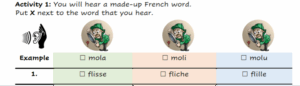
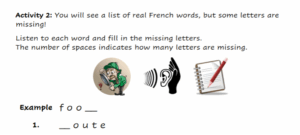
In the second activity, the children hear a real, but unfamiliar, word in the language, and have to fill in the missing letter(s) to match the sound they hear:
Grammar
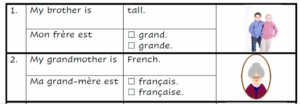
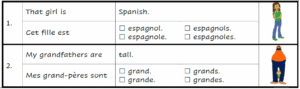
For grammar, we created a set of activities to see what children understand about key grammatical concepts in the language, including: articles, adjective endings, present tense verb endings, and negation. We created different versions of the activities for each year group, increasing in difficulty, with the activities for older children (who have been learning the language for longer) focussing on a wider range of structures.
Here is an example from an adjective endings task for children in the first and second year of learning French:
And here is an example from an adjective endings task for children in the fourth year of learning French:
In the analysis of the grammar activities, the scores from the different versions were equated on a single scale, so that we could directly compare between them.
Preliminary findings so far
Here, we are focussing on the findings from the activities children completed in Spring/Summer 2024. In our analysis, we compared the scores on each activity for children in their first year of learning French, German or Spanish (typically Year 3, age 7-8) to those of children in their second (typically Year 4, age 8-9), third (typically Year 5, age 9-10) and fourth (typically Year 6, age 10-11) year of learning the language. We wanted to see whether there is an increase in vocabulary, phonics and grammar knowledge with each additional year of study. We also looked at whether having a specialist teacher made a difference to any year-on-year changes. In addition, we considered children’s School/Class groupings within the analysis to account for differences across the different learning environments.
Do we see an increase in children’s vocabulary knowledge over time?
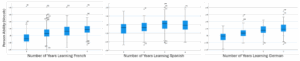
Across all three languages, we found that children’s vocabulary knowledge significantly increased with each additional year of study. This suggests that the number of words that children can recognise in French, German and Spanish increases year-on-year. For German, we found a smaller, but still positive, difference between the vocabulary knowledge of children in their third versus fourth years of learning, whilst for Spanish progress plateaued in the fourth year.
Do we see an increase in children’s phonics knowledge over time?
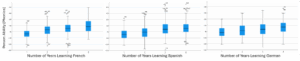
For French and Spanish, as with vocabulary, we found a significant increase in children’s phonics knowledge with each additional year of study. For German, we saw a more modest, but still positive, increase in phonics knowledge between children in their first year of learning compared to children in the fourth year of learning. This suggests that children do get better at recognising key sounds in the language with each year of learning.
Do we see an increase in children’s grammar knowledge over time?
In terms of grammar learning, the picture was a little more mixed.
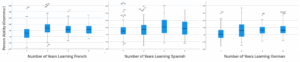
For French and German, we found that the biggest increase in children’s understanding of grammar happened between the first versus second year of learning the language, but there were minimal further changes in later years of learning. For Spanish, there was a significant difference between the first and third years of learning, but this plateaued in the fourth year. This suggests that there was some initial learning of basic grammatical concepts in the first one to two years of learning the language, but that further learning in later years was more limited.
We found that children’s understanding of certain areas of grammar increased significantly between the first and second years of learning the language:
- Verb endings (in all languages)
- Articles (in French and Spanish)
- Adjectives (in French only)
- Negation (in German and Spanish)
Does having a specialist teacher make a difference?
We also explored whether it matters if a specialist or a generalist teacher delivers the language teaching across our participating schools who were teaching French or Spanish. (In both our German schools, the language teaching was delivered by a specialist; therefore, they were not included in this analysis.)
For vocabulary and grammar, we found that having a specialist teacher did make a significant difference – children taught by a specialist teacher demonstrated better understanding of vocabulary and better understanding of grammar in both French and Spanish. The added value of having a specialist teacher was roughly equivalent to having an additional year of language teaching.
Interestingly, however, for phonics, having a specialist teacher did not make any difference.
Final thoughts
Most importantly, our preliminary findings show that with regular input (45-60 minutes per week) children do consistently make progress in their language learning at primary school – this is particularly the case when it comes to getting to grips with vocabulary and phonics. The picture for grammar is more mixed, but we found that children are developing an understanding of some aspects of grammar. However, this is an area that would benefit from more systematic teaching and revisiting in lessons, particularly in later years of learning as more grammatical structures are introduced.
Although we found evidence of year-on-year progress, regardless of who is delivering the language teaching, having a specialist teacher does seem to make a difference, particularly when it comes to vocabulary and grammar learning. This highlights the importance of providing opportunities for teacher subject knowledge development.
What’s next?
Our next step is to look at the impact of other factors, such as student characteristics (e.g. language background, gender, socio-economic status) on progression in language learning.
So far we have been comparing different groups of children based on how long they have been learning a language in primary school. In the meantime, we have been continuing to visit our participating primary schools and gather more information, so that we can follow the same children over three years, to see how their language knowledge changes.
Your thoughts
We’d love to hear your thoughts and experiences. Have you seen similar patterns in terms of progress in learning vocabulary, phonics, or grammar? How do you track your pupils’ progress? Get in touch with the team at PiPL@reading.ac.uk and let us know what you think!
[i] Schemes of work used in the compilation of core vocabulary lists for each language. French: Lightbulb Languages, Primary Languages Network, Language Angels, Rachel Hawkes. Spanish: Lightbulb Languages, Primary Languages Network, Language Angels, Rachel Hawkes. German: Goethe Institut, Early Start, Primary Languages Network, Rachel Hawkes.