
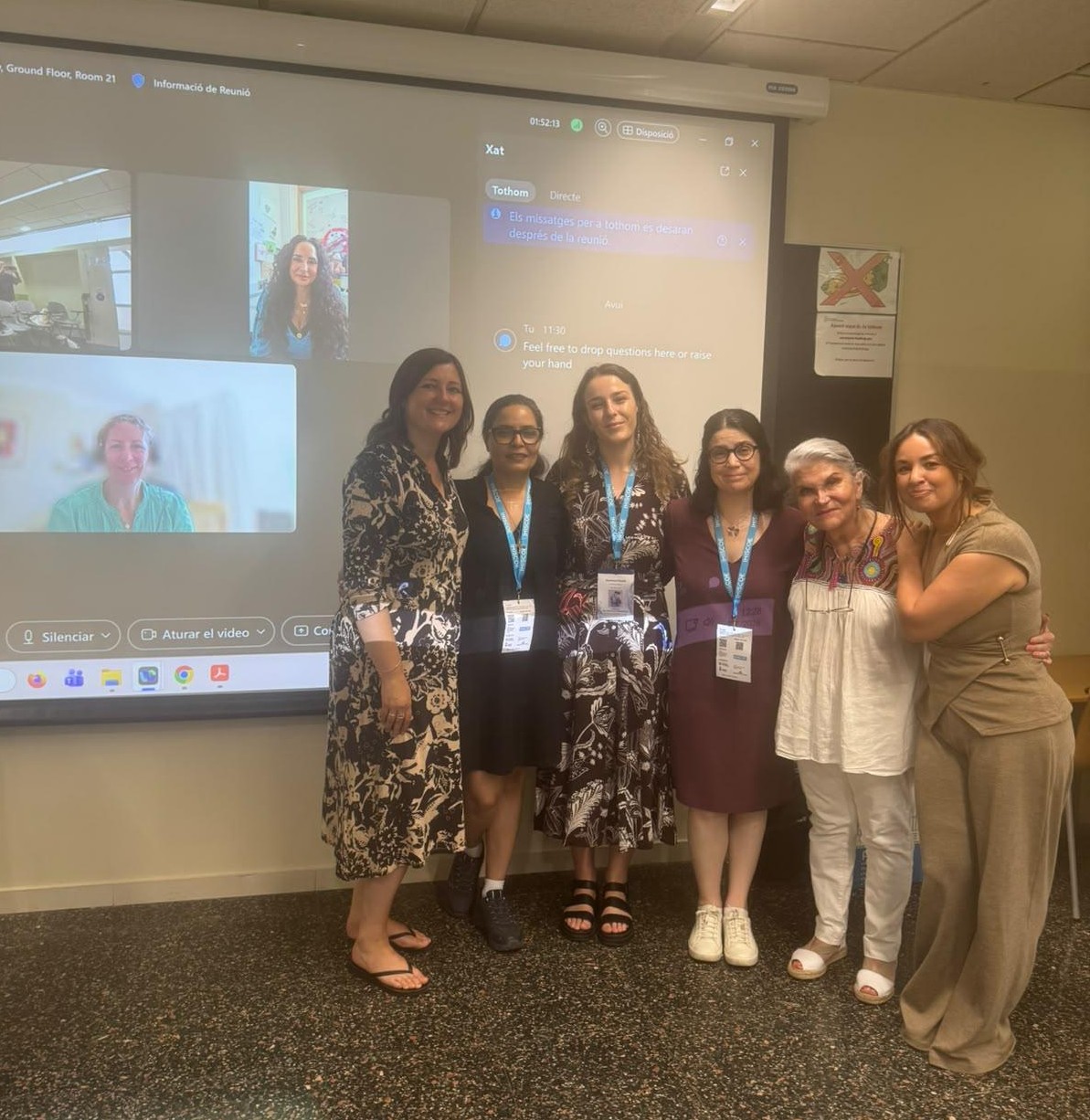
UK team’s contributions to 23rd IMISCOE Annual Conference “Strengthening Migration Studies through Community Engagement” in Girona (Catalonia, Spain), 29th June to 2nd July 2026
Ruth Evans (University of Reading) and Rosa Mas Giralt (University of Leeds), participated in the 23rd IMISCOE Annual Conference, 2026 on the theme “Strengthening Migration Studies through Community Engagement”. In the wonderful surroundings of Girona’s old city and through digital means, Ruth and Rosa contributed to a panel and a workshop. Our contributions continued to reflect and share the learnings from the conceptual and methodological approach adopted in the CareWell Transnational Families project. These sessions and others in the conference also provided opportunities to discuss care oriented research and dissemination practices with academic and peer researchers and practitioners.
Panel: “Power, Positionality, and the Praxis of Community Engagement in Migration Research through an intersectional lens”
Organisers: Lorena Izaguirre (CIRFASE, UCLouvain) & Andrea Souto (Lecturer, ESOMI, University A Coruña), with discussant Tanja Bastia (University of Manchester)
This panel session centred on applying an intersectional lens to researchers’ positionalities and reflexivity. It interrogated how this lens could be used as a methodological and ethical tool which drives migration scholars to remain faithful to intersectionality’s feminist and anti-racist principles in research, collaboration and dissemination. Ruth Evans (University of Reading) and Rosa Mas Giralt (University of Leeds) presented a paper entitled “Care ethics in participatory dissemination: co-producing participatory theatre and film with transnational families and actors with lived experience” drawing from a publication co-authored with Jude Haste, Hannah Micuta, Domiziana Turcatti, Grady Walker.
The paper discussed the relational ethics of care approach we adopted when co-producing participatory theatre and film with transnational families, actors with lived experience and practitioners as part of the Care, Inequalities and Wellbeing in Transnational Families in Europe research project. The focus of the presentation was on the academic researchers’ intersecting positionalities and roles as ‘mediators’ and the ethical concerns that emerged, including the need to balance the neoliberal academic drive to produce ‘outputs’ with contextual care ethics and avoid creating ‘false hope’ among participants. The paper proposed that ‘uncomfortable reflexivity’ (Pillow, 2003, p.188) and sensitivity guided by a feminist ethic of care are needed to create safe spaces capable of holding the heightened emotions which emerge when co-producing participatory theatre and film with care.
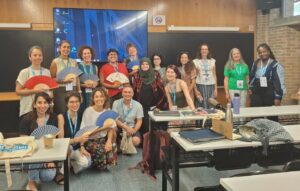
The discussion led by Tanja Bastia invited contributors and attendees to reflect on the power dynamics that continue to dominate academia and drive an output-focused culture, and on the feelings of ‘guilt’ that may emerge when considering our own ‘privileged’ positions as academic researchers. Participatory, feminist and critically engaged research continues to be undertaken within highly unequal organisational contexts and remains deeply gendered. There is the need to challenge the expectation that academic publications are the main measure of value, and to recognise instead the principles and practices that de-colonise academia and democratise knowledge production.
Workshop: “Resisting co-optation of participatory research and community engagement in migration studies through an ethics of care”
This hybrid workshop aimed at creating spaces to discuss how researchers, educators and practitioners can resist the co-optation of community voices by embedding an ethics of care (Tronto, 1993) in their work. Central to the ethos of the workshop was the coming together of an intergenerational group of practitioners, peer and academic researchers (some of them long-time collaborators) to reflect, share and engage participants in a dialogical process and critical reflections on notions and practices of care, and their importance in participatory research and community engagement with migrant families and young people.
Ruth Evans (University of Reading) and Rosa Mas Giralt (University of Leeds) shared their experiences of adopting a feminist ethic of care approach to working with peer or community researchers and actors with lived experience in the Care, Inequalities and Wellbeing in Transnational Families in Europe research project. Drawing from a publication co-authored with Jude Haste, Hannah Micuta, Domiziana Turcatti, and Grady Walker, the presentation focused on reflecting on some of the key ethical issues that emerged when working with community researchers during fieldwork and discussing the work with families and actors with lived experience during participatory feedback and dissemination stages. The central idea was to show how an ethic of care approach enabled academic researchers to remain attuned to power differentials and the care relations present throughout the project. This included efforts to reduce power imbalances in research relations, facilitate the participation of families and practitioners with lived experience, and foster care across the whole team. It was also important to recognise the ‘tensions and messiness’ (Caretta and Riaño, 2016, p.263) that often characterise feminist participatory research projects. The project involved ‘muddling through’ what was possible within its constraints, while remaining open to new opportunities and ways of working. This exploratory and reflective approach created a process of mutual learning and may inform different ways of working in the future.
The workshop attendees were highly engaged, with particular interest in hearing more from the practitioners and peer researchers who took part in the workshop. This demonstrated the importance of fully recognising the partnership work beyond academic walls that lies at the heart of participatory research.
Workshop Participants: Kate Smith (Independent Scholar, Research Fellow and Practitioner, UK), Rosa Mas Giralt (University of Leeds), Martha Montero-Sieburth (University of Massachusetts-Boston), Domiziana Turcatti (University of Oxford), Hana Alhadi (International Association for Intercultural Education), Claudia Lopez-Prieto (Saint Gabriel’s College London), Nabila El Ouatassi (BESMA – Mercy Program), Ruth Evans (University of Reading), Yasna Khan (Community Researcher, Community organiser at Together in Unity).
Further information:
View our film: Reflections on Participatory Research with Transnational Families
References:
Caretta, M. A., & Riaño, Y. (2016). Feminist participatory methodologies in geography: creating spaces of inclusion. Qualitative Research, 16(3), 258-266.
Pillow, W. (2003). Confession, catharsis, or cure? Rethinking the uses of reflexivity as methodological power in qualitative research. Qualitative Studies in Education, 16, 175–196.
Tronto J. (1993). Moral Boundaries: A Political Argument for an Ethic of Care. New York and London: Routledge