
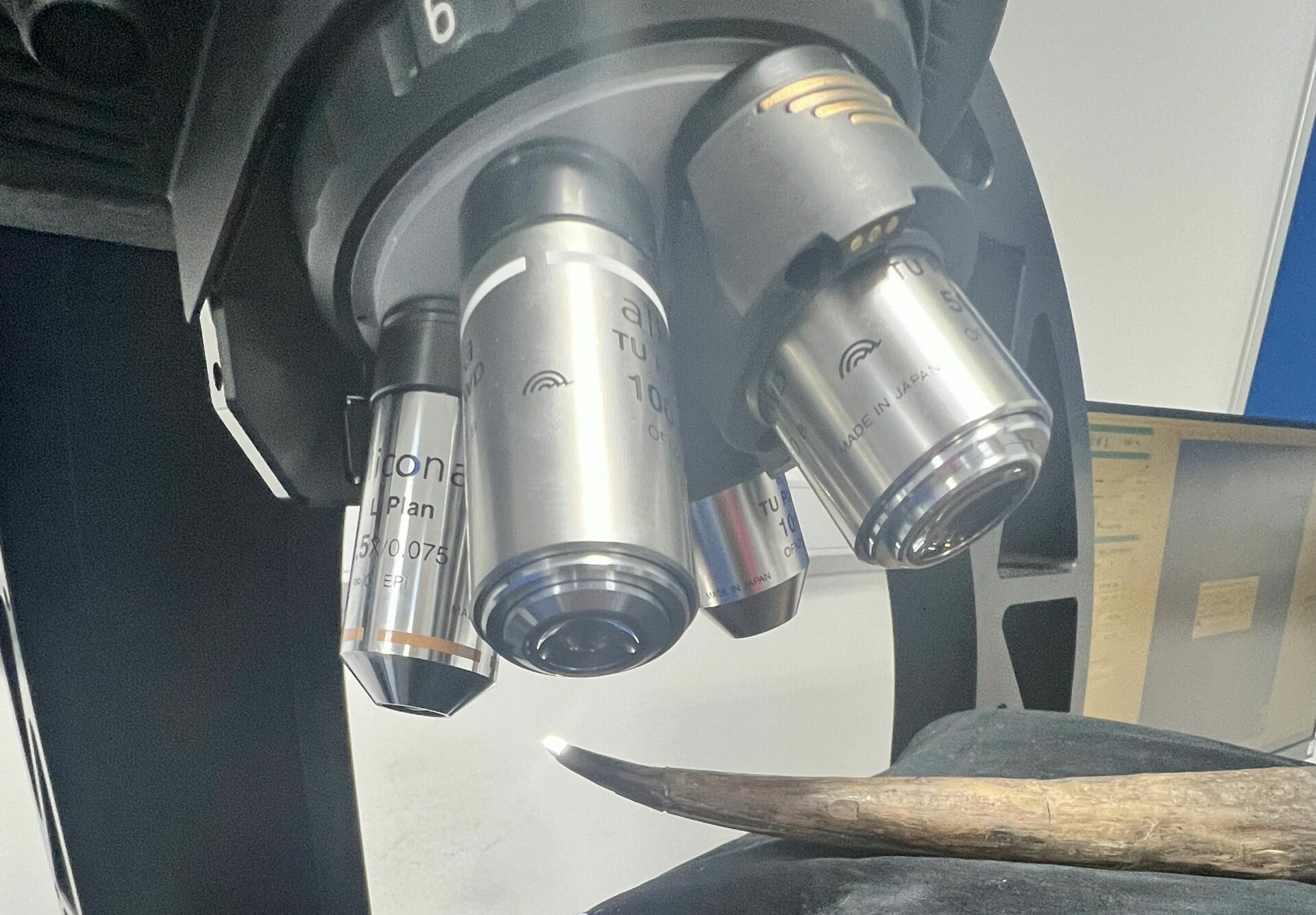
Archaeologists from the University of Reading and the Natural History Museum (NHM) have created a ‘biography’ of what could be the world’s oldest woodworked artefact, putting the skills of its Palaeolithic makers into sharper focus.
Discovered in 1911, the Clacton spear is one of the oldest examples of woodworking in the world with an approximate age of 400,000 years. Housed permanently in the Human Evolution Gallery at the NHM, new studies of the spear have been revealing insights into the skills and handiwork of ancient hominins, our ancestors.
Using modern techniques and the latest imaging technologies, a team comprising of archaeologist Dr Annemieke Mills (University of Reading) and Silvia Bello, Simon Parfitt and Lucile Crete of the NHM Centre for Human Evolution Research have compiled a ‘biography’ of this ancient weapon.
Through various methods of microscopy, tomography and scanning, the team have analysed the external and internal features of the artefact and compared them to similarly-made spears found in Schöningen, Germany, that date back to approximately 300,000 years ago. The combined results unveil the hominin creators’ strategies for shaping the spear, with early indications that they would have been aware of the material’s properties and how to manipulate them to create an effective weapon.
The research team are now working to contextualise the spear in the specific time period known as ‘Marine Isotope Stage 11’ or approximately 400,000 years before the present. Their analyses and images are being prepared for journal submission.