
Shortlisted for Knowledge Exchange/Transfer Initiative of the Year – Times Higher Education Awards 2025
Reading researchers are helping Ghanaian cocoa producers combat soil degradation through sustainable composting techniques, achieving 40% yield increases and training over 1000 farmers.
The world loves chocolate and global demand is increasing. But continuous cropping of the same land leaves cocoa farmers across West Africa, the largest cocoa producing region in the world, with degraded soil. This in turn results in yield decline and shifting cultivation, often linked to deforestation.
Soil amendments made from on-farm organic wastes represent a sustainable alternative or complement to expensive inorganic fertilisers. Yet many farmers lack the necessary information and training to develop formulations that suit the particular soil of their farms.
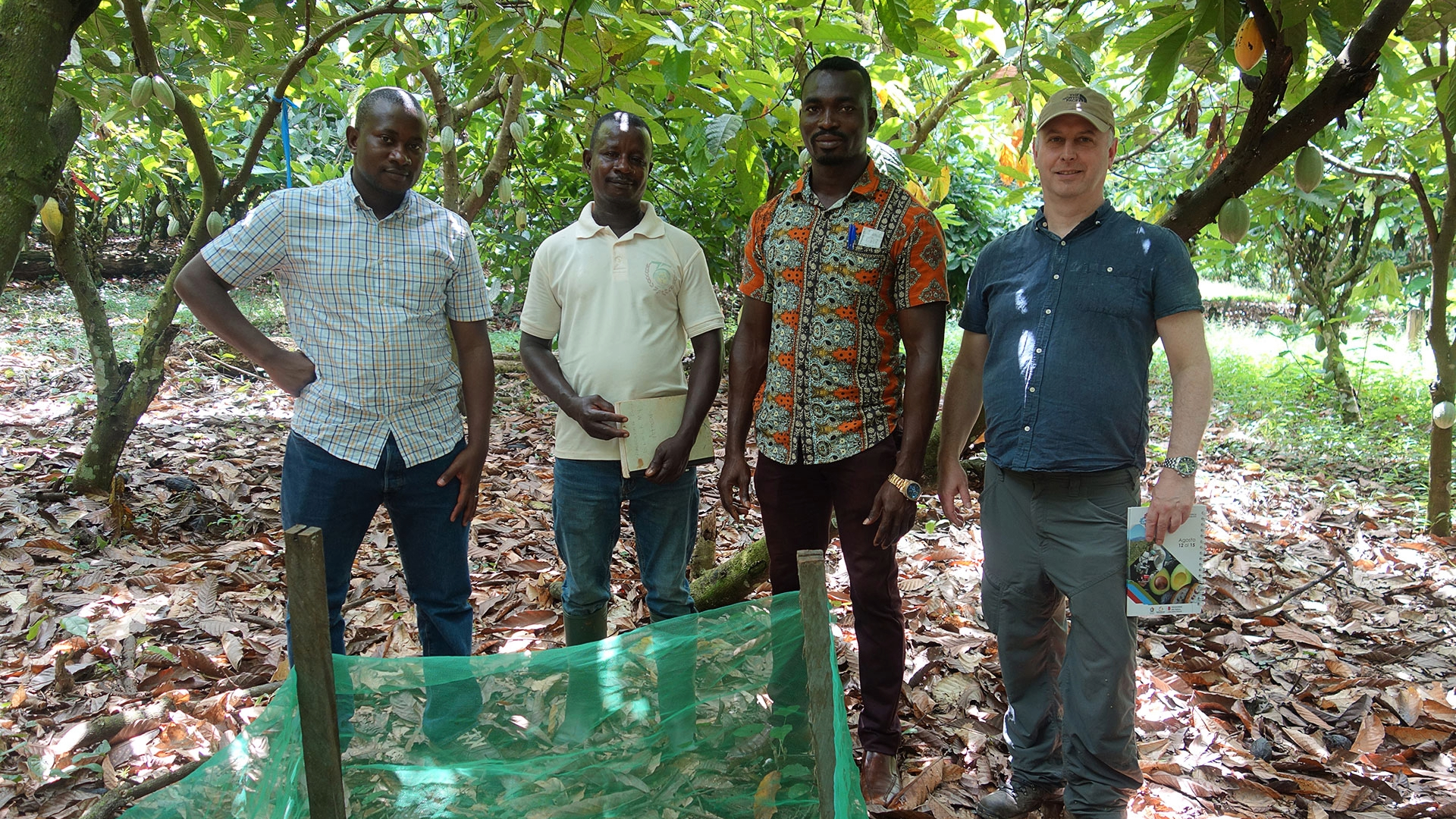
This project originated from a GCRF-funded partnership between the University of Reading, the Cocoa Research Institute of Ghana (CRIG) and Kwame Nkrumah University of Science and Technology (KNUST). A team led by Dr Andrew Daymond and Professor Tom Sizmur took an innovative participatory approach, establishing field trials in Ghana in partnership with farmers on their farms (in 2021) and involving field extension agents in data collection throughout 2023, 2024 and beyond. In so doing, the team demonstrated the yield benefit of compost and biochar made from cocoa pod husks, an abundant on-farm organic waste. This work set the foundation for subsequent knowledge exchange activities, which aimed to increase adoption of organic soil amendments and ultimately improve cocoa yields.
In early 2024 the team conducted field-based collaborative workshops that have resulted in the training of over 1,000 farmers and extension agents. By conducting these training events in communities where field trials had taken place, farmers were able to provide testimonials on the benefits of the use of biochar and compost they observed on their farms. For the 2024 season, the project recorded an average yield increase of approximately 40% with application of 5 tonnes per hectare compost, and farmers also observed that their crops were generally more healthy.
Various knowledge exchange materials (leaflets and videos on compost production and farmer testimonials) produced as part of the project have been translated into multiple languages (Twi, French, Spanish, Portuguese) and made available to download to facilitate international access. To date, the videos have accumulated over 1,300 views in total.
As well as benefitting farmers, the project has had a direct impact on Emfed farms, a business that partnered in the original project by providing compost for the field trials. Subsequently, the fastest growing part of their business is now compost production from cocoa farm waste. Broader industry engagement was achieved through a stakeholder workshop in June 2024, which was used to transfer knowledge of the benefits of the use of soil amendments. Following on from this, a further proposal has been developed with a confectionery company to examine the impacts of soil amendments on field establishment. That will further build on the original research and continue the partnership between University of Reading, Kwame Nkrumah University of Science and Technology and the Cocoa Research Institute of Ghana.
Team: Andrew Daymond and Tom Sizmur (University of Reading), Amos Quaye (Cocoa Research Institute of Ghana), Laura Atuah and Dadson Awunyo-Vitor (Kwame Nkrumah University of Science and Technology)
Published: September 2025