
Research with 220 UK stakeholders provides a roadmap for scaling up agroforestry, starting with trusted advice and real farm examples.
Research with 220 UK stakeholders, led by Dr Amelia Hood (Department of Sustainable Land Management, University of Reading), provides a roadmap for policymakers, educators and researchers to turn interest in agroforestry into action and support farmers through agricultural transition.
UK agriculture is undergoing its most significant transformation since WWII. Post-Brexit agricultural policy reforms, alongside growing environmental pressures such as climate change, have created major uncertainty for farmers. At the same time, new policies are opening opportunities to farm differently, including increased financial support for tree planting through agroforestry.
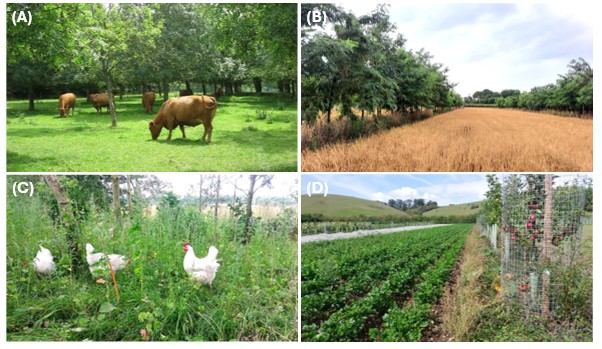
Agroforestry – the integration of trees into crop (e.g. cereals) or livestock (e.g. grazing cattle) systems – is one of the few farming approaches that can benefit both food production and the environment at the same time (Figure 1).
Trees in fields can support climate resilience, biodiversity and soil health, while maintaining or even increasing food production. This makes agroforestry particularly attractive to both farmers and conservationists. Despite this promise, agroforestry remains rare in the UK, with only around 3% of agricultural land estimated to be under agroforestry systems.
Dr Hood said, “We’re seeing strong interest in agroforestry, but interest isn’t the same as implementation. Our research shows that many land managers still struggle to adopt agroforestry because they feel they lack the practical knowledge needed to set it up and manage it effectively.
Many farmers want to see working examples of agroforestry in their area, before committing to new methods with long-term implications for farm management.”
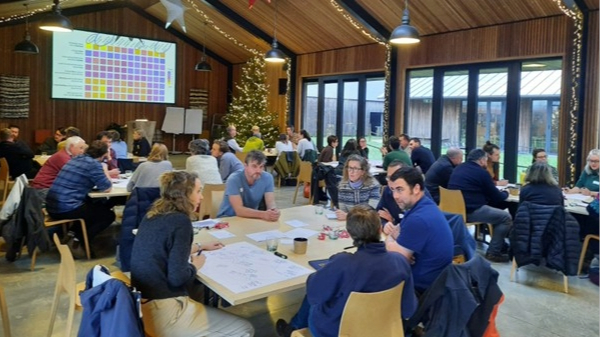
To address these challenges, Dr Hood brought together 220 stakeholders from across the UK, including farmers, policymakers, non-governmental organisations and researchers. Through workshops and consultations, participants identified key barriers to agroforestry adoption and worked together to co-design practical tools and solutions to overcome them.
This resulted in a national research agenda and an educational agenda for agroforestry, five key actions for policymakers and four key actions for agroforestry educators.
Building the research evidence: Trees-in-Fields Network
One of the strongest messages from farmers and educators was the importance of real-world, on-farm examples. Stakeholders emphasised that seeing agroforestry in practice and understanding how different systems are managed over time is essential for building confidence.
In response, Dr Hood has established a long-term national research programme, the Trees-in-Fields Network, which brings together demonstration farms across the UK. The network is designed to generate robust, practical evidence on agroforestry management under real farming conditions, with research questions that are farmer-led. Dr Hood’s team of researchers and farmers are now testing the impacts of planting different tree species and introducing novel crops within agroforestry systems, helping to answer farmers’ most pressing questions.
Strengthening education and trust
Alongside research, the project highlighted the need to strengthen agroforestry education. Participants noted that the UK has a lower rate of formal agricultural training than several other European countries, limiting opportunities for current and future land managers to learn about sustainable farming approaches.
Trust in existing agricultural advice was also described as low. Stakeholders suggested a range of solutions, including developing an agroforestry accreditation scheme and creating government-funded education programmes. These recommendations form the core of the project’s educational agenda and are designed to ensure advice is credible, practical and rooted in real farming experience.
Supporting food security, the environment and net zero
By engaging a wide range of stakeholders from across the agricultural supply chain, this research has produced specific, actionable recommendations that reflect the realities of farming. Agroforestry stands out as a farming intervention that can deliver meaningful environmental benefits while maintaining – and in some cases increasing – food production, a rare combination in agricultural management.
Implementing the research and educational agendas identified through this project could help accelerate agroforestry adoption in the UK and unlock its potential to support food security, environmental recovery and progress towards net zero, while helping farmers navigate a rapidly changing agricultural landscape.
Dr Amelia Hood is a research-intensive lecturer at the University of Reading’s Department of Sustainable Land Management whose work focuses on agroforestry, biodiversity and soil health, with a strong emphasis on participatory research with farmers. Her project “Building climate-resilient food systems with silvoarable farming” is funded by the National Institute for Research into Dairying Trust’s AgriFood ‘Rising Star’ Fellowship.
Hood, A.S.C., Scholes, R.E., Degani, E. et al. (2026) Co-designing a research agenda for UK agroforestry using a multi-actor approach. Agronomy for Sustainable Development, 46, 20. https://doi.org/10.1007/s13593-026-01089-8
Hood, A. S. C., Scherfranz, V., Scholes, R. E., Degani, E., Staton, T., Varah, A., Schaller, L., & Mauchline, A. L. (2025) Identifying knowledge barriers to agroforestry adoption and co-designing solutions to them. People and Nature, 00, 1–16. https://doi.org/10.1002/pan3.70219