
By Alison Fowler
At the end of September, I joined approximately 100 scientists from operational centres and academia, each contributing to progress in data assimilation. Together in Melbourne for the 11th International Symposium on Data Assimilation, we had a week of sharing our latest research and debating on the future directions.
The Presentations
The week was split into oral and Poster sessions. Keynote speakers included Anna Shlyaeva (UCAR, NOAA), Craig Bishop (U. Melbourne), Greg Hakim (U. Washington), Joel Bedard (ECCC), Marc Bocquet (Institut Polytechnique de Paris), Kozo Okamoto (JMA), Tony McNally (ECMWF) and Xuguang Wang (U. Oklahoma).
I enjoyed the breadth of work discussed. Topics ranged from the importance of initial conditions on predictability (cf. Georg Craig) and how machine learning could potentially redefine the limits of predictability (cf. Greg Hakim), to advances in all-sky data assimilation (cf. Kozo Okamoto, Leonard Scheck, Philipp Griewank, Lilli Lei), and encompassing many topics in between and beyond!
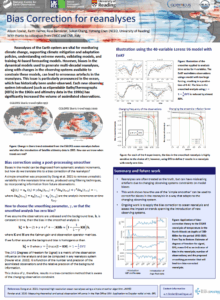
My contribution focused on the issue of artefacts in reanalyses that arise due to changes in observing systems. Earth system reanalyses are crucial for monitoring climate change, informing policies, understanding extreme events, validating models, and training AI-based forecasting models. However, biases in the underlying dynamical models and evolving observing systems used to constrain these models can introduce erroneous artefacts. This challenge is especially significant in the ocean, which has been historically under-observed. Whenever a new observing system is introduced—such as Expendable Bathythermographs (XBTs) in the 1960s or altimetry data in the 1990s—the volume of assimilated observations increases dramatically. We addressed this by adapting a post-processing smoother. We included a parameter to account for the evolving observation information, which helps remove these erroneous artefacts from the reanalysis time series.
Machine Learning
It is no surprise that machine learning was a recurring theme throughout the symposium. We concluded the week with a 2-hour forum on integrating machine learning and data assimilation. Concerns were raised that the rise of AI might lead to funding being unwisely diverted from advancing our fundamental physical understanding of the world. The importance of maintaining this focus needs to continue to be clearly communicated. Nevertheless, machine learning offers many opportunities to rethink our approaches to forecasting, how we represent physical processes and the information we can extract from observations. Discussion included the reliance of data-driven models on reanalyses and what aspects of these reanalyses need improvement to enhance the performance of data-driven models. Can machine learning be used in itself to improve reanalyses, enabling faster and more targeted reanalysis production accessible to many?
Until the next time
It was great to catch up with the DA community and the vast Reading alumni now spread across the globe. I leave the southern hemisphere in Spring to return to Autumn and to work buzzing with ideas for future research directions. I would like to thank the organising committee who made the week so enjoyable. Next year, the symposium will be held in Nanjing. Meanwhile, the ISDA online series returns in the new year.
Acknowledgements
The work I shared at the symposium was funded by the National Centre for Earth Observation and Copernicus.


