

by Ravi Shankar Nemani, March 2026
In the pursuit of accurate initial conditions for Numerical Weather Prediction, the specification of the background error covariance matrix, commonly referred to as the B-matrix, is a defining challenge. While pure Ensemble Kalman Filter methodologies implicitly derive error covariances directly from ensemble member updates, Variational Data Assimilation (VarDA) frameworks must explicitly model this massive matrix. Within VarDA and modern hybrid systems, error variances dictate the relative weight given to the background forecast versus incoming observations, but it is the cross-variable covariances (the off-diagonal elements) that govern how information propagates between different physical variables.
In high-resolution, convective-scale data assimilation, these multivariate correlations are not merely statistical artefacts; they are the mathematical enforcers of dynamical balance and physical consistency.
Enforcing balance in the analysis
In traditional VarDA, the primary function of modelled cross-variable covariances is to enforce multivariate balance relationships. This ensures the assimilation system does not shock the forecast model with unbalanced gravity waves when observations are introduced. At synoptic scales, these relationships are successfully derived from large-scale linear balance equations relating mass fields to wind fields.
By defining these correlations through specific control variable transforms, an observation of wind can physically adjust the pressure field, and vice versa. Without explicitly modelling these cross-covariances, a pure VarDA analysis would treat variables as entirely independent, leading to physically inconsistent states that the forecast model would rapidly reject.
The challenge of high resolution and flow dependency
In high-resolution, convective-scale modelling, the “static” balance relationships valid at synoptic scales (like geostrophy) break down. Climatological covariances fail to capture the transient, fine-scale correlations inherent in convective storms, such as the strong coupling between vertical velocity, humidity, and hydrometeors.
For instance, in convective areas, there is a physical correlation between mid-level humidity and low-level convergence. Standard climatological B-matrices often neglect the coupling between humidity and divergence, treating humidity as a univariate control variable. However, research demonstrates that introducing specific, flow-dependent cross-covariances in precipitating areas allows the assimilation of radar reflectivity to correctly adjust the dynamical fields. This heterogeneous formulation enables mid-level humidification to reinforce low-level cooling and convergence, a critical mechanism for sustaining modelled storms.
To address the limitations of static balances, modern data assimilation systems increasingly rely on ensemble-based approaches (e.g., EnVar). Ensembles provide flow-dependent background error covariances that reflect the “errors of the day” rather than a long-term climatological average.
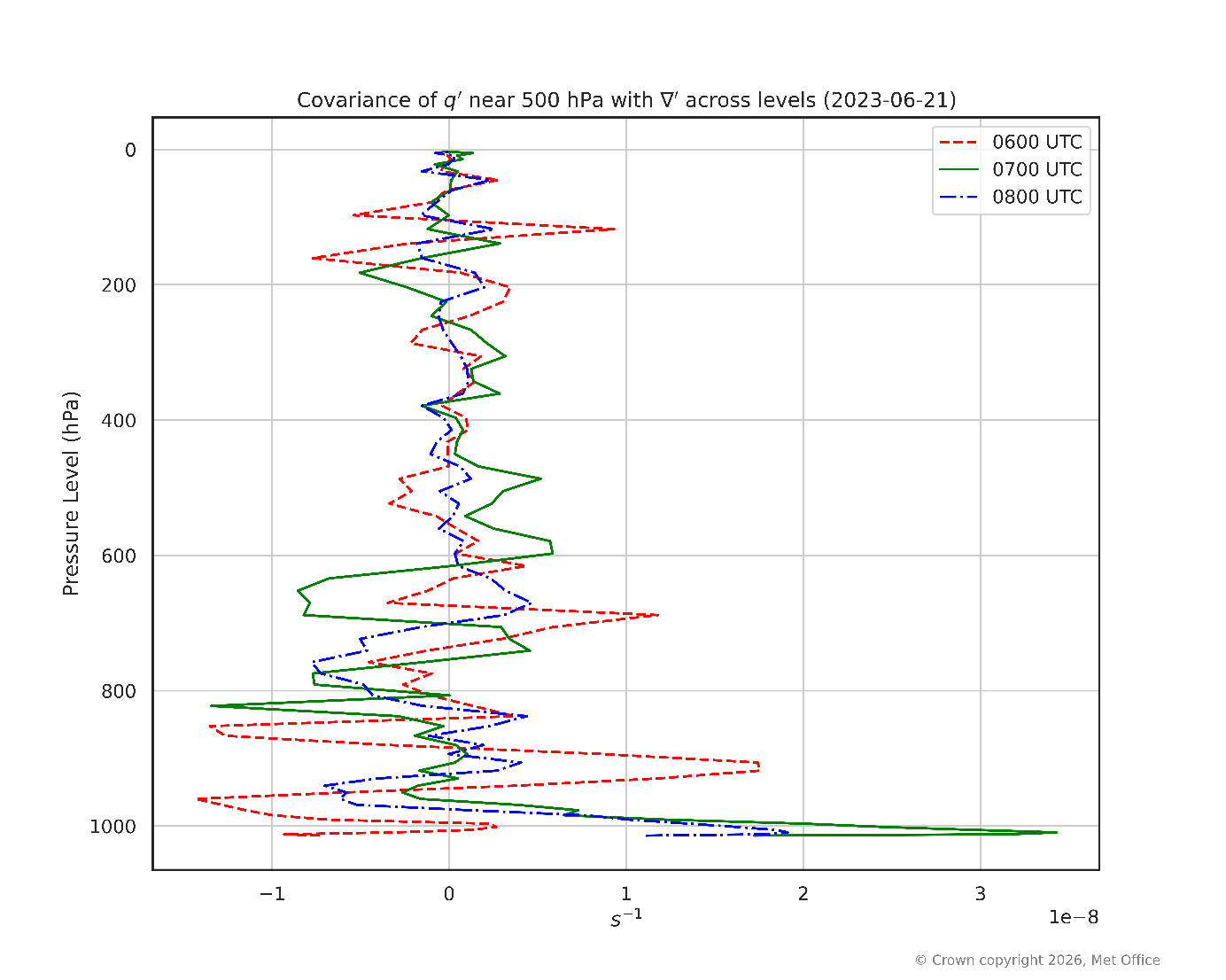
The necessity of this flow-dependent formulation is illustrated in Figure 1, which displays the vertical structure of cross-variable error covariances between specific humidity perturbations near 500 hPa and divergence perturbations across pressure levels at distinct time steps. The data are from the high-resolution Met Office Wessex model over the Wessex domain in the southwest part of England, with the profile shown at a representative grid point. Note the significant temporal variability in the coupling strength and vertical extent, a feature that a static 𝐵-matrix would completely misrepresent.
These flow-dependent correlations are vital for high-resolution models where fine-scale features dominate. They allow the assimilation system to capture sharp gradients and complex multivariate relationships that static parameter transforms cannot represent. For example, in the presence of strong curvature, terms involving the rotational wind become significant, requiring nonlinear balance constraints that change from cycle to cycle.
Conclusion
Do cross-variable covariances really matter? Absolutely. They are the bridge between observation and physical consistency. In high-resolution data assimilation, neglecting these covariances or relying on static, large-scale approximations severs the link between thermodynamic and dynamic variables, limiting the ability of dense observations (like radar) to correct convective-scale flow. The transition toward flow-dependent, ensemble-derived B-matrices represents a necessary evolution to capture the complex, transient multivariate balances that define high-impact weather.
Further reading
Bannister, R. N. (2008). A review of forecast error covariance statistics in atmospheric variational data assimilation. II: Modelling the forecast error covariance statistics. Quarterly Journal of the Royal Meteorological Society. Royal Meteorological Society (Great Britain), 134(637), 1971–1996. doi:10.1002/qj.340
Bédard, J., Buehner, M., Caron, J.-F., Baek, S.-J., & Fillion, L. (2018). Practical ensemble-based approaches to estimate atmospheric background error covariances for limited-area deterministic data assimilation. Monthly Weather Review, 146(11), 3717–3733. doi:10.1175/mwr-d-18-0145.1
Hanley, K., & Lean, H. (2025). Urban-scale modelling for WesCon. Technical Report 667 doi:10.62998/dite4759
Liu, B., Huang, Q., & Zhao, Y. (2024, January 19). Research on balance relationships in variational data assimilation and its statistical methods. 2024 4th International Conference on Neural Networks, Information and Communication (NNICE), 1754–1757. Presented at the 2024 4th International Conference on Neural Networks, Information and Communication (NNICE), Guangzhou, China. doi:10.1109/nnice61279.2024.10499093
Ménétrier, B., Montmerle, T., Berre, L., & Michel, Y. (2014). Estimation and diagnosis of heterogeneous flow-dependent background-error covariances at the convective scale using either large or small ensembles. Quarterly Journal of the Royal Meteorological Society. Royal Meteorological Society (Great Britain), 140(683), 2050–2061. doi:10.1002/qj.2267
Montmerle, T. (2012). Optimization of the assimilation of radar data at the convective scale using specific background error covariances in precipitation. Monthly Weather Review, 140(11), 3495–3506. doi:10.1175/mwr-d-12-00008.1


