
by Tristan Quaife, May 2025
Implementing a Data Assimilation system for a model can be an arduous task, often involving a substantial amount of reprogramming. A better option, where possible, is to build Data Assimilation into the design of a model from the outset. The Terrestrial Carbon Community Assimilation System, or TCCAS, has been designed with exactly that in mind.
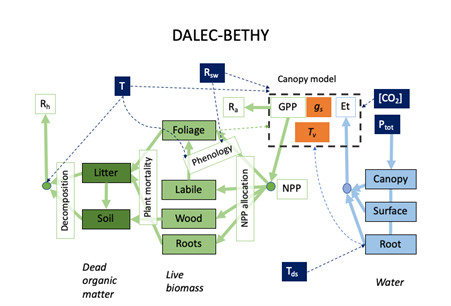
TCCAS contains two existing models: DALEC and BETHY. These models handle different aspects of land surface processes related to the carbon cycle, and combined they form a single model called D&B. Both models have significant pedigree in terrestrial carbon cycle science and are used in a wide range of applications. Figure 1. illustrates some of the processes that are included in the combined D&B model.
Data Assimilation
The TCASS computer code is wrapped in a data assimilation system that can take in a variety of data types. The data assimilation wrapper can also adjust the parameters of the D&B model to provide the best match between the model outputs and the observed data (e.g., the flux of carbon between the land and the atmosphere), The Data Assimilation routines require differentiated versions of the model code so, as new parts of the model are added, all necessary tools for differentiation are included at the same time. This means that Data Assimilation is always available for the latest model version.
The development of TCCAS was funded by the European Space Agency, under several projects, with the goal of allowing it to exploit a range of different satellite data. To that end, TCCAS contains observation operators (see my previous blog post) that represent low-level observations from various satellites, including vegetation optical depth and solar induced fluorescence. Future developments will address observations from some satellites that have yet to be launched, such as FLEX. FLEX will be the first dedicated satellite mission to observe solar induced fluorescence from plants and will provide important information about how much carbon they are taking up.
Applications for TCCAS
TCCAS is ideally suited to assessing carbon budgets on regional to global scales. Given sufficient data to constrain it, it can predict how much carbon is being taken up by terrestrial vegetation, such as forests. Therefore, using TCCAS we can predict how much carbon will be absorbed under different land management regimes, for example afforestation.
TCCAS can also be used at the site scale to examine ecosystem level process in detail. This has been done for a handful of experimental forest sites where large amounts of data are routinely collected. Where such data exists, D&B can help to understand questions such as ‘how have droughts affected the carbon balance of a forest?’ or ‘how do cold temperatures affect photosynthesis?’.
TCCAS can also be used for something known as observing system simulation experiments (or “OSSEs”). For example, if a new satellite was proposed to study the carbon cycle, TCCAS can be used to assess the impact of the new satellite observations in terms of the model’s ability to constrain carbon sequestration rates. It’s also possible to examine “what if” scenarios such as the impact of clouds or a change in satellite orbit on the model predictions.
Can anyone use it?
In short, yes! TCCAS is freely available for download. Sample datasets used to run the model and perform assimilation experiments are also included. There is an extensive user manual which is being continually updated. The manual includes instructions on how to install the software and how to run some pre-configured examples. There are also occasional training events to help get people started using the software.
Where can I find out more?
More information is available on the TCCAS web page: https://tccas.inversion-lab.com/
A recent peer reviewed scientific paper describes the D&B model in detail: Knorr, Wolfgang, et al. “A comprehensive land-surface vegetation model for multi-stream data assimilation, D&B v1. 0.” Geoscientific Model Development 18.7 (2025): 2137-2159. https://gmd.copernicus.org/articles/18/2137/2025/
And another paper describing the data assimilation system will be published in due course.


