
by Rishabh Bhatt, June 2026
Role of observations in data assimilation (DA)
Observations are a key component of DA. Space agencies invest billions of pounds in providing wide-ranging, high-resolution observations of the Earth to improve weather forecasting. These observations provide information about the atmospheric state at spatial scales that numerical models cannot resolve. This becomes increasingly important for convective-scale DA where model uncertainties are often large such as within areas of deep convection and tropical cyclones.
Despite the abundance of available satellite data, only a small proportion is actively assimilated at operational forecasting centres. For example, at the European Centre for Medium-Range Weather Forecasts (ECMWF), only around 40-50% of available AMSU-A (a microwave temperature sounder) observations are assimilated. While some observations are rejected during quality control procedures, many are excluded through observation thinning strategies to mitigate the effects of unaccounted-for spatially correlated observation errors. Therefore, to achieve a denser assimilation of observations in DA, accurately quantifying and representing observation-error correlations remains important.
What are spatial observation-error correlations?
Observation-error correlations describe how the error in one observation is related to the error in another observation. Spatial correlations quantify this relationship based on the separation distance between any two observations.
To illustrate this concept, consider temperature observation errors in Reading, London and Edinburgh. If the observation error is large in London, it is more likely that the error will also be large in Reading than in Edinburgh (assuming positive correlations). This may occur because the errors are influenced by similar local atmospheric conditions or common sources of error, such as satellite calibration biases.
The existence of such correlations means that observations are not fully independent. In other words, neighbouring observations do not always provide completely new information. If these correlations are ignored, the DA system may overestimate the information content of dense observations, leading to suboptimal weighting in the DA cost function and potentially degrading the quality of analysis. It is only when accounting for correlations that it is possible to appropriately fit observations at all scales (Rainwater et al., 2015).
Correlations in AMSU-A observations
In our recent study (Bhatt et al.,2026), we provided estimates of spatial observation-error correlations in AMSU-A observations assimilated under all-sky conditions using a month of operational data from ECMWF and the UK Met Office. The correlations were estimated using the widely adopted method of Desroziers et al. (2005).
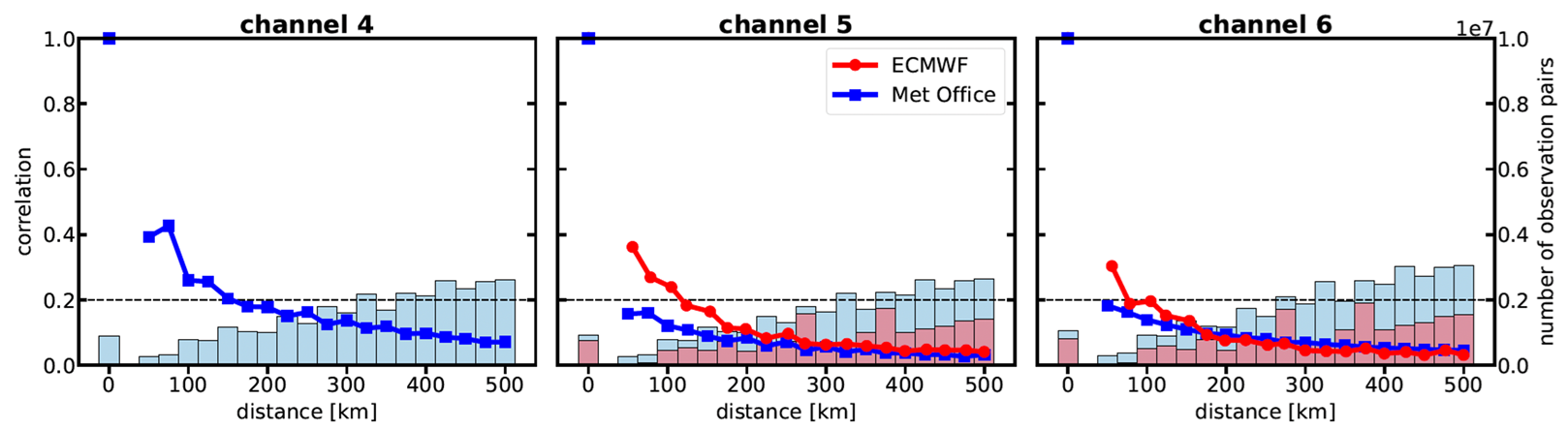
We found positive spatial observation-error correlations whose magnitude varies with the surface type and cloud conditions. Figure 1 shows the global correlation estimates for AMSU-A tropospheric channels onboard NOAA-18. Large correlations can be seen for channel 4 at Met Office and for channels 5 and 6 at ECMWF.
More generally, the strongest correlations were found for tropospheric channels over land and in the presence of clouds for both operational centres. Our findings suggest that these strong correlations can largely be attributed to the errors in the specification of surface emissivity and skin temperature within the radiative transfer model. Another important source is likely to be the misrepresentation of clouds and hydrometeors within the forecast model.
Current status
At present, spatial observation-error correlations are not accounted for globally at operational centres because of the immense computational costs involved (inverting a large dense observation-error covariance matrix). We are currently investigating efficient numerical techniques that could significantly reduce this cost. Given that microwave observations such as from AMSU-A are among the most influential observation types in numerical weather prediction, improvements in the treatment of observation-error correlations have the potential to improve forecast skill.
References
Bhatt, R., Bonavita, M., Bormann, N., Dance, S.L., Fowler, A., Hólm, E., Merchant, C.J., Mittaz, J., Newman, S. and Waller, J., 2026. Spatial observation‐error correlations for AMSU‐A in all‐sky assimilation: An ECMWF and UK Met Office intercomparison. Quarterly Journal of the Royal Meteorological Society, p.e70238.
Desroziers, G., Berre, L., Chapnik, B., & Poli, P. (2005). Diagnosis of observation, background and analysis‐error statistics in observation space. Quarterly Journal of the Royal Meteorological Society: A journal of the atmospheric sciences, applied meteorology and physical oceanography, 131(613), 3385-3396.
Rainwater, S., Bishop, C. H., & Campbell, W. F. (2015). The benefits of correlated observation errors for small scales. Quarterly Journal of the Royal Meteorological Society, 141(693), 3439-3445.