Our DH Academic Champion and Community of Practice lead, Dr Mara Oliva, shares her reflections on the CoP’s inaugural conference on our Connecting Research blog. The conference, on the theme of Digital Humanities and Artificial Intelligence, took place last month.
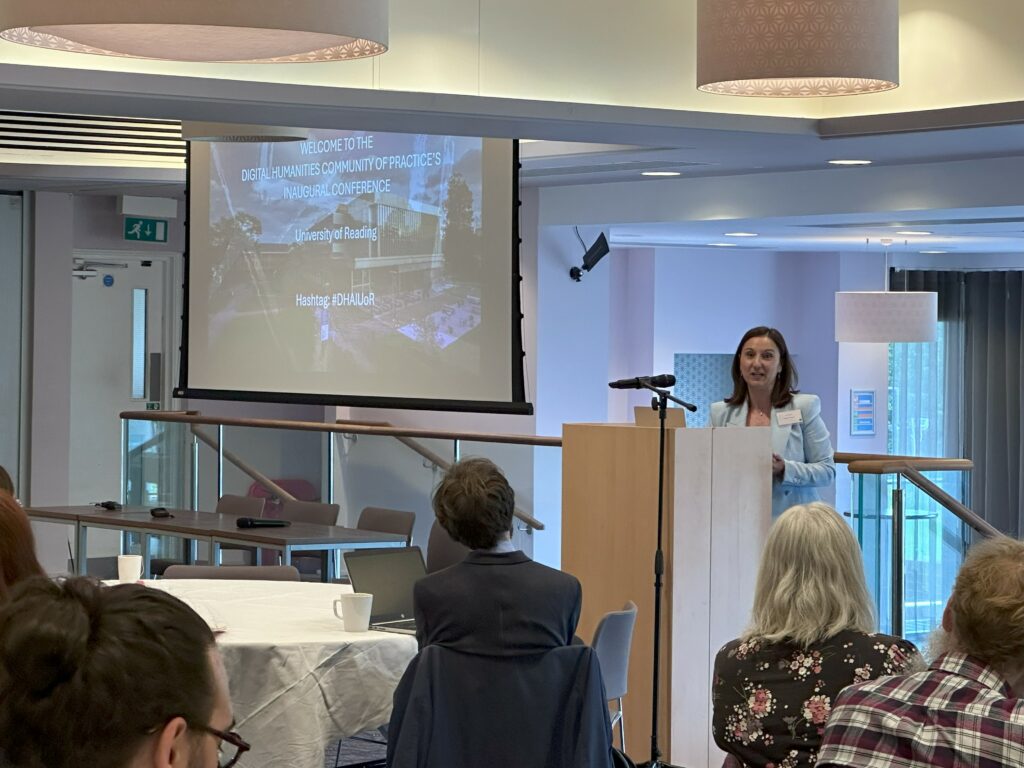
Dr Mara Oliva, Associate Professor in US History and Digital Humanities Champion, welcoming delegates. Photo credit: Professor James Ferryman.
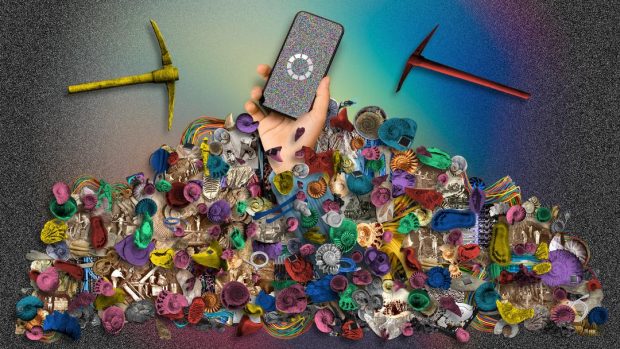
Luke Conroy and Anne Fehres & AI4Media / Better Images of AI / Models Built From Fossils / CC-BY 4.0
Archives have changed throughout history often in response to the introduction of novel technologies. At the heart of the BRAID/AHRC-funded project ‘Creating a Dynamic Archive of Responsible Ecosystems in the Context of Creative AI’ (2023-4), has been the question as to what might archives become in the future when AI will most probably form part of several artworks that will be archived by different kinds of cultural organisations which will also most likely use AI for the documentation and conservation of such artworks. The project, led by the University of Nottingham in collaboration with the University of Exeter, National Archives, and Blueskeye AI, investigated how archives could become dynamic so as to accommodate these kinds of artworks, and related documentation and archiving practices, looking also into what ecosystems are necessary for the production and conservation of this kind of archive.
Building on the curator and new media researcher Annet Dekker’s findings about how best to conserve artworks by using a ‘network of care’ (2018) and Dekker and Giannachi’s notion of ‘generative preservation’ as a way to enable further iterations of existing artworks as part of the conservation process (2023), we started by looking into who might be the possible stakeholders of such archives, mindful of the fact that the ecosystem of an artwork and the ecosystem of its documentation and archive may differ depending on whether the artwork is preserved by the artists, a library, a museum, or all of the above. This suggests that the key stakeholders of a work will be its creators, performers, funders, copyright-holders, and end-users, as well as the stakeholders from the archives and collections in which the works may reside.
Conscious of AI’s potential to hallucinate especially when faced with incomplete and recent data, we arrived at the conclusion that dynamic archives should be editable and facilitate annotation; continue to grow over time; reconstitute themselves in accordance to keywords set by whoever may wish to consult them; make visible different time-based versions of themselves; be used curatorially and creatively as a live (generative) archive; and provide the context and live, iterative, documentation of a work, including artworks generated by AI. Interestingly, when we asked ChatGPT what it thought a dynamic archive was, it described it as an evolving and interactive repository of different types of resources facilitating personalisation (or customization), agility, contextualisation, collaboration and feedback — a definition that was not too far from the one we had arrived at. Critical, is the fact that these archives’ ecosystems should make room for unpredictable factors that might emerge over time. In this sense, ecosystems must remain open and be capable of anticipating change.
We found that the potential of AI in documentation is related to what has already been documented and is available to it. This means that the use of AI for contextualisation, audience documentation, the documentation of a large quantity of data pertaining to different iterations of a work and the documentation of change, which are key parameters that current documentation practices struggle with, as well as the use of AI in the generation of ‘live’ dynamic archives, could all be built on, provided the AI has access to these documents. Moreover, AI could process documentation specifically in relation to different stakeholders paying attention to the individual actors and groups interacting with each other and with the AI both at a specific moment in time and iteratively. This means AI can be used to produce generative archives which are placed both within the fields of conservation and the creative industries.
In conclusion, we found that AI can generate documents, artworks, further iterations of those works, and their archives, and keep them connected among each other, operating as a time machine. This shows that AI could be extremely useful for the documentation, generation, and preservation of intangible cultural heritage, but only as far as it is cared for by healthy and deep ecosystems. In this, we must ensure that AI as a creator, producer, generator and documenter of a work showcases the priorities of responsible innovation (Jirotka et al. 2017). Hence, the design process of a dynamic archive should be inclusive of different stakeholders and should anticipate risks and challenges associated with the use of huge volumes of other incomplete data. This means that a healthy and deep AI ecosystem, should be invested not only in a trustworthy but also an ethical, accessible, sustainable, and EDI-oriented AI so that it could itself, as a human-AI entanglement, promote EDI while remaining mindful of ethics, accessibility, and sustainability.
Acknowledgments
We gratefully acknowledge BRAID/AHRC for funding ‘Creating a Dynamic Archive of Responsible Ecosystems in the Context of Creative AI’.
I recently had the good fortune to join the vibrant Digital Humanities (DH) community at the University of Reading and share some recent work I and my colleagues, Heng Gu and Jeroen Vandommele, have been doing with chatbots in cultural heritage venues. Our conversational agent, dubbed CuratorBot, is one manifestation of the possibilities afforded by new large language models (LLMs). It inhabits a space alongside experiments with chatbots in other domains and shares their capacities for good, ill and shades in-between. Since the release of ChatGPT I have regularly seen conversational agents of various kinds in the news. Our colleagues at MIT present members of the public with avatars of their future selves, contemplative mirrors which encourage them to reflect on personal choices.[1] We also see more ambiguous but very human attempts to revive deceased friends and family.[2] It’s easy to get lost and draw quick conclusions as these experiments flare up and die out, so we’ve been trying to use our prototype as a dialogue piece, an anchor for envisioning how – or whether – this technology can be productively used in our more familiar world of libraries and museums. We’re still learning, but a picture is slowly emerging for what constitutes good utility of this technology when it encounters our cultural heritage.
At present many of us harbour a wish that chatbot interfaces will help resolve information retrieval and let us more naturally parse the digital world (or perhaps explode it?[3]). There is some collective, unspoken promise that LLMs will eventually have the capacity to infer intention from questions we ask of them and then convey that intent on our behalf to negotiate the vast world of…something: contemporary news, collections of books, the internet. This doesn’t work yet, and it’s not entirely certain it ever will, at least not with the LLM-based approach that we currently use.[4] They are built to mimic human speech but have no intentionality behind them toward truth or otherwise.[5] The future fictions of chat-based interfaces in my own head – the Star Trek computer or Douglas Adams’ ‘Deep Thought’ – remain in the realm of the Unreal. But lest we go too far down a technological or philosophical rabbit hole: generative text tools built atop LLMs can produce pretty convincing imitations of what people have said or might say. Surely there are uses for this already, ones which are simultaneously beneficial and not harmful?[6]
For me some of the most promising uses of LLMs right now involve some element of creativity. I work in a design faculty, and my students tinker with prompts to make strange new connections, brainstorm, ideate.[7] Barry Enderwick was doing the same thing in his Friday ChatGPT sessions of ‘Sandwiches of History’ on Youtube.[8] Here chatting with a machine is a means not an end, stimuli more than answers. My colleagues who run the Connected Creativity Design Lab[9] are in much better stead to evaluate the creative process behind this (or refute me outright), but from even with my imperfect understanding, generative text systems look pretty feasible for activities where dialogue and sharing are important, where idea quantity (a particular merit of computed automation) is beneficial and the fictional or unreal are welcome.
Wooden Spade (1686) (Rijksmuseum, CC0)
We DH practitioners – (art) historians, philologists, archaeologists and many others – are in the business of constantly changing perspective. We investigate old things in new ways. Generative text tools can open up ways of exploring or even draw out new ways of seeing. Some people are ahead of the curve in utilizing generative text for this type of use, as I discovered when hearing Kieran O’Halloran’s presentation on pedagogical uses for ChatGPT in short story interpretation.[10] A part of our scholarly process – and I’m not sure how closely this is related to creativity – is exploration or discovering,[11] getting to know a new area or line of thought. When we branch out into an unknown area, we expect to get lost and spend a fair bit of time confirming, denying and otherwise charting new information. Generative LLM tools tentatively appear rather useful for superficial exploration, where we already force ourselves to validate items we flag as possibly important against more reliable sources. Maybe we should treat ChatGPT as Wikipedia’s gabby younger sibling, one which still needs to incorporate how to curate and represent sources for its claims.
For now we can keep generative text as one arrow in our search quiver. It’s a sharp tool we can teach others to use with care for specific purposes. And if all goes well, we will have the choice to cast it away for a more suitable replacement when it comes.
[4] Hints of LLM limitations and risks were already flagged up by the now famous ‘Stochastic Parrots’ paper (Bender, Emily M., et al. “On the dangers of stochastic parrots: Can language models be too big?🦜.” Proceedings of the 2021 ACM conference on fairness, accountability, and transparency. 2021.)
[5] Cf. Hicks, Michael Townsen, Humphries, James and Slater, Joe. “ChatGPT is bullshit.” Ethics and Information Technology 26.2 (2024): 38.
[6] Here I refer to two of the five ‘principles for AI & Society’ – beneficence and non-malificence – expressed by Thomas Padilla following Floridi & Cowls. Padilla, Thomas. ‘Responsible Operations: Data Science, Machine Learning, and AI in Libraries’. OCLC Research Position Paper, 26 August 2020.
[7] On creativity and ideation cf. Runco, Mark A. 2010. “Divergent thinking, creativity, and ideation.” In The Cambridge Handbook of Creativity, 413-446.
As generative artificial intelligence (AI) becomes an integral part of society, it is crucial that we keep abreast of these developments and their implications. When it comes to ancient world studies, many people avoid engaging with these tools because they are far outside the usual remit of traditional research, teaching, and learning. In order to bridge this gap, our project, iGAIAS: Investigating Generative Artificial Intelligence in Ancient World Studies, breaks down the ethical considerations and current developments of generative AI for humanities audiences (Figure 1).
Figure 1: iGAIAS: Investigating Generative Artificial Intelligence in Ancient World Studies.
This project started as a short conversation in the hallway. In January 2023, Jackie and I were discussing the booming popularity of ChatGPT and wondered if it was something that could handle ancient languages. After a couple of tests, now published in the Journal of Classics Teaching, we found that conversational AI tools had some capability but still had a long way to go before they could be effective ancient language study tools. However, since generative AI was developing so rapidly, we aimed to follow its development and create accessible tutorials for our students. We received a Teaching and Learning Enhancement Project (TLEP) grant for the 2023-2024 academic year to support this research.
We started our presentations by engaging in productive conversation with teaching staff in the Department of Classics at the University of Reading to develop initial generative AI policy and discern how these tools could be used to productively support teaching and learning in the department. Using this data, we led generative AI ethics tutorials in our ancient language classes (Ancient Greek, Latin, and Egyptian Hieroglyphics) at all levels over the Autumn 2023 term. In each session, we gathered survey data from our students on their opinions and usage of generative AI prior to their language studies in the 2023-2024 academic year. We also had the opportunity to present these themes to modern languages students and gathered comparative survey data. The results of these initial survey sessions have now been published in the Journal of Classics Teaching. The ethics portion of these presentations has been recorded as a video tutorial available on a playlist on the Department of Classics’ YouTube Channel.
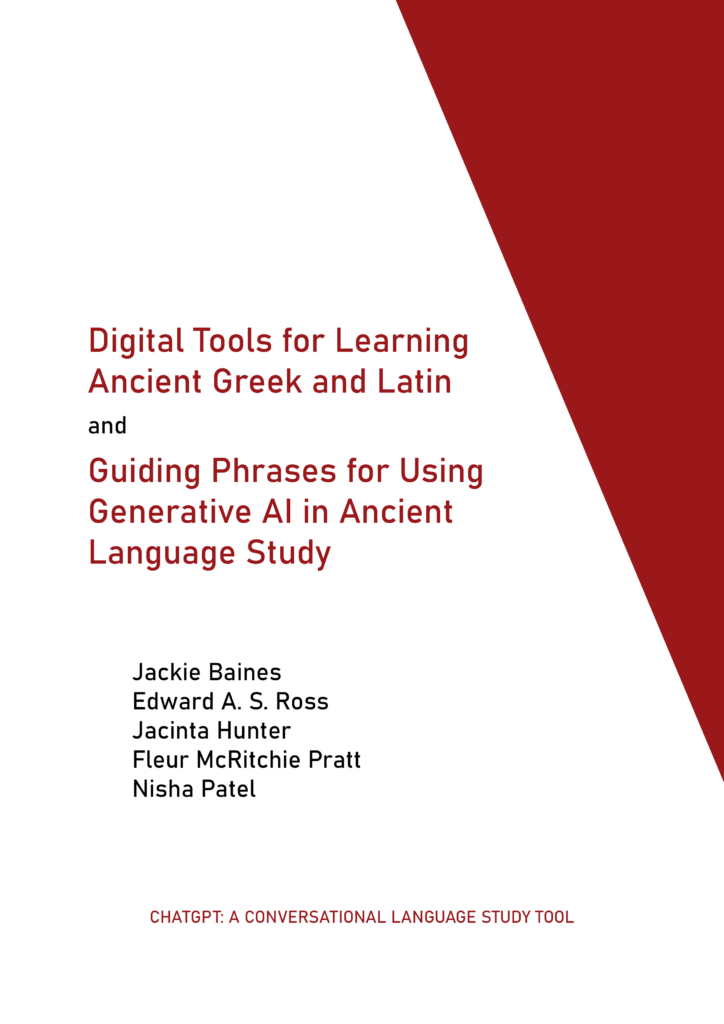
With our undergraduate research assistants Jacinta Hunter, Fleur McRitchie Pratt, and Nisha Patel, we created a booklet outlining a wide variety of digital learning tools for ancient languages that included both traditional tools and generative AI (Figure 2). This included tested guiding phrases, prompts which can be copy-pasted as the first message in a generative AI chat box to guide a user’s experience, and some prompt engineering tips and tricks.
Figure 2: Jackie Baines, Edward A. S. Ross, Jacinta Hunter, Fleur McRitchie Pratt, and Nisha Patel. Digital Tools for Learning Ancient Greek and Latin and Guiding Phrases for Using Generative AI in Ancient Language Study. V3. May 10, 2024. Archived by figshare. https://doi.org/10.6084/m9.figshare.25391782.v3.
At the end of the 2023-2024 academic year, we surveyed our same ancient language students again to see how they felt generative AI had impacted their studies. In addition, we queried if and how often they used generative AI in the past year. The initial analysis of the spring data was first presented at the Digital Humanities and Artificial Intelligence Conference at the University of Reading on June 17, 2024. We intend to publish a complete analysis in Digital Humanities Quarterly shortly.
While keeping track of the advancements of generative AI, we found the developments in generative image AI to be particularly problematic for ancient world studies. This was primarily because many of the figures and objects presented in these outputs appeared to be biased by modern media. We received Undergraduate Research Opportunities Programme (UROP) funding and a Research Collaboration and Impact Fund (RCIF) grant to investigate this further. With our undergraduate research assistants Shona Carter-Griffiths, Hannah Gage, and Jacinta Hunter, we are developing a temporary exhibition at the Ure Museum of Greek Archaeology on identifying biases about the ancient world in generative image AI. This exhibit, opening September 23, 2024, will present image comparisons between generative AI outputs, modern media representations, and ancient art.
As new developments in generative AI continue to arise, we aim to keep up with these tools and make them accessible for humanities scholars. By increasing generative AI literacy across ancient world studies, these tools will no longer be an unrecognizable monster but rather a surmountable challenge.
Dr Mara Oliva, Digital Humanities Academic Champion, welcoming our guests. Photo credit: Prof James Ferryman
The conference was sold out, the sun was shining and we enjoyed a wonderful day of learning and networking!
Dr Barbara McGillivray taking questions from an inspired audience. Photo credit: Prof James Ferryman
Dr Barbara McGillivray, King’s College London and Turing Institute Fellow, delivered the keynote address: “Coding Culture: A Journey at the Nexus of Artificial Intelligence and Digital Humanities”.
We then had a range of thought-provoking parallel sessions on synthetic media, cultural heritage, ethics and teaching.
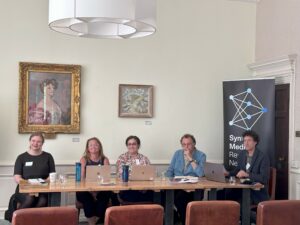
The Synthetic Media Panel chaired by conference co-organiser Dr Dominic Lees. Photo credit: James Ferryman.
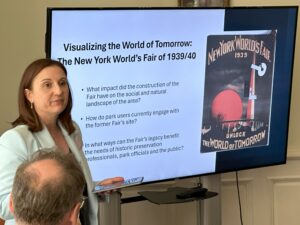
Dr Mara Oliva presenting her work on a VR reconstruction of the New York World’s Fair of 1939. Photo credit: Prof James Ferryman
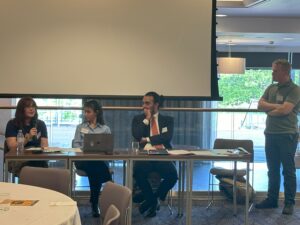
Ethics Panel chaired by conference co-organiser, Dr Jumbly Grindrod. Photo credit: Prof James Ferryman
The conference proceedings will be published in a special edition of Digital Humanities Quarterly. In the meantime, you can enjoy a few snapshots from our conference by following our new blog series, starting on Friday, 28 June. First up: Jackie Baines and Edward Ross from the Department of Classics at the University of Reading with a blog on “Breaking Down Generative Artificial Intelligence for Ancient World Studies”.
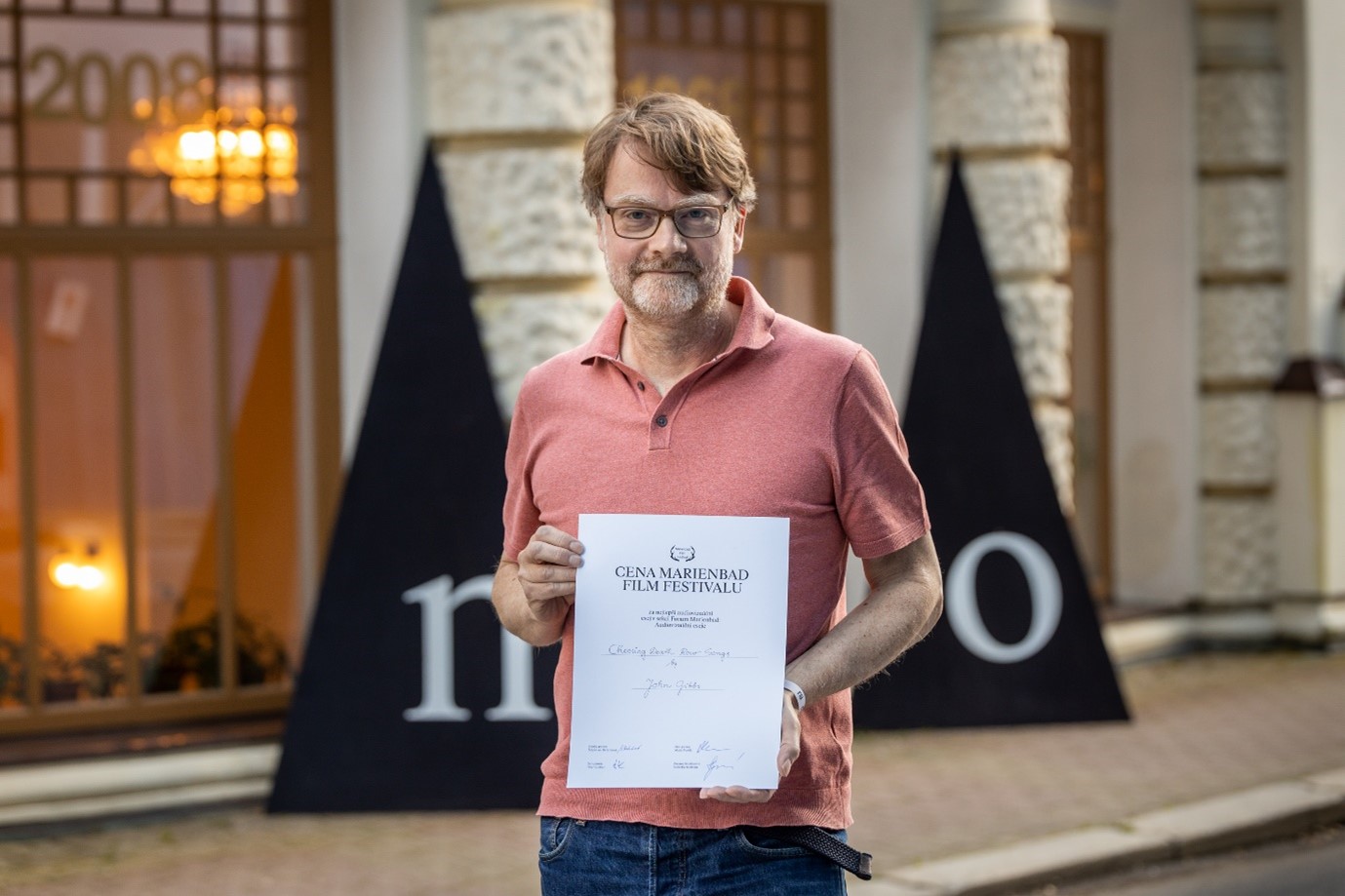
Please join me in congratulating John Gibbs whose video essay Choosing Death Row Songs was part of the Official Selection at the Marienbad Film Festival and was the joint winner of the audiovisual essay competition. The essay is also about to be published in Music, Sound and the Moving Image.
John is Research Dean for the Heritage and Creativity theme at the University of Reading and an internationally renowned video essayist whose work has featured in many leading publications. While videographic criticism originated in film and media studies, it has evolved into a significant digital humanities method. John has been pioneering this innovative and interdisciplinary approach in other fields by leading a highly successful videographic summer school for colleagues here at Reading. I was very lucky to attend the summer school last year, where John, along with colleagues in FTT, created an incredibly supportive and safe environment that encouraged participants to explore their creativity. In the process, we all discovered a new research methodology that has allowed us to conduct and communicate new and innovative research.
Many congratulations John and thank you for your visionary and generous leadership.
Dr Mara Oliva
Associate Professor in History and Digital Humanities Champion
We look forward to welcoming delegates from all over the world the to Digital Humanities Community of Practice’s Inaugural Conference on Monday 17 June 2024.
Established in September 2022, the DH CoP stands as a beacon of innovation within our university community, driving research excellence, fostering ambition, and nurturing a culture of experimentation and collaboration among all research themes. Through a diverse range of activities and initiatives, the CoP aims to increase awareness and understanding of DH within the University, while enhancing its national and international profile in the field. The CoP serves as a platform for open dialogue on DH issues, facilitates the exchange of expertise, and provides essential support for both ongoing and prospective projects. Through networking events, methodological workshops, grant development support, and training sessions (in collaboration with the DH Hub) as well as fostering internal research synergies and cultivating external partnerships, the DH CoP serves as a cornerstone for the advancement of digital scholarship and collaborative research at Reading.
As we convene for this landmark event, we celebrate the culmination of our collective efforts in shaping a vibrant and dynamic DH landscape. The conference theme aligns with the DH CoP’s mission and invites us to explore the rich intersections between Digital Humanities and Artificial Intelligence. Reflecting on Reading’s research strengths in Cultural Heritage, Ethics and Synthetic Media, our discussions promise to illuminate pathways, challenge conventional boundaries, and inspire innovative research. View conference programme
We are thrilled that the conference is sold out! For those who were unable to book a place, don’t worry – you can still follow the day’s events on our social media channels, including our X account @UniRdg_Research, using the conference hashtag #DHAIUoR.
Additionally, throughout the summer, we will be hosting a blog series featuring snapshots from the research presented at the conference. Stay tuned for more exciting content!
It’s a pleasure to have joined the University of Reading last month as Digital Humanities (DH) Officer. I’ll be working as part of the Digital Humanities Hub, which combines expertise in different teams across the University in order to support research that falls within the broad and dynamic discipline of DH.
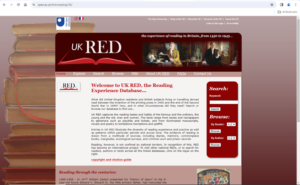
The first DH project that I became interested in – or at least, the first I recognised as DH – was the UK Reading Experience Database (UK RED). The UK RED collates records of experiences of reading in Britain or by British subjects between 1450 and 1945. It includes information both about the experiences themselves (for example, who was reading) and about our evidence of them (for example, who recorded the reading experience). The former (information about reading) can be understood as data and the latter (information about information about reading) as metadata. I was fascinated by this systematic approach to something as complex and subjective as the experience of reading, not least because it has enabled researchers to examine, for example, how reading has changed over time.
Screenshot of the UK Reading Experience Database, https://www.open.ac.uk/Arts/reading/UK/
At the time that I discovered the UK RED, I was employed at the National Portrait Gallery (NPG), digitising textual information about portraits so that it could be served online. In the course of doing so, I discovered several accounts of portrait sittings: the moments of interaction between artists, sitters and sometimes others, from which portraits are typically produced. The accounts interested me because they gave insight into the social dimension of portrait practice. They spoke of the circumstances which prompted portrait production, the conversations that took place during sittings, and the thoughts and feelings of participants. However, this information could not be searched, analysed or compared systematically. Whereas I could search the gallery’s collections database for all paintings, I could not retrieve all portraits produced between friends, for example. (This focus on tangible cultural objects as opposed to intangible cultural events is not unique to the NPG, but rather characteristic of digital approaches to cultural heritage more broadly.)
‘Elizabeth [Garrett Anderson] wished to be painted in her M.D. gown. [John Singer] Sargent begged for some jewellery, so she added a pearl necklace costing sixpence.’ Biography of Elizabeth Garrett Anderson by Jo Manton (1965)
‘I [Alfred Hitchcock] sold [a script] to … [Michael] Balcon, for five hundred pounds. But I was so ashamed of the profit that I had the sculptor Jacob Epstein do a bust of Balcon with the money.’ Interview with Alfred Hitchcock by Francois Truffaunt (1966)
‘During our time together we discussed … music … I [Frank Salisbury] said my favourite piece … was Handel’s “Largo”. He [Henry Wood] said at once, “It is mine also.” [The] next day he brought his [sheet] music, and … I painted it into the portrait.’ Autobiography of Frank Salisbury (1953)
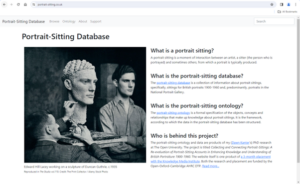
I went on to devise a PhD research project, which explored how the methodology of the UK RED (and other, albeit exceptional, experience databases such as the Listening Experience Database) could be applied to address the portrait-sitting experience. As part of the research, I considered such questions as: What constitutes portrait-sitting data? What would be the value of such data? What could it tell us about portraiture and portrait practice? Specifically, I examined a period in the history of British art (1900-1960) in which there was supposedly a dramatic shift in portrait practice and function – from commissioned portraiture that affirmed the sitter’s position in society, to artists’ experiments in shape, space and colour that happen to take people as subjects. I used a database of portrait sittings to test – and present an alternative to – this narrative, to support new groupings of portraits, and to propose a new periodisation of portraiture. (Links to the forthcoming thesis and other related resources appear here.)
Screenshot of the Portrait-Sitting Database, https://portrait-sitting.co.uk/
One thing that I particularly enjoyed about this research was the capacity of digital and computational approaches to surprise me and to suggest new research questions. For example, I was surprised by how many portrait sittings involved exchanges of personal gifts. This led me to question the significance of such gifts and whether they were used, alongside portraits, in other periods. More generally, I am excited by what comes from combining the order and process of computing with the ambiguity and often-hidden complexity of humanities ‘data’ – and by the question of whether these disciplines are, in fact, so different and distinct. I look forward to exploring these matters further in the course of my role as Digital Humanities Officer, and to working with experienced colleagues across departments to support research in this field.
We invite scholars, researchers, and practitioners to participate in a focused exploration of the intersections between Digital Humanities (DH) and Artificial Intelligence (AI) at a one-day conference at the University of Reading.
The conference will feature three distinct strands, each proving a unique perspective on the evolving landscape of DH-AI:
Strand 1: Cultural Heritage
Explore the role of artificial intelligence in preserving, interpreting, and making accessible cultural heritage.
Discuss innovative projects and technologies that digitise, catalog, and safeguard cultural artifacts and historical sites.
Examine the impact of AI on the study and dissemination of cultural heritage.
Strand 2: Ethics
Delve into the ethical considerations and challenges posed by the use of AI in Digital Humanities.
Discuss issues of bias, representation, and inclusivity in AI-driven research and projects
Explore strategies and best practices for ensuring ethical AI applications in the digital humanities
Strand 3: Synthetic Media
Investigate the creative potential of AI-generated content, such as art, music, literature and virtual environments.
Showcase projects that leverage synthetic media for storytelling, cultural expression, and education.
Examine the ethical and cultural implications of AI-generated content in the Digital Humanities.
We welcome submissions in the following formats:
Individual research papers
Panel Proposals
Please submit your proposal by 20 January, 2024 following the guidelines below.
The conference will also lay the groundwork for a special edition of Digital Humanities Quarterly. If you are unable to attend the conference, but want to contribute to the DHQ special edition, please send your abstract by 30 July, 2024. See guidelines below for further details.
Guidelines for Submission & Timeline
Please submit your abstract (250 words) including a brief biography (200 words), affiliation and email address to DH-AI-Conference@reading.ac.uk by 20 January, 2024.
CONFERENCE DATE: Monday 17 June, 2024
Abstract Submission Deadline: 20 January, 2024
Notification of Acceptance: 15 February, 2024
Program and Registration opens: 1 March, 2024
Registration closes: 1 May, 2024
Abstract Submission for DHQ Special Issue: 30 July, 2024
Article Submission Deadline: 1 December 2024
Submission to DHQ: 15 January 2025
This is a free event sponsored by the Digital Humanities CoP at the University of Reading. Places are limited and registration is required.
For any inquiries, please contact the organising committee at
Digitisation is becoming an ever-important aspect of the way collections are managed and shared. Colleagues at The Museum of English Rural Life and the University of Reading Special Collections hosted an audience of colleagues recently, eager to learn more about their work in this area. Here’s a short summary of the insights and advice they shared.
Caroline Gould welcoming colleagues to the Digitisation workshop
Why do we digitise?
To provide a visual aid on the collections catalogue so that researchers can see the item when they search.
To provide access to slides and negatives in our reading room that are a little too delicate for regular handling.
To preserve items of financial or historical significance that would otherwise be damaged by overuse.
How do we digitise?
We have a host of different equipment for digitisation. Some we’ve had for a long time and some we were lucky enough to acquire through recent AHRC funding to provide sustainable digital infrastructures.
One of our digitisation suites is dominated by a camera and mount which allows us to photograph flat items as well as bound volumes up to A1 size. It was a huge investment but has meant that we have been able to undertake a huge amount of digitisation in-house rather than paying large amounts of money for external companies to do it. We’ve recently added a portable A3 size version of this setup at our offsite store so that collections can be digitised there without being transported back to The MERL.
We have a flatbed scanner that enables us to scan 35mm negative strips as well as medium format negatives. We also have a specially built slide scanner with a mounted camera, and a microfilm/fiche scanner. We do sometimes use a professional photographer, especially for large documents. This ensures we get the best image possible, which is crucial for exhibitions and commercial use.
Our digitisation work also extends to other formats. Our new audio-visual rack has VHS, cassette and minidisc players all connected to a powerful PC to capture and edit this content. We are busy drawing up procedures and guides so that more staff on the team can use the equipment.
How do we store and share?
The way we store and share digitised content has changed considerably over the years.
We used to store all the images we took on CDs, but these will become obsolete and are not the most secure medium. We’ve also backed up digitised content on university drives and servers, but these files can be easily deleted by staff by mistake.
We have now progressed onto a digital asset management system (DAMS). The advantage of using a DAMS is you must have permission to delete digital assets so it’s more secure and you can search for images using keywords which you can’t do on a shared drive. Our Virtual Reading Room is an online portal where we securely provide access to digitised content to researchers around the world.
Exhibitions and Research
Online exhibitions enable us to enhance the visibility of our collections and tell stories about them. They offer a visual and digital output for collections-based research projects. They are built around images, audio and video content with captions added to them. We have a variety of visually appealing ways to structure these exhibitions depending on the desired audience and aims.
We have templates and guides for these should you be interested in creating a collections-related online exhibition. Our usual expectation is that the content is provided to us by the researcher or academic and collections staff upload this to the website, depending on what staffing resource is available.
What are the challenges and demands?
Digitisation is more than just the act of digitising. Staff have to be trained on equipment, retrieve collection items, investigate copyright issues and rights information, as well as process and store the resulting files. We don’t have a dedicated role for digitisation at present and rely on externally funded projects or fitting work around other core responsibilities.
Many items are covered by copyright which lasts for 70 years after the death of the creator or 31 December 2039 – whichever is sooner. These are just some of the considerations we must factor into the decision to digitise.
Want to incorporate digitisation into your research proposal? Here are some things to consider.
Get in touch with us before you get funding for a research project. That way, we can advise you on the practicalities of digitising certain material. We may not – due to copyright and rights issues – be able to digitise and share the content. There might be some material we don’t have the right equipment to digitise. But we are always interested in talking to colleagues about the role we can play in digital humanities projects.
We use cookies on reading.ac.uk to improve your experience. You can find out more about our cookie policy. By continuing to use our site you accept these terms, and are happy for us to use cookies to improve your browsing experience.